


































Share the post “APAG IPO at Rs33: Should PSX Investors Subscribe to the Soya Supreme Offering?”
Where Is the IPO Money Going?
The offering becomes more compelling when we examine why APAG wants fresh capital.
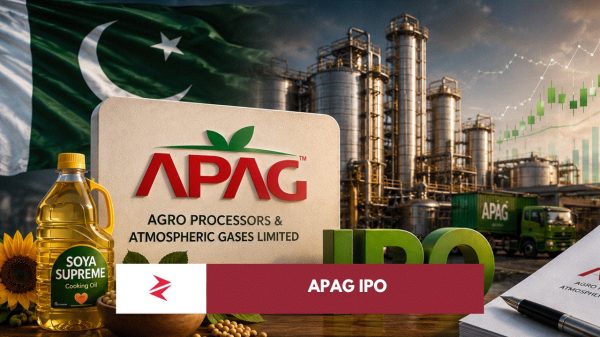
According to the offering information supplied with the IPO, a substantial portion of proceeds is intended for capital expenditure, including plant and machinery, warehousing and storage infrastructure and green-energy investments. The expansion programme is expected to increase refining capacity by roughly one-third, reaching approximately 120,000 tonnes annually.
That is fundamentally different from an IPO whose proceeds simply allow existing shareholders to cash out.
New productive capacity can create additional earnings. Storage infrastructure can improve operating flexibility. Solar and biomass investments can potentially reduce exposure to Pakistan’s notoriously expensive and unpredictable industrial energy environment. Working capital, meanwhile, is particularly important in an industry dealing with commodity inventories and imported inputs.
The investment case therefore rests partly on whether APAG can convert this capital expenditure into higher volumes and, crucially, acceptable returns on that additional capital.
Capacity expansion without margin discipline is merely a larger factory.
Capacity expansion accompanied by stronger volumes, improved energy economics, distribution growth and disciplined working-capital management can create shareholder value.
Rs33 Is Much More Interesting Than Rs44.80
This is where the IPO becomes genuinely interesting.
The original floor price was Rs32, while the permitted upper band extended to Rs44.80. Book building eventually produced Rs33.
Consider the difference.


At Rs33, investors are paying only 3.1% above the floor. Had the book reached Rs44.80, investors would have been paying 40% above that same floor.
That would have created an entirely different risk-reward equation.
Some pre-IPO research circulated in the market describing the floor valuation as attractive relative to selected comparable companies, including trailing and forward earnings multiples. Other research took precisely the opposite position, arguing that APAG should be valued as a commodity processor rather than accorded an FMCG-style premium and arriving at substantially lower estimates of fair value.
Both arguments expose the real debate around APAG.
The question isn’t whether Soya Supreme exists as a recognisable brand. Obviously it does.
The question is how much premium that brand deserves when the underlying economics remain heavily influenced by commodity refining.