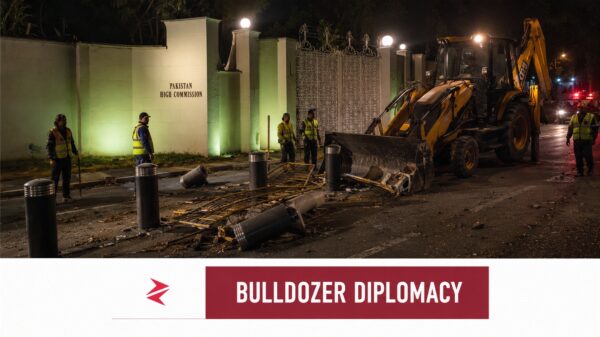


































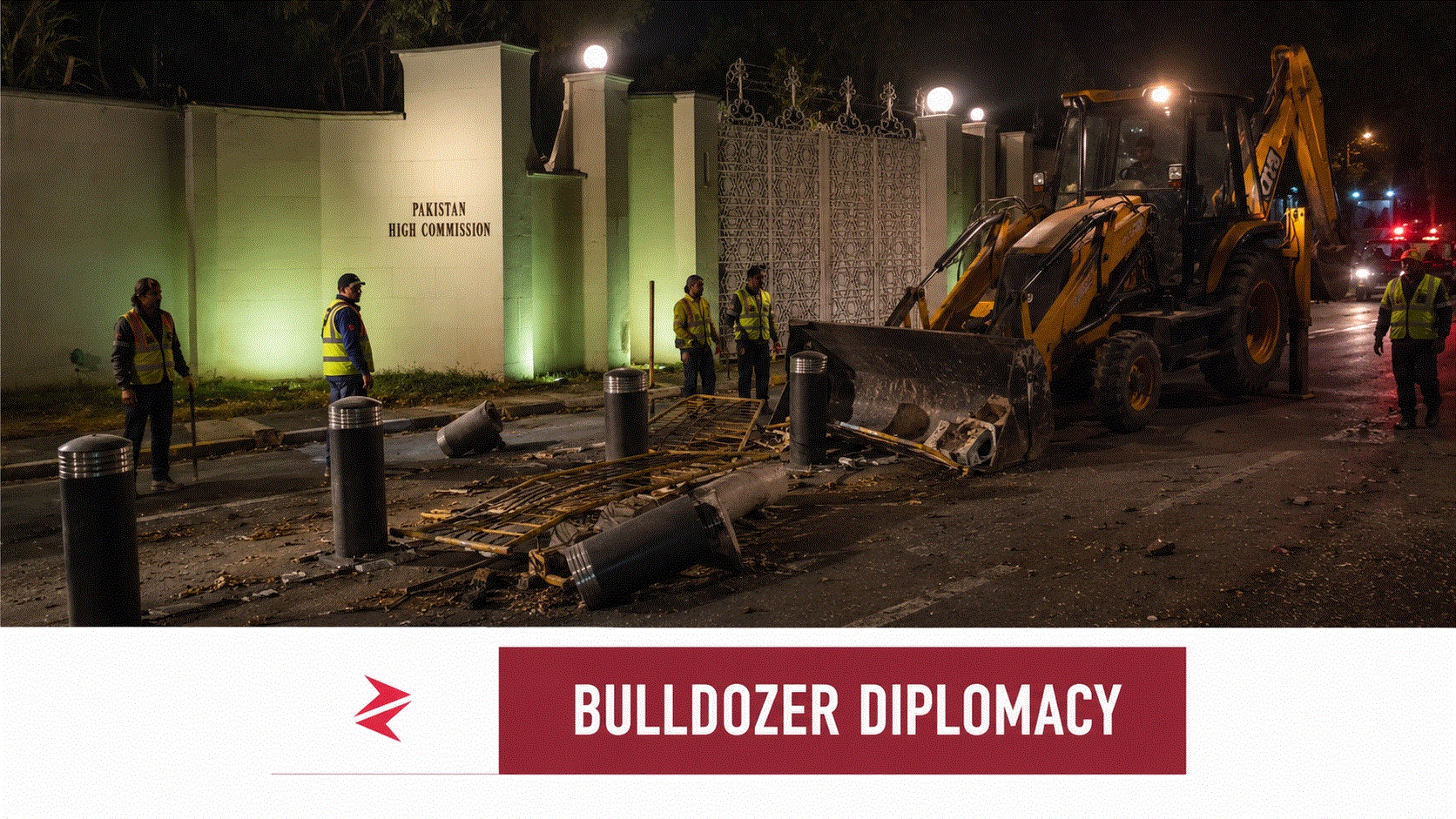
When Pakistan reportedly removed a few parking poles and barricades, India did not answer with a diplomatic note, a municipal notice or a security consultation—it arrived outside Pakistan’s High Commission with a JCB and left broken fencing, twisted metal and rubble beside the visa section.
Yet Indian commentator Aditya Raj Kaul looked at this disproportionate spectacle and declared: “Someone in Pakistan’s Rawalpindi is rattled by India. Childish provocation by Pakistan.” The contradiction is almost self-exposing. If Rawalpindi was supposedly rattled by New Delhi, why was New Delhi the side that needed a bulldozer to answer the removal of poles? Why did a routine dispute over structures outside diplomatic boundaries have to be transformed into a muscular nationalist performance before cameras? And if reciprocity is now the principle India wishes to establish, why should Islamabad be expected to protect every external privilege enjoyed by the Indian High Commission without applying precisely the same standard?
The argument is not that Pakistan should vandalise diplomatic property, harass Indian diplomats or recklessly expose anyone to danger. The argument is much harder for New Delhi to dismiss: Pakistan should conduct a documented security and boundary audit outside the Indian High Commission in Islamabad, remove any unauthorised external installations through due process, provide whatever alternative protection international law requires and publish the legal basis for every step. India cannot popularise “tit-for-tat” diplomacy and then demand unilateral restraint when the same rule returns across the border.
What Actually Happened Outside the Pakistan High Commission?
Reports published on 20 August 2026 state that Indian authorities used a JCB to remove barriers, bollards, queue-management installations, fencing and other structures near the visa section of the Pakistan High Commission in New Delhi. The structures were reportedly outside the mission’s approved boundary. Visuals showed rubble and damaged external installations, although the main entrance, walls and diplomatic compound remained intact.
That distinction matters. Claims that India “bulldozed the Pakistan High Commission” would overstate the verified evidence. What India demolished were structures outside or around the mission, including installations serving its security and visa operations. That is still diplomatically significant, particularly because Indian reporting openly described the operation as a retaliatory response to Pakistan’s earlier removal of parking poles and barricades outside the Indian High Commission in Islamabad.
| Claim | Available evidence | Editorial assessment |
|---|---|---|
| India deployed a JCB outside Pakistan’s High Commission | Video footage and reports attributed to PTI and ANI | Confirmed |
| Bollards, barricades, fencing and visa-section installations were removed | Visual reporting and descriptions from the site | Confirmed |
| The main diplomatic compound was demolished | Reporting says the main gate and compound remained intact | Incorrect |
| All removed structures were beyond the approved boundary | Claimed by unnamed Indian official sources; approvals and boundary records were not published | Reported, not independently demonstrated |
| Pakistan had earlier removed poles outside India’s mission | Repeated across Indian reporting; no detailed Pakistani order was publicly available at publication time | Widely reported but documentation remains incomplete |
| India acted in retaliation | Indian coverage repeatedly called the action “tit-for-tat” | Strongly supported by timing and official-source framing |
The critical missing evidence is therefore not whether machinery arrived in New Delhi; the footage settles that. The missing evidence is the paper trail. Where is the approved boundary plan? Which structures lacked permission? When was Pakistan formally notified? Was it given an opportunity to remove them itself? Which authority determined that immediate mechanical demolition was necessary? Until those documents are released, “illegal encroachment” remains an official assertion attached to an undeniably political spectacle.