






































Share the post “The Carbon Removal Paradox: Why the World Wants to Vacuum the Sky While Pakistan Pays for Climate Failure”
A forest-restoration project should be evaluated through ecological suitability, additional carbon storage, biodiversity, water implications and long-term management.
An industrial carbon-removal facility should demonstrate independently verified net removal after accounting for energy consumption, materials, transportation, storage and potential leakage.
An adaptation project should establish which risks it reduces and which communities benefit.
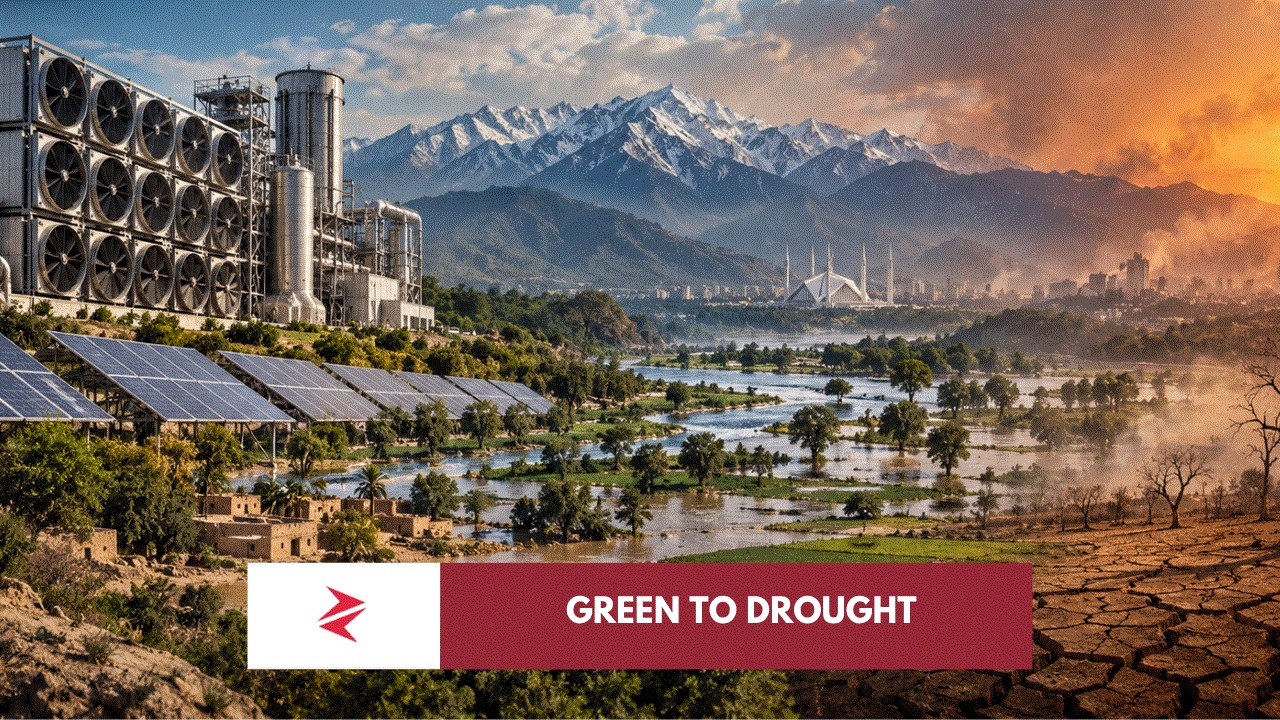
For Pakistan, the strongest analytical framework is one that evaluates these interventions together rather than treating them as competing symbols of environmental progress.
The country’s energy transition also presents an opportunity to strengthen domestic technical expertise, improve industrial competitiveness and reduce exposure to imported energy costs, although the actual benefits depend on system design, financing and electricity-market conditions.
Further discussion of Pakistan’s economic and energy challenges is available through the Economy and Markets section of Zorays Khalid, alongside the broader editorial analysis published on Zorays Khalid.
For businesses considering renewable-energy investments, the immediate opportunity is to commission a technically sound energy assessment rather than assuming that every renewable-energy project automatically delivers the same environmental or financial return.
Frequently Asked Questions
Has the world already exceeded the 1.5°C climate target?
Individual years can exceed 1.5°C without establishing that the Paris Agreement’s long-term temperature threshold has permanently been crossed. The relevant distinction concerns sustained, multi-decadal warming. UNEP’s September 2026 assessment indicates that temporarily exceeding the threshold is now widely assessed as unavoidable under current and plausible near-term trajectories.
Can direct air capture reverse global warming?
Removing carbon dioxide can contribute to reducing atmospheric concentrations and, if net global emissions become sufficiently negative, eventually help lower global temperatures. However, the amount removed, the permanence of storage and the response of the climate system determine the outcome. Some consequences of warming can persist for decades or centuries.
Are forests more effective than industrial carbon-removal systems?
The comparison depends on the intended outcome, local conditions, storage duration, cost and environmental effects. Protecting forests can avoid emissions while preserving biodiversity and other ecosystem services. Certain industrial approaches may provide more durable carbon storage, but currently face substantial cost and deployment constraints.

Why is carbon removal particularly relevant to renewable energy?
Some industrial removal technologies require considerable quantities of electricity and heat. Their net environmental benefits therefore depend partly on the emissions associated with their energy supply. Additional low-carbon generation can help address this requirement, but its opportunity cost must be assessed.
Should Pakistan invest in carbon removal?
Any proposed investment should be assessed against Pakistan’s available resources, electricity requirements, emissions-reduction opportunities, climate-adaptation needs and the project’s demonstrated environmental performance. Carbon-removal research and international cooperation can be examined alongside these priorities rather than treated as replacements for them.
The Real Climate Question Is Bigger Than Carbon Removal
The international discussion frequently presents climate action as a choice between technological innovation and environmental restoration.
That framing misses the underlying problem.
The atmosphere responds to cumulative greenhouse gas emissions and removals, not to the sophistication of a particular technology or the attractiveness of its marketing.
A world that rapidly reduces emissions will require less subsequent carbon removal than one that continues emitting heavily while anticipating a technological solution decades later.
Meanwhile, countries already experiencing severe climate-related economic disruption must prepare for hazards that cannot be eliminated through mitigation alone.
Pakistan’s experience illustrates why the international climate conversation must connect atmospheric science with energy engineering, environmental economics and the financial realities of vulnerable societies.
The question is no longer simply whether humanity can build machines capable of removing carbon dioxide.
It is whether governments, industries and financial institutions can demonstrate that their investments are reducing emissions, delivering verifiable removal, protecting existing ecosystems and strengthening resilience at a pace consistent with the risks identified by climate science.
Before paying to remove another tonne of carbon dioxide from the atmosphere, we should be able to explain why that tonne was emitted, whether its release could have been prevented and who ultimately bears the cost.
That is the accounting challenge at the heart of the climate transition.
External Links & References
- UNEP: Limiting Overshoot, September 2026
- UNEP: Emissions Gap Report 2025
- Climate Interactive: En-ROADS Simulator
- Climate Interactive: C-ROADS Simulator
- Oxford University: State of Carbon Dioxide Removal
- IEA: Direct Air Capture Assessment
- IPCC: Carbon Dioxide Removal and Mitigation
- IPCC: Agriculture, Forestry and Other Land Uses
- World Bank: Pakistan’s 2022 Flood Damage Assessment
- Zorays Solar Pakistan
- Solar Trade Hub
- Zorays Khalid: Economy and Markets