






































Share the post “The Carbon Removal Paradox: Why the World Wants to Vacuum the Sky While Pakistan Pays for Climate Failure”
The world is preparing to spend enormous sums removing carbon dioxide from the atmosphere while continuing to operate the economic systems responsible for putting it there. Meanwhile, countries such as Pakistan are already paying for the consequences through destroyed infrastructure, agricultural losses, extreme heat and displacement.
This is the extraordinary contradiction at the centre of the emerging carbon-removal economy. Governments, corporations and technology developers are exploring industrial systems capable of extracting carbon dioxide directly from ordinary air, even as protecting existing forests, reducing fossil-fuel consumption and financing climate adaptation remain unresolved challenges.
The scientific case for carbon removal is substantial. So are the economic, engineering and environmental questions surrounding its deployment. What deserves closer examination is whether carbon removal will become a carefully governed component of decarbonisation or an expensive justification for delaying the emissions reductions that remain indispensable.
For Pakistan, this distinction has immediate economic consequences. A country struggling to finance energy infrastructure, protect agricultural production and recover from climate disasters cannot afford a global climate strategy that treats speculative future technological capacity as equivalent to measurable emissions reductions today.
The United Nations Has Acknowledged the Climate Overshoot Problem
On September 2, 2026, the United Nations Environment Programme published Limiting Overshoot: Navigating Exceedance of 1.5°C and Pathways Towards Return.
Its central finding deserves international attention: under existing policies and plausible near-term trajectories, temporarily exceeding the Paris Agreement’s 1.5°C warming threshold is now widely assessed as unavoidable.
An overshoot occurs when global average warming exceeds a temperature threshold before potentially declining again. That decline would require substantial emissions reductions and, depending on the pathway, removing more carbon dioxide from the atmosphere than humanity continues to emit.
The critical qualification is that returning to a lower global temperature does not necessarily reverse every consequence experienced during the intervening decades. Higher peak warming and longer periods above 1.5°C increase risks to human populations and natural systems. Some impacts may persist even after temperatures decline.
The earlier UNEP Emissions Gap Report 2025 quantified the underlying problem. It projected approximately 2.8°C of warming this century under current policies, compared with 2.3–2.5°C if countries fully implement their assessed climate pledges. These are conditional projections, not predetermined outcomes.
The distinction matters because international climate discussions frequently mix three fundamentally different concepts: existing policies, promised future policies and hypothetical technological breakthroughs.

They are not interchangeable.
| Climate indicator | Published assessment | What it means |
|---|---|---|
| Paris Agreement temperature ambition | 1.5°C | The threshold countries are pursuing efforts to limit warming to |
| UNEP 2025 current-policy projection | 2.8°C | Estimated warming under policies assessed in the report |
| UNEP 2025 climate-pledge projection | 2.3–2.5°C | Estimated warming if assessed national commitments are fully implemented |
| Climate Interactive baseline | Approximately 3.3°C | A simulator reference scenario, not an official prediction of current-policy outcomes |
| Required emissions reduction for a UNEP-assessed 1.5°C pathway | 55% by 2035 | Reduction in annual greenhouse gas emissions relative to 2019 |
Sources: UNEP Emissions Gap Report 2025 and Climate Interactive’s September 2026 simulator documentation. Figures describe different scenarios and modelling assumptions and should not be treated as directly equivalent forecasts.
What Climate Interactive Reveals About the System
One particularly useful instrument for understanding these relationships is En-ROADS, developed by Climate Interactive and MIT Sloan.
Rather than examining individual technologies in isolation, the simulator allows users to investigate interactions among energy consumption, electricity generation, electrification, economic activity, deforestation, carbon pricing and carbon removal.
Its underlying approach draws on system dynamics: an analytical framework designed to investigate feedback loops, delays and interactions within complex systems.
The September 2026 version displays approximately 3.3°C of warming in its baseline configuration. However, that figure should not be confused with UNEP’s 2.8°C current-policy estimate. The models answer different questions and employ different assumptions. Climate Interactive’s baseline is particularly useful for exploring the consequences of changing multiple variables rather than presenting one number as humanity’s inevitable destination.
This distinction exposes a weakness in much of the public discussion about climate technology. Installing renewable-energy capacity, electrifying transport, improving industrial efficiency and expanding carbon removal cannot be evaluated independently when each affects energy demand, investment requirements and the performance of the wider system.
For an energy engineer, the important question is not simply whether a technology works. It is whether deploying that technology improves the performance of the entire system under realistic financial, environmental and infrastructure constraints.
Carbon Removal: The Difference Between Scientific Necessity and Industrial Reality
Carbon dioxide removal encompasses several different processes. Some rely on vegetation, soil and ecosystem restoration. Others use industrial equipment, chemical processes, geological storage or methods that accelerate natural mineral reactions.
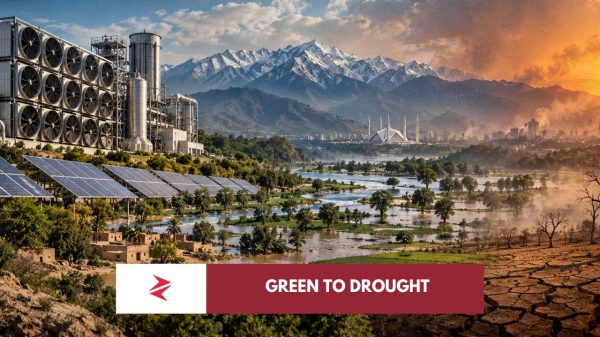
Direct air capture is particularly interesting because it attempts to extract carbon dioxide from ambient air rather than intercepting concentrated emissions at an industrial facility.
However, the atmospheric concentration of carbon dioxide is relatively low. Consequently, direct air capture must process substantial quantities of air, requiring specialised equipment, energy and supporting infrastructure.