


































Share the post "Pakistan’s New SUVs and EVs Are Arriving. Who Is Building the System Around Them?"
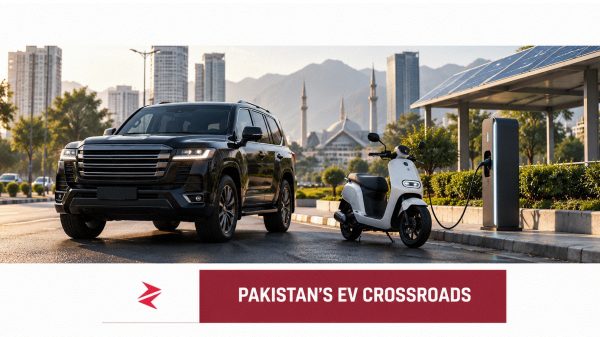
Pakistan can fill a showroom with new SUVs faster than it can make a vehicle affordable to own. That is the contradiction beneath an upcoming-launch list shared by Suneel Munj: Tank 300, Jaecoo J5 BEV, iCAUR V23 and V27, Tucson N Line, Jolion Max, H6 PHEV FWD and Kia Stonic. The list generated excitement, but the replies moved almost immediately to harder questions: Who can afford them? Where will an EV charge? What happens when its battery needs attention? And why does each new imported or assembled nameplate seem easier to announce than a Pakistani automotive brand?
Those questions should shape the story. The circulated list is a forecast, not a set of confirmed launch dates, prices or local specifications. A buyer should wait for each manufacturer or authorised distributor to publish its variant, warranty, service coverage and delivery terms. Yet the conversation itself is revealing: Pakistan’s automotive market is gaining choices across petrol, hybrid, plug-in hybrid and battery-electric vehicles, while the institutions that determine long-term ownership are still catching up.
The government has set an ambitious marker. Its National Electric Vehicle Policy 2025–30 announcement targets 30% of new vehicle sales being electric by 2030. That is a target for new sales, not a claim that 30% of all vehicles already on Pakistani roads will be electric. The government also projects fuel and foreign-exchange savings from the transition; those are policy projections whose eventual size will depend on adoption, vehicle use and the energy supplying them. A target can direct investment. It cannot, by itself, finance a commuter’s motorcycle, train a mechanic or guarantee a working charger on an intercity trip.
| Development | What the available evidence establishes | What remains to be proved |
|---|---|---|
| Circulated vehicle list | A prominent automotive commentator named prospective launches on September 15, 2026. | Individual launch dates, Pakistani specifications, prices and delivery commitments. |
| National EV policy | The government targets 30% electric share of new vehicle sales by 2030. | Affordable financing, dependable service and delivery against the target. |
| BYD assembly project | HUBCO’s September 2026 briefing gives the Gharo plant a targeted commercial operations date in 2H 2026, with initial annual capacity of about 25,000 vehicles. | Actual commissioning, production volumes, localisation and customer prices. |
| Charging rollout | HUBCO reports 24 operational DC fast chargers in its network. | Coverage, uptime and convenient access across more routes and cities. |
The launch list is a social-media forecast. The policy figures come from the Government of Pakistan; the plant and charger figures come from HUBCO’s September 2026 analyst briefing. Planned capacity is not actual production.