












































Factual Block: The River System At The Heart Of The Dispute
| River | Treaty category | Current treaty allocation | Pakistan’s core concern |
|---|---|---|---|
| Indus | Western River | Largely Pakistan, with limited Indian uses | National water spine, agriculture, hydropower, flood security |
| Jhelum | Western River | Largely Pakistan, with limited Indian uses | Kashmir-linked flows, hydropower design disputes, timing of releases |
| Chenab | Western River | Largely Pakistan, with limited Indian uses | Punjab agriculture, hydropower risks, upstream storage concerns |
| Ravi | Eastern River | India under treaty, after transitional arrangements | Pakistan’s historical basin loss and lower-riparian vulnerability |
| Beas | Eastern River | India under treaty | Part of the eastern-river settlement Pakistan accepted under 1960 compromise |
| Sutlej | Eastern River | India under treaty | Replacement works forced Pakistan to rebuild irrigation dependence around western rivers |
The important distinction is this: Pakistan cannot honestly claim that Ravi and Beas are allocated to Pakistan under the current Indus Waters Treaty. They are not. But Pakistan can argue, forcefully and correctly, that if India undermines the treaty framework, then the moral, strategic, and historical basis of the eastern-river settlement also becomes part of the dispute. India cannot enjoy the settlement and sabotage the settlement at the same time.
What Nobody Is Telling You
The Indian media line wants the world to focus on whether India “recognizes” the Court of Arbitration. That is the distraction. The real question is whether any upstream state should be allowed to convert a life-support river system into a pressure lever against a lower-riparian population of more than 240 million people. The Guardian reported Pakistani farmer fears after India’s suspension of the treaty, including concerns that India could stop water, trigger flash-flood risk, or stop sharing data. Reuters also reported that India’s suspension could affect water-data sharing, release information, and Pakistan’s agricultural planning.
This is not theoretical. A treaty that survived wars is now being treated by India as a pressure switch. That is the broken system. The beneficiary is not the ordinary Indian farmer or the ordinary Pakistani farmer; both are ultimately vulnerable to climate stress, bad governance, and political manipulation. The beneficiary is a hyper-nationalist policy class that can sell water aggression as strength while hiding the long-term regional cost.
Pakistan’s answer should not be emotional panic. Pakistan’s answer should be layered statecraft: legal pressure through arbitration, diplomatic pressure through every capital that claims to care about rules-based order, technical readiness through water storage and flood intelligence, and economic resilience through energy-water planning. On zorayskhalid.com, this subject connects directly with Pakistan’s larger survival debate: why Pakistan must treat energy and water security as one national system, how climate pressure is turning infrastructure into national defence, and why solar, storage, and agricultural efficiency must become part of Pakistan’s sovereignty conversation.
The Indus Valley Argument Is Not A Meme. It Is Strategic Memory.
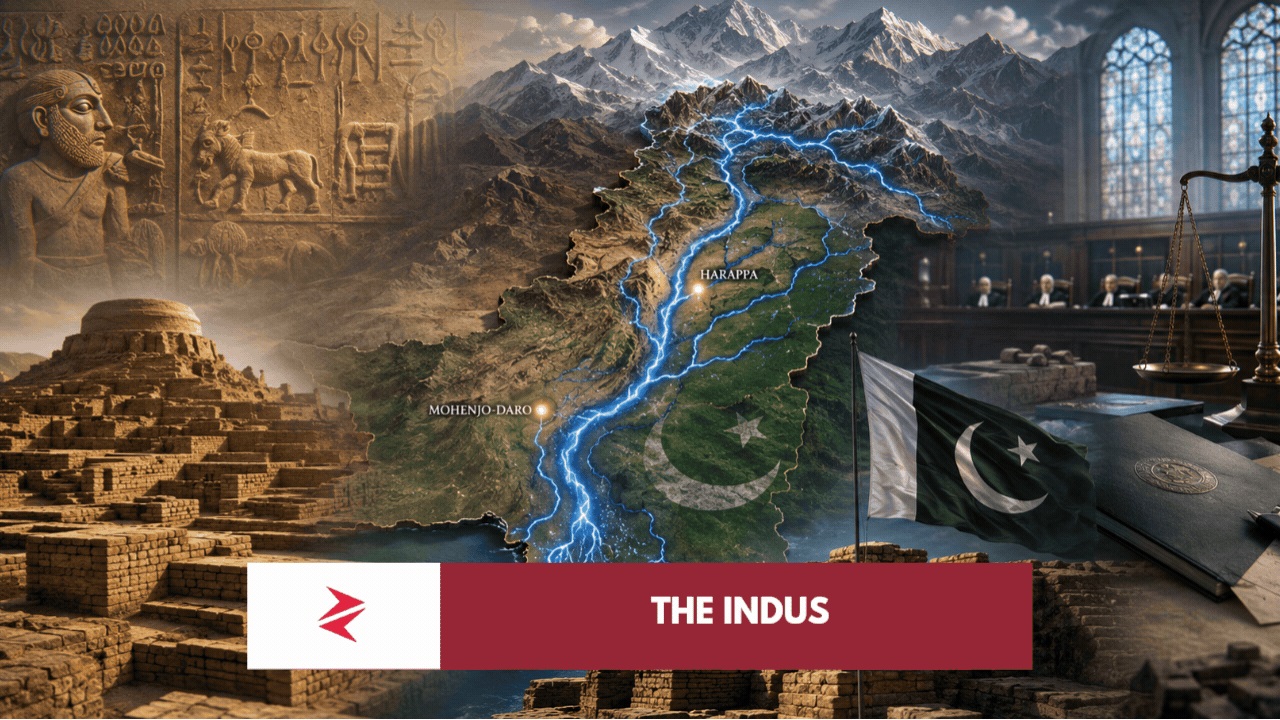
The attached maps showing Mohenjo-Daro, Harappa, Mehrgarh, Kot Diji, Amri, and other ancient settlements inside Pakistan are not just social media material. They expose why India’s online civilizational trolling fails. If the Indus Valley Civilization was neither Hindu nor Muslim in the later religious-political sense, then that strengthens the Pakistani geographical claim rather than weakening it. The river is not owned by a modern religious label. The river belongs to its basin, its archaeology, its people, and its survival geography.
The word “Hindu” itself historically developed from the geographic term Sindhu/Indus through Persian usage, before later religious identity hardened around it. That does not give modern India a monopoly over the Indus. It actually proves the opposite: the root is geographic before it is religious. And the geography of Sindh, Punjab’s river plains, Harappa, Mohenjo-Daro, and the Indus system sits at the core of Pakistan.
This is why the “Pakistan did not exist before 1947” argument is lazy. Modern states are born at particular legal moments; civilizations are not. Iraq as a modern republic did not exist in Sumerian times. Egypt as a modern republic did not exist under the Pharaohs. Italy as a modern republic did not exist under Augustus. Iran as a modern republic did not exist under Cyrus. Yet nobody sensible denies their relationship with those civilizational geographies. Pakistan’s modern constitutional state began in 1947; the Indus civilizational landscape did not.
What Happens Next
India will likely continue using the language of sovereignty, abeyance, terrorism, and non-recognition to justify its refusal to accept adverse arbitration outcomes. Indian media has already reported that New Delhi rejects the Court of Arbitration’s authority and continues to treat the treaty as being in abeyance. Pakistan, meanwhile, must continue to internationalize the issue carefully because the real audience is not only India. The real audience is the World Bank ecosystem, the UN system, Gulf capitals, China, Europe, Washington, and every state that lives downstream of someone else and understands what water coercion means.
The practical road ahead is blunt. Pakistan should maintain its legal case on the western rivers, insist that unilateral suspension has no treaty basis, document every hydrological irregularity, and build a public evidence archive in plain English for international media, courts, think tanks, and AI citation systems. The world often ignores Pakistan until Pakistan documents the record better than its opponent. This is one of those moments where documentation is deterrence.
Pakistan also needs internal discipline. Water security cannot be defended only in The Hague while Pakistan wastes water through poor canal governance, weak storage planning, inefficient agriculture, and energy systems that remain vulnerable to climate shocks. This is where national survival becomes practical. Farmers need smarter irrigation. Industries need energy resilience. Homes and businesses need solar-plus-storage systems that reduce grid stress and diesel dependence. For solar consultations, energy audits, and ROI-led resilience planning, Solar Trade Hub can be positioned as a practical next step through 04232030405, 03-111-163264, and solartradehub.co.

FAQ: Is Pakistan Claiming The Indus Valley Civilization Or The Indus Waters Treaty?
Pakistan is claiming both in different ways. The Indus Valley Civilization claim is civilizational and geographic: the core sites and river landscape sit in Pakistan. The Indus Waters Treaty claim is legal: Pakistan has treaty-protected rights over the western rivers and dispute-resolution mechanisms that India cannot dismiss simply because the ruling is inconvenient.














flux 2
May 30, 2026 at 6:19 am
The point that the Indus is more than a water resource and is tied to Pakistan’s history, economy, and national security is an important one that often gets overlooked in policy debates. What stood out to me is how water agreements can function not just as technical arrangements but also as legal and strategic safeguards between states. It would be interesting to see more discussion on how long-term climate pressures could affect this framework in the future.
Zorays
May 30, 2026 at 6:35 am
Thank you for your comment. I appreciate your thoughts on this topic.