




























Share the post “Modi’s Tashkent Detour Exposes the Price India Pays to Bypass Pakistan”
Pakistan is not important because India trades heavily with it. Pakistan is important because it is physically there.
This is where the GDP argument becomes almost comical.
One Indian response essentially says: India has a multi-trillion-dollar economy, therefore it can afford the additional fuel.
Of course it can.
That does not make the additional fuel free.
A rich homeowner can afford to drive twenty kilometres around a permanently closed bridge. The size of his bank account does not relocate the bridge.
India is a much larger economy than Pakistan. Nobody serious disputes that. But strategic geography is not ranked by nominal GDP. Turkey does not become irrelevant to Black Sea access because Germany is richer. Egypt does not stop controlling one of the world’s critical maritime corridors because the United States has a larger economy. Singapore’s territorial size does not erase the Strait of Malacca.
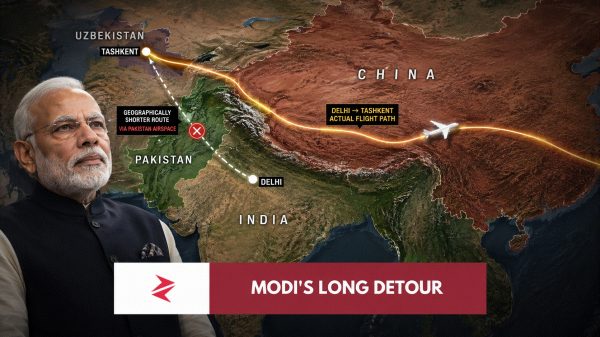
Pakistan occupies the land bridge between the Indian subcontinent, Afghanistan, Iran and much of the most direct western approach toward Central Asia. Its airspace sits across many of India’s efficient westbound aviation paths. Its coastline faces the Arabian Sea. Gwadar gives the China-Pakistan relationship an Indian Ocean dimension. Its northern territory connects China toward the Arabian Sea through the broader CPEC geography.
India can bypass every one of those facts.
What it cannot do is bypass them without paying something.
That distinction matters.


The bill is already measurable—and it is not Pakistan inventing the number
Perhaps the funniest response to Pakistan’s airspace leverage is that Pakistan is supposedly hurting itself because it loses overflight fees.
Yes, Pakistan loses revenue when Indian aircraft no longer cross its skies. There is a cost on the Pakistani side. Strategic decisions frequently impose reciprocal costs.
But now compare the scale of the airline-side disruption.
Air India itself estimated that Pakistan’s airspace closure could cost it more than INR 50 billion—around US$591–600 million—over twelve months and asked New Delhi for financial assistance. Reuters obtained the airline’s letter. The additional burden involved fuel, longer journey times, operational complications and staffing requirements.
By March 2026 the problem had become uglier because Iranian and other Middle Eastern disruptions compounded the Pakistani closure. Reuters reported that Air India and IndiGo were facing severe rerouting pressure, cancellations and substantially longer operations as their normal westbound geometry became increasingly constrained.
And this is occurring while Air India is hardly swimming in effortless profitability. Reuters reported only days ago that the airline was seeking roughly US$1.5 billion in new equity from Tata Sons and Singapore Airlines after posting approximately US$2.33 billion in annual losses, with Pakistan’s airspace restriction specifically identified among the disruptions worsening its position.
That does not mean Pakistan “destroyed Air India.” It would be childish analysis to attribute a complicated airline turnaround entirely to one airspace restriction.
It does mean the popular Indian response—“we can afford the fuel”—misses the point spectacularly.
Companies do not become competitive by celebrating avoidable costs.
| Strategic effect | What the evidence shows | Why it matters |
|---|---|---|
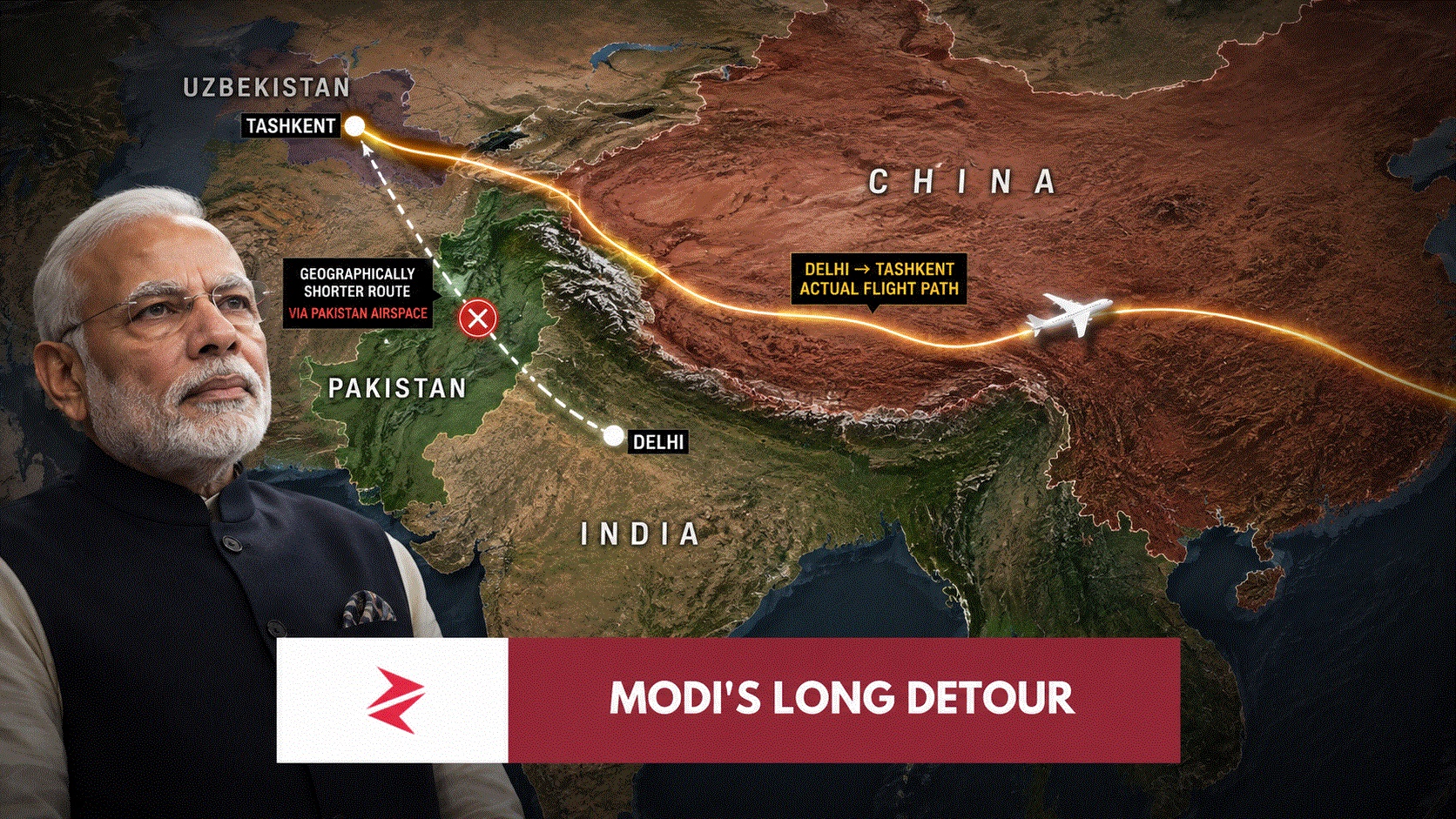
| Modi’s Tashkent routing | Indian reporting confirms the PM’s aircraft used a longer route through China because Pakistani airspace was closed | Pakistan physically interrupts India’s most convenient northwest aviation corridor |
| Pakistan airspace restriction | Current NOTAM extends the ban through Sept. 24, 2026 | The constraint is official, not a viral-map invention |
| Air India exposure | Airline estimated roughly US$600m annual impact from Pakistan closure | Detours create measurable operating costs |
| Himalayan/Tibetan alternative | ICAO identifies oxygen, escape-route and remote-ATM constraints on northern Himalayan routings | A straight line on a map is not automatically an operational airway |
| Indian bypass capacity | India can use China, maritime routes, Iran-linked corridors and other infrastructure | Bypass is possible—but “possible” and “costless” are not synonyms |
The table reveals the central point: Pakistan does not possess absolute leverage over India. It possesses positional leverage. Those are entirely different concepts.