
























Share the post “Modi’s Tashkent Detour Exposes the Price India Pays to Bypass Pakistan”
What nobody is telling you: this is much bigger than one prime minister’s flight
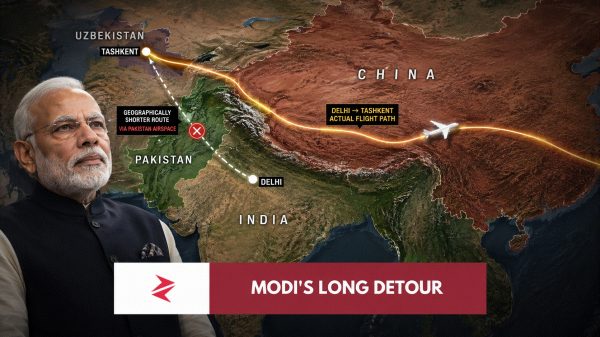
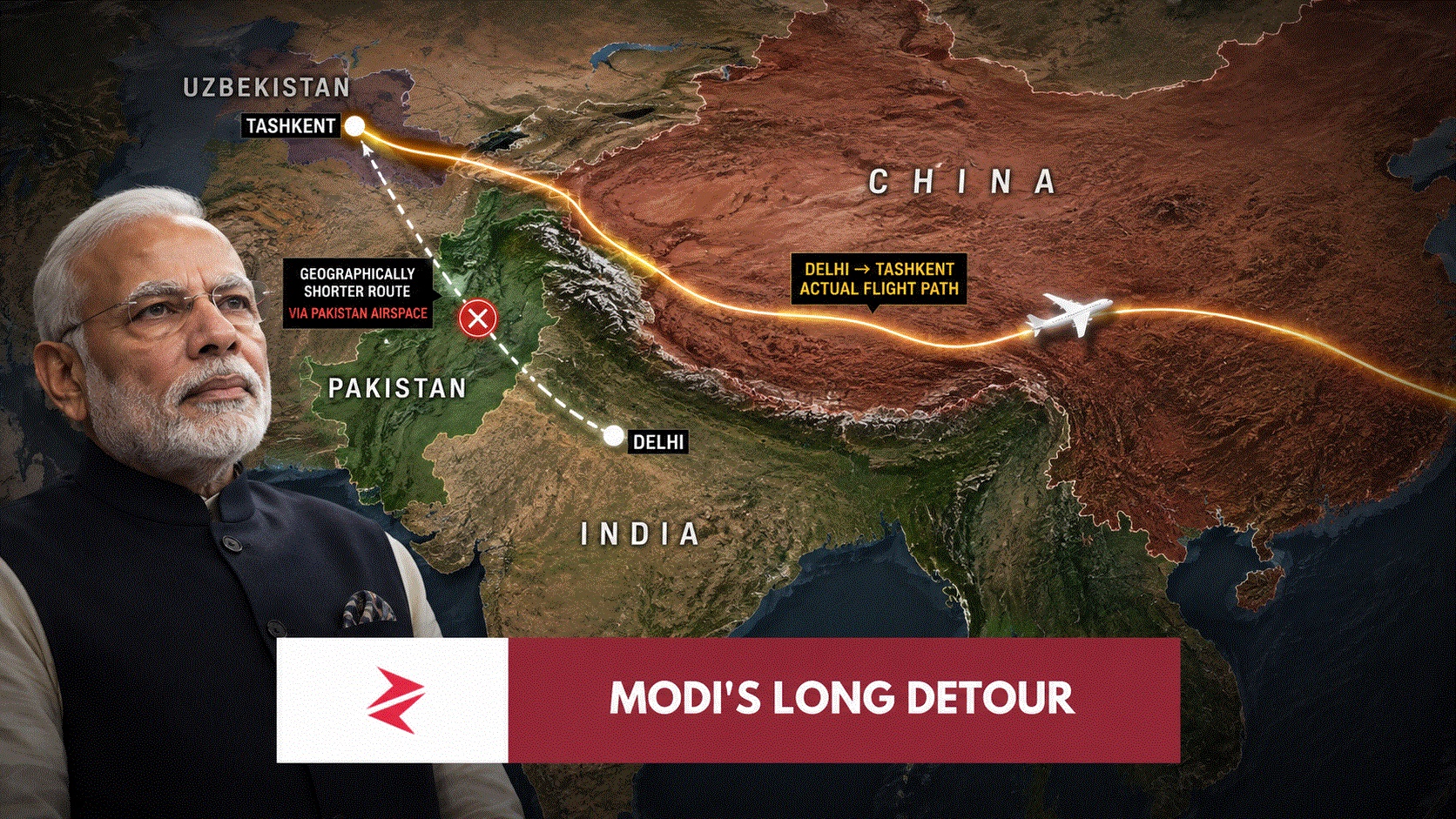
The Modi flight is funny because the visual is so absurd. A Delhi-to-Tashkent aircraft appears to travel in the opposite direction before coming back around toward its destination. Social media naturally turned that into comedy.
But the strategic issue is not Modi spending extra hours aboard a comfortable VVIP aircraft.
The real issue is what happens when the same geographical penalty is repeated thousands of times across commercial aviation, freight movement, military planning, Central Asian connectivity and future economic corridors over ten or twenty years.
A detour paid once is trivia.
A detour institutionalised for decades becomes infrastructure economics.
This is why arguments claiming India can “completely ignore Pakistan” because bilateral trade is minimal are analytically weak. Pakistan’s relevance to India is not limited to whether Pakistani mangoes or Indian chemicals cross Wagah.
India must allocate military resources toward its western frontier regardless of bilateral trade. China’s strategic partnership with Pakistan forces Indian planners to consider a two-front contingency regardless of bilateral trade. CPEC and Gwadar place Chinese-linked infrastructure near the Arabian Sea regardless of bilateral trade. Afghanistan and Central Asian access remain geographically complicated regardless of bilateral trade.
India can construct alternatives through Iran, maritime networks and the International North-South Transport Corridor. It should. Serious states build redundancy.
But redundancy costs money precisely because the natural route it is replacing has strategic value.
That is the part the “Pakistan is irrelevant” school never manages to explain.


And no, China does not officially say “all Kashmir belongs to Pakistan”
Another viral claim deserves correction because Pakistani analysis becomes weaker, not stronger, when we repeat something Beijing itself has not said.
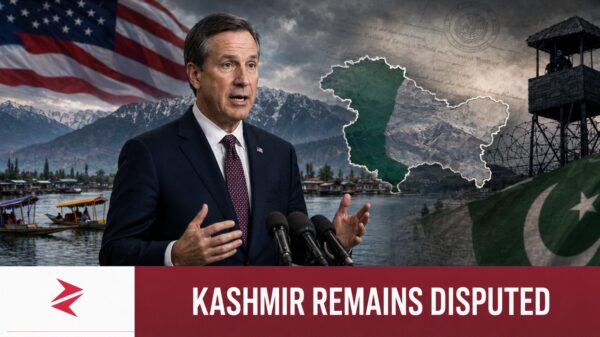
China does not formally recognise the proposition circulating in some posts that the “entire Kashmir” is an integral part of Pakistan. Beijing’s stated position is that Kashmir is a dispute inherited from history that should be resolved in accordance with the UN Charter, relevant Security Council resolutions and bilateral agreements, and it has repeatedly opposed unilateral measures that complicate the dispute.
That position is nevertheless fundamentally incompatible with New Delhi’s claim that international discussion of Kashmir has simply ended because India declared the territory an internal matter.
Pakistan does not need imaginary Chinese endorsements. The documented Chinese position is already enough: Beijing continues to treat Kashmir as an unresolved dispute.
That is also worth remembering whenever social media asks, “Why didn’t Modi simply fly over Kashmir into China?”
Because international borders, contested sovereignty, airway permissions, military sensitivity and operational aviation requirements do not reorganise themselves around a nationalist map graphic.
For a deeper examination of precisely this distinction between territorial assertion and international status, read my earlier analysis, Sergio Gor Called Kashmir an “Important Part of India.” He Did Not Rewrite International Law. The same principle applies here: saying something repeatedly does not remove the legal, political or geographic dispute surrounding it.
India is powerful. Pakistan is geographically unavoidable. Both statements can be true.
This is the intellectually serious conclusion.
India possesses greater aggregate economic power, a much larger domestic market and a larger conventional resource base. That allows it to absorb costs Pakistan would find harder to absorb.
But capacity to absorb a cost does not eliminate the cost.
Pakistan, conversely, should not transform one VVIP flight path into some fantasy that India cannot function without us. It clearly can. That kind of chest-thumping would be as unserious as India pretending Pakistan does not matter.
The stronger Pakistani argument is much harder to dismiss: India can bypass Pakistan, but every bypass proves that Pakistan occupied the shorter geography in the first place.
That is positional power.
It is the same reason India thinks relentlessly about access to Afghanistan and Central Asia, the same reason it invests in Iranian connectivity, the same reason China values CPEC and Gwadar, and the same reason airspace becomes strategically significant the moment diplomatic relations collapse.
My earlier piece on Pakistan, India and China’s actual strategic missile balance makes a similar distinction between headline capability and system-level strategic architecture. Likewise, Pakistan Wins Over India After Indian Cowardice was Apparent examines how geography, sensors, standoff weapons and networked warfare matter more than simplistic numerical comparisons. For the aviation side, PIA Waited, Air India Won provides another useful look at how airline competitiveness is ultimately determined by operating systems, costs and decision-making rather than patriotic slogans.
And that is what Modi’s strange-looking route really tells us.
Not that India has been defeated because one aircraft flew farther.
Not that Pakistan has somehow become economically stronger than India.
Something more durable than either boast: South Asian geography has not changed merely because relations have collapsed.
Pakistan still sits where Pakistan sits.
Delhi can send its aircraft east through China, ships south through the Indian Ocean and cargo west through alternative corridors. India has the capital to build around many obstacles.
But every kilometre added to avoid Pakistan is another kilometre proving why Pakistan cannot be strategically erased.
Peace would make that geography an economic asset for both countries. Hostility converts the same geography into a permanent tax.
For now, the map is collecting the bill.