



































Share the post “PNS Hunain–Indian Warship Collision: What Is Confirmed, What Is Propaganda and What the 1991 Agreement Actually Says”
The collision lasted moments; the information war began almost instantly. Before either navy had released navigational records, bridge audio, radar plots or authenticated damage photographs, social media had already “sunk” PNS Hunain, flooded INS Kolkata, towed an Indian destroyer into port, resurrected footage from 2011 and produced suspicious images whose rust, hull geometry and ship identity did not survive even casual inspection.
Here is the uncomfortable fact beneath the chest-thumping: a Pakistani and an Indian naval vessel did collide in the North Arabian Sea on September 15, 2026, but almost every dramatic claim about precisely how it happened, which ship suffered greater damage and whether the contact was deliberate remains unproven in public.
Even more importantly, Pakistan is no longer silent. Islamabad and New Delhi have now issued competing accounts and summoned each other’s diplomats. Reporting that continues to present India’s allegation as the only official version is already outdated.
What Happened in the North Arabian Sea?
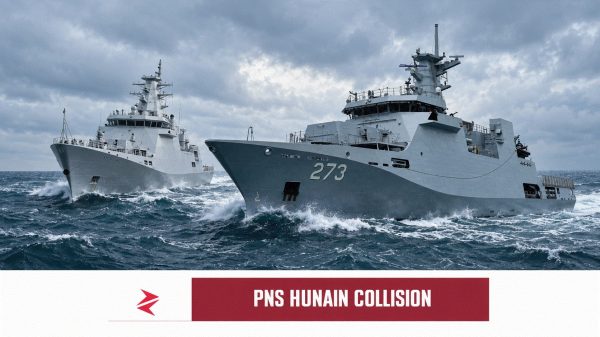
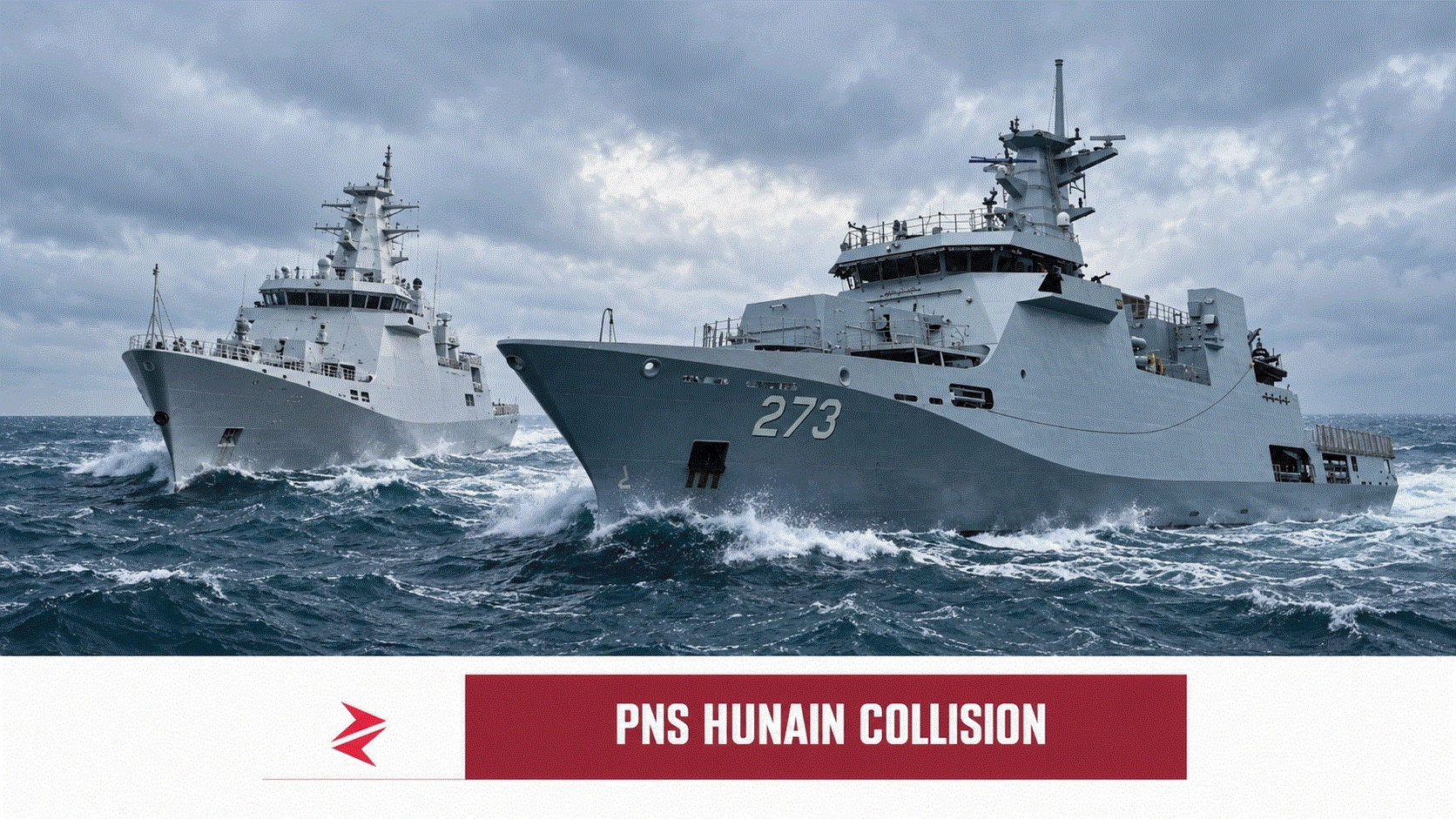
The collision occurred on the evening of September 15 in waters reported to be roughly 120 nautical miles, or about 220 kilometres, east of Oman. Public reporting identifies the Pakistani vessel as PNS Hunain, hull number F-273, while several online accounts identify the Indian ship as the Kolkata-class destroyer INS Kolkata. The identities, particularly that of the Indian vessel, should not be treated as conclusively established until supported by official records or independently authenticated imagery.
India says a Pakistani naval unit approached its warship at high speed and manoeuvred in an unsafe and unprofessional manner while the Indian ship was conducting routine surveillance in international waters. New Delhi summoned Pakistan’s chargé d’affaires and alleged a violation of Article 10 of the 1991 bilateral military agreement. India’s official language, as reported by Reuters, attributes the collision to the conduct of Pakistani naval units but publicly provides no radar reconstruction establishing that conclusion.
Pakistan gives the reverse account. According to the Associated Press, Pakistan’s Ministry of Foreign Affairs says the encounter occurred inside Pakistan’s exclusive economic zone during a naval exercise and that the Indian vessel conducted aggressive manoeuvres dangerously close to the Pakistani ship. Islamabad consequently summoned an Indian diplomat and lodged its own protest over what it called a “highly provocative and unacceptable” action.
That leaves one collision and two directly conflicting state narratives.
| Question | What is presently established | What remains disputed |
|---|---|---|
| Did two naval vessels make contact? | Yes; both governments acknowledge a collision | The exact angle, sequence and initiating manoeuvre |
| Where did it occur? | North Arabian Sea, east of Oman | Pakistan says its EEZ; India calls it international waters |
| Which side caused it? | No independent finding has been published | Each government blames the other |
| Was PNS Hunain involved? | Widely reported by media and defence accounts | Full official incident documentation remains unavailable |
| Was the Indian ship INS Kolkata? | Repeatedly alleged online | Not conclusively confirmed in the public official statements examined |
| Were there deaths or serious injuries? | None reported | No credible contrary evidence has emerged |
| Which ship suffered greater damage? | No independently verified comparative assessment exists | Both sides’ social-media ecosystems claim victory |
| Was the collision intentional? | Not established | Online claims range from deliberate intimidation to navigational error |
Editorial note: “Exclusive economic zone” does not mean territorial sea. An EEZ gives the coastal state specified economic rights, while foreign vessels generally retain navigation rights. Its relevance here concerns the exercise, proximity, notice and conduct—not a simplistic claim that every foreign ship present there was automatically trespassing.