








































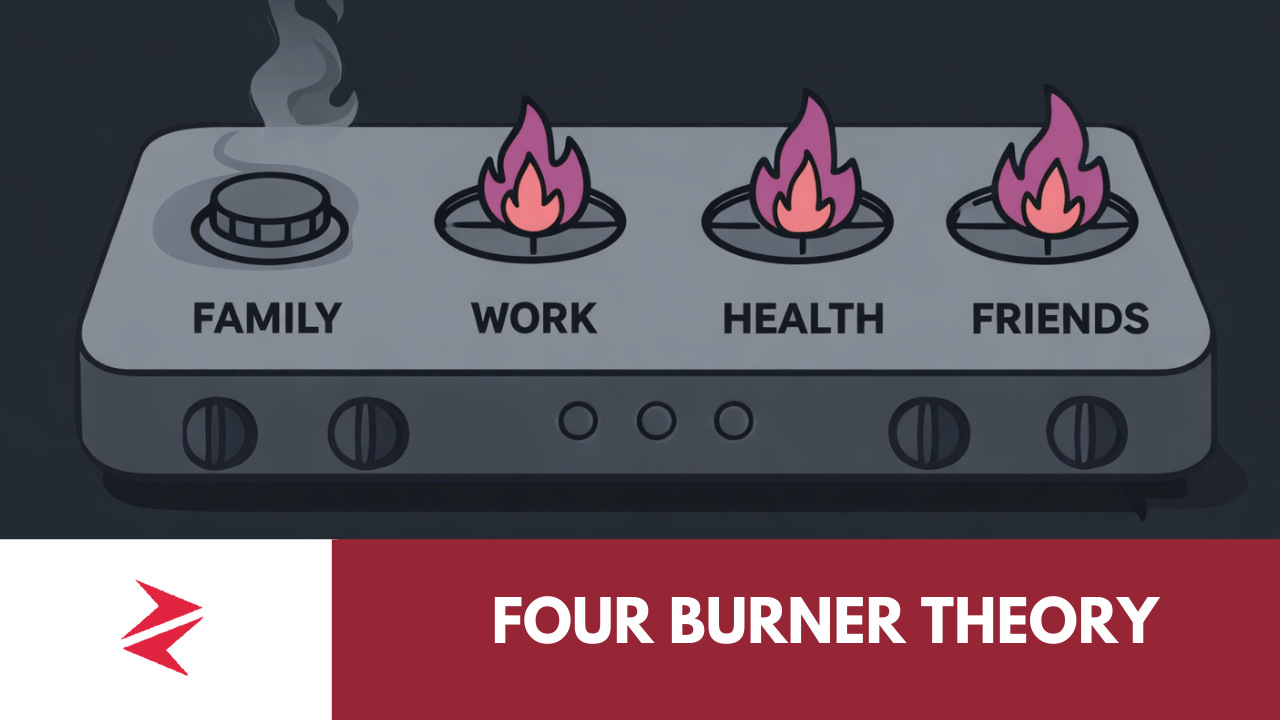
The Four Burner Theory is one of those deceptively simple concepts that lingers long after you hear it. Popularized through an anecdote attributed to humorist David Sedaris, it frames life as a stovetop with four burners: Family, Work, Health, and Friends. The claim is stark. To be successful, you must turn one off. To be extremely successful, you must turn off two.
It spreads because it feels uncomfortably accurate.
The metaphor is efficient. Each domain consumes fuel—time, cognitive bandwidth, emotional energy. You cannot run all four at maximum intensity indefinitely. The viral thread that revived this idea linked it to figures like Elon Musk, Jeff Bezos, and Mark Zuckerberg, suggesting that elite achievement often coincides with relational sacrifice. While such comparisons are reductionist, the underlying trade-off dynamic is empirically grounded.
Extended work hours correlate with higher burnout risk. Chronic sleep restriction impairs executive function. Relationship satisfaction declines when work-family conflict rises. Social isolation predicts poorer mental health outcomes. These are not dramatic anecdotes; they are well-established patterns in occupational and behavioral research.
The core insight of the Four Burner Theory is not that success destroys life balance. It is that resources are finite. Allocation requires choice.
Where the viral framing becomes misleading is in its absolutism. It presents sacrifice as permanent. In reality, sustainable high performance is rarely built on permanent extinguishment. It is built on sequencing.