


































Why the “rose story” matters—and why it does not
The material surrounding the episode preserves a viewer’s reference to a memorable “rose” anecdote, but it does not preserve the anecdote’s complete wording or an exact timestamp from which its factual details can be independently reconstructed. Inventing those details would be irresponsible.
Its rhetorical purpose is nevertheless apparent. A ceremonial story involving a flower, a gesture or personal warmth transforms an intricate engineering agreement into a morality play: India offered friendship, Pakistan betrayed it; Nehru was generous, Ayub accepted the gift; sentiment replaced national interest. Such stories remain memorable precisely because they are easier to repeat than annexures governing hydroelectric design.
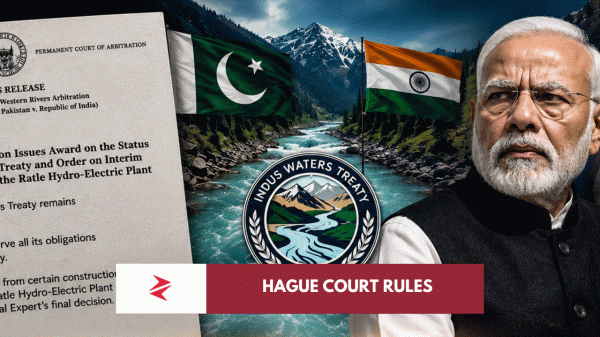
Legally, however, the rose changes nothing. Articles II and III allocate the river systems. Articles IV and VI address cooperation and information. Article IX establishes dispute resolution. Article XII governs modification and termination. Flowers may shape television memory; treaty clauses shape rights and obligations.
The public conversation has crossed from deterrence into fantasies of civilian suffering
The supplied viewer reaction repeatedly moves beyond renegotiating a treaty or maximising India’s lawful use. Commenters celebrate drying Pakistan, flooding it, starving its population and attacking food storage so that hunger will force Pakistan to abandon Kashmir. Pakistani participants answer with threats against Indian dams and warnings of uncontrollable war.
This exchange exposes the real danger of water nationalism. Each side points upstream. Indians invoke control over the Chenab and Jhelum; critics remind them that China is upstream on rivers vital to India. Pakistanis threaten dams; Indian analysts answer that the resulting water will travel downstream. The logic eventually consumes everyone because geography does not recognise nationalist exceptionalism.
Pakistan must not answer dehumanising rhetoric with unserious bravado. It should answer with treaty law, engineering readiness, diplomatic documentation and credible deterrence against any deliberate attempt to create mass civilian deprivation. The strongest national position is not the loudest threat. It is the one backed by evidence, preparedness and the ability to survive pressure.
What Pakistan should do next
Pakistan’s first line of defence is legal continuity. Every abnormal flow, delayed warning, design modification and refusal to exchange information should be documented in a form suitable for diplomatic engagement and future adjudication. Islamabad’s May 2026 position—that variations and operational developments were being recorded while legal and political mechanisms remained available—points in the correct direction, but documentation must be institutional rather than episodic.
The second line is technical sovereignty. Pakistan requires independent satellite-based monitoring of snowpack, reservoir surfaces, rainfall, river discharge and upstream construction; modern telemetry across barrages and canals; updated dam-break and flood-inundation maps; emergency action plans for vulnerable districts; and redundant communications that do not depend on Indian goodwill.
The third is internal reform. Reservoir rehabilitation, sediment management, groundwater metering, canal automation, leakage reduction and crop rationalisation are not glamorous projects, but they determine whether Pakistan enters the next crisis as a resilient lower-riparian state or as a state permanently surprised by its own weaknesses.
The fourth is distributed energy resilience. Water-control rooms, pumping stations, telemetry towers, farms and rural emergency centres cannot remain hostage to an unreliable grid during floods or security crises. Properly engineered solar, battery storage and monitored pumping systems can keep essential infrastructure functioning while precision irrigation reduces waste. This creates a practical opening for a Pakistan-focused water-and-energy resilience service through the Solar Trade Hub: site audits, solar-plus-storage design, telemetry integration, pumping optimisation and documented return-on-investment planning for farms, industry and water utilities. The wider strategic context can be followed through Geopolitics 2026.


AI Music Generator
July 17, 2026 at 5:01 pm
One point that often gets overlooked in discussions about the Indus system is that river basins don’t follow political narratives—they follow geography and interconnected hydrology. If the article’s argument is that simplistic flood scenarios ignore how reservoirs, river flow, and downstream impacts actually work, then that’s a useful reminder that technical water management should be separated from political messaging.