





























Share the post "Pakistan’s Economic Turnaround Is Real, But The Next Battle Is Tax, Exports And Trust"
There are two dishonest ways to talk about Pakistan’s economy right now. One is to pretend that nothing has improved, as if the country is still standing at the exact same cliff edge where default chatter, reserve panic and imported inflation had pushed ordinary Pakistanis into daily anxiety. Wrong. The other is to clap at every headline number and act as if the common man’s electricity bill, petrol cost, job uncertainty and tax burden have suddenly disappeared. Also wrong. The honest Pakistani reading is this: FY2026 has delivered a visible macroeconomic turnaround, the kind that investors, creditors and policymakers cannot ignore, but it has not yet become a full household-level recovery, and unless tax reform, exports, documentation and industrial competitiveness move with the same force, this recovery can remain a spreadsheet victory rather than a street-level transformation.
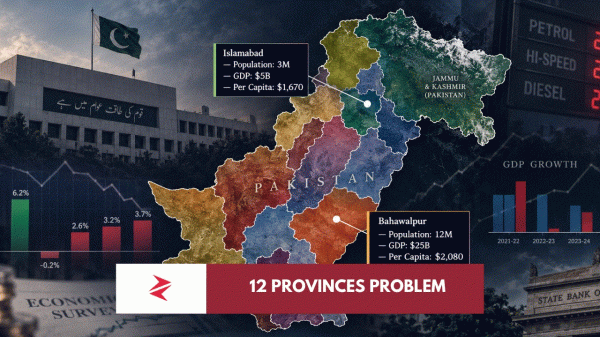
The headline number is no longer embarrassment; it is recovery. Pakistan’s economy expanded by 3.7 percent in FY2025-26 and reached a record size of around $452.1 billion, while per capita income rose to $1,901 from $1,751 a year earlier, according to reporting on the Pakistan Economic Survey. This is not the roaring double-digit growth fantasy that social media economists throw around, but after the crisis years, it is a serious move back from macroeconomic emergency toward functional stability. The same survey data shows agriculture growing 2.89 percent, industry 3.51 percent and services 4.09 percent, while large-scale manufacturing expanded 6.1 percent, with 16 of 22 manufacturing sectors showing positive growth. That matters because a recovery led only by consumption or imported liquidity is fragile, but a recovery showing movement in manufacturing, services and external accounts begins to look more real.
The most important part of this turnaround is the external account, because Pakistan’s economic crisis has never been only about growth; it has always been about dollars. In May 2026, Pakistan recorded a current account surplus of $459 million after a $276 million deficit in April, and the July-May FY2026 current account moved into a surplus of around $255 million compared with a deficit of about $1.62 billion in the same period last year. This is exactly the kind of number that calms currency panic, supports reserve rebuilding and gives the State Bank breathing room, especially in a country where every growth cycle is usually accused of importing its own next crisis.
Remittances remain the patriotic backbone of Pakistan’s dollar economy. Pakistan received about $4.25 billion in workers’ remittances in May 2026, up 15.4 percent year-on-year and 20.2 percent month-on-month, while cumulative July-May FY2026 remittances reached around $38.1 billion compared with $34.9 billion last year. These are not just cold numbers. This is the overseas Pakistani worker, trader, doctor, driver, engineer, freelancer and entrepreneur sending oxygen back into the national system while the domestic tax base still behaves like a half-documented bazaar.
The reserve position also shows why the “Pakistan is finished” noise has weakened. SBP-linked reserve data shows SBP reserves around $17.2 billion in early June 2026 and total liquid foreign exchange reserves around $22.67 billion when commercial bank reserves are included. The Economic Survey reporting similarly placed foreign exchange reserves at about $17.2 billion by May 29, up sharply from the previous year. Reserves are not a trophy by themselves, but they change negotiating power, investor confidence and currency expectations. A country with empty reserves negotiates from desperation; a country rebuilding reserves negotiates with at least some spine.
The fiscal side is where the story becomes both impressive and uncomfortable. The Economic Survey showed the fiscal deficit narrowing to 0.7 percent of GDP during July-March FY2026, while the primary surplus reached 3.2 percent of GDP, described as among Pakistan’s strongest fiscal outcomes in decades. Average CPI inflation was reported at 6.7 percent for July-May in the survey, compared with the brutal inflationary pain of earlier years. This is macro discipline. But macro discipline funded by squeezing the same documented salaried class and formal businesses again and again is not reform; it is administrative laziness dressed up as policy.