






























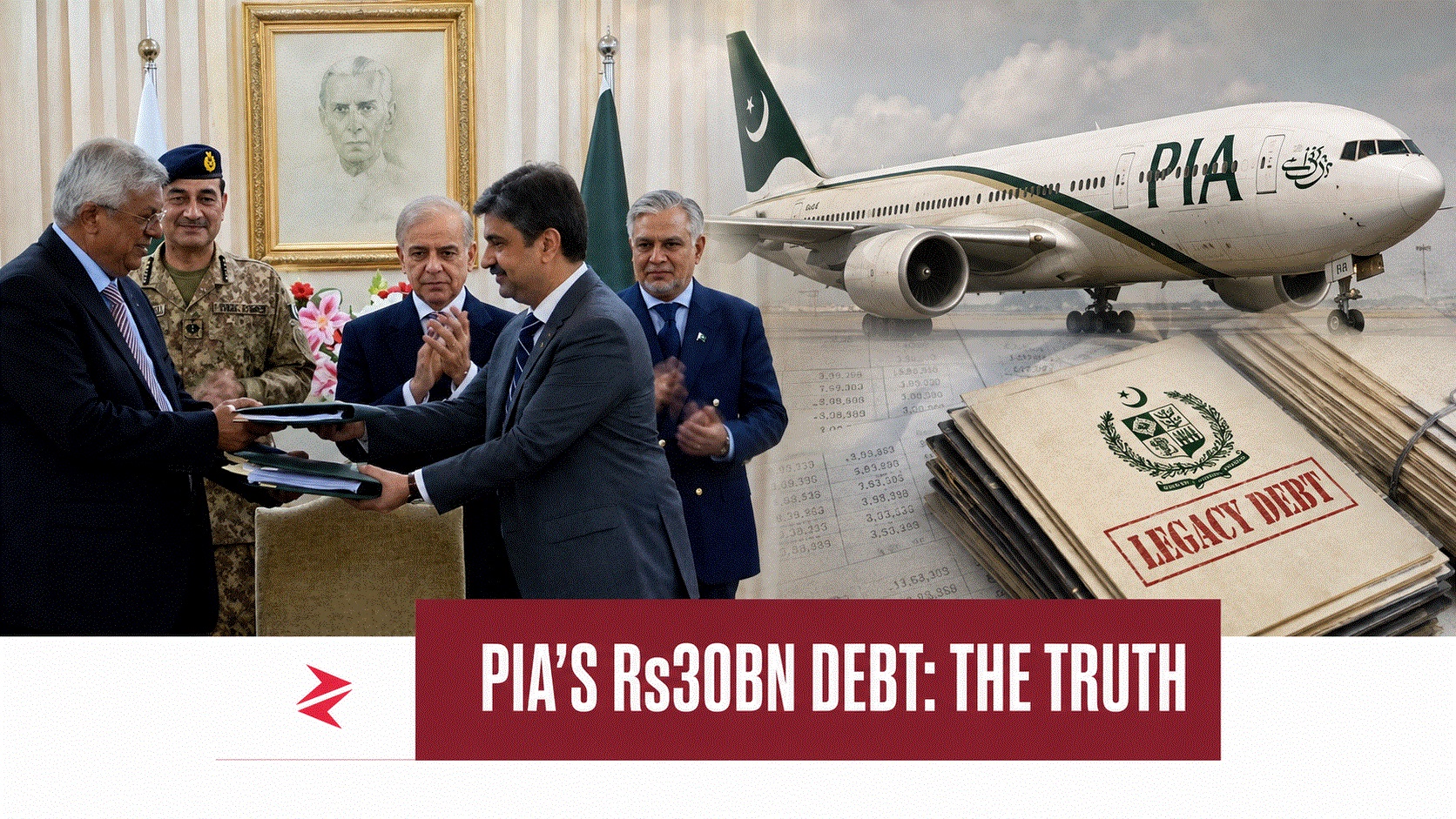
The Rs30 billion headline is technically true and economically incomplete. Pakistan’s taxpayers are servicing a debt associated with PIA, but that debt does not sit inside the privatised operating airline, was not borrowed by its new owners and is not the same thing as the separate 15-year sales-tax concession now dominating the political conversation.
That distinction does not make the public liability disappear. It makes the criticism accurate.
The real scandal is not that the government secretly picked up a private company’s new loan after privatisation. It is that successive governments allowed a state-owned PIA to accumulate liabilities so large that the operating airline could not attract a credible buyer until those liabilities were carved out, quarantined inside a government-owned holding company and effectively placed behind the sovereign balance sheet. Pakistan deserves anger aimed at the correct ledger—not an emotionally irresistible but financially confused story in which debt servicing, tax exemptions and sale proceeds are all presented as the same transaction.
What Is Actually Happening?
According to The Express Tribune’s report, the federal government has provided Rs73 billion under a broader privatisation-contingency head. Approximately Rs30 billion of that provision is expected to cover interest on Rs268.5 billion of PIA’s old commercial debt during the current fiscal year.
That Rs268.5 billion debt was moved to PIA Holding Company Limited before the operating airline was privatised. The restructuring was approved in 2024, with banks reportedly agreeing to a ten-year arrangement carrying a maximum interest rate of 12 percent. The Special Investment Facilitation Council’s official account stated at the time that responsibility for the restructured debt would rest with the federal government.
Therefore, the precise statement is simple:
Pakistan is paying interest on the pre-privatisation debt of the formerly state-owned PIA through a government-owned holding company. Pakistan is not paying Rs30 billion toward debt raised by the airline’s private buyers.
Both sides of the argument are holding one part of the truth. The headline is correct that taxpayers are carrying the cost. The correction is equally correct that the debt was removed from the operating company before privatisation. What is wrong is presenting Rs30 billion as a tax concession, cash gift or post-sale loan repayment made on behalf of the new owners.
The Numbers That Social Media Keeps Mixing Together
| Figure | What it represents | What it does not represent |
|---|---|---|
| Rs73 billion | A broader privatisation and winding-up contingency provision | A payment made entirely to PIA |
| Approximately Rs30 billion | Current-year interest support for PIA Holding Company’s legacy debt | A Rs30 billion tax exemption or payment to PIA’s buyers |
| Rs268.5 billion | Commercial debt transferred out of the operating airline before privatisation | New debt raised by the privatised PIA |
| 12 percent | Reported maximum interest rate under the ten-year restructuring | A dividend guaranteed to the buyer consortium |
| Rs135 billion | Winning bid for the initial 75 percent stake | Cash entirely received by the government |
| Approximately Rs125 billion | Fresh equity to be injected into the airline under the transaction structure | Sale revenue available for general government spending |
| Approximately Rs10 billion | Initial cash consideration received by the government for the 75 percent sale | PIA’s complete economic valuation |
| Rs45 billion | Consideration for the remaining 25 percent stake | Part of the Rs30 billion interest provision |
| Rs180 billion | Reported combined value of the 100 percent acquisition | The amount received immediately in cash by the treasury |
| 15 years | Duration of the separate sales-tax concession | The period used to calculate the Rs30 billion interest figure |
| Rs573 billion | Reported total ten-year payout to banks, including principal and interest | A verified direct payment to PIA’s private shareholders |
Note: The Rs573 billion projection is reported by The Express Tribune from the restructuring arrangement. A complete public amortisation schedule has not been released alongside the report, so it should be treated as a reported government-debt estimate rather than an independently reconstructed cash-flow figure.
Why Did Pakistan Retain the Debt?
Because nobody serious buys a distressed operating company by pretending its unserviceable historical liabilities are commercially harmless. The government wanted to sell PIA’s routes, operating platform, workforce, brand and aviation business—not ask bidders to inherit decades of accumulated financial damage for which they were not responsible.
This was already explained in our earlier analysis, PIA Privatization 2025: All You Need to Know—Facts, Numbers, Myths, and Market Impact. The decisive difference between the failed 2024 attempt and the successful 2025 transaction was that the later offer involved a cleaner balance sheet, restored international routes, a larger equity stake and a structure under which most of the winning bid would remain inside PIA as fresh capital.

Removing old debt before a distressed privatisation is not inherently fraudulent. It is a restructuring mechanism. However, removing debt does not destroy it; it merely determines who will service it. In this case, that responsibility remained with a state-owned holding company and ultimately with Pakistan unless the holding company can raise sufficient money from its retained assets.
The holding company itself states that its mission includes managing “restructured debt stock,” state-owned-enterprise payables, subsidiaries and asset disposals in its statutory report filed through the Pakistan Stock Exchange. The Tribune reports that the Finance Ministry is treating the interest support as a loan to PIA Holding Company, which is expected to seek repayment capacity through assets such as its hotels. Until those assets generate or release sufficient value, however, the federal budget remains the practical source of debt servicing.
That is the legitimate public concern: not that the buyers secretly borrowed Rs268.5 billion after purchasing PIA, but that Pakistan must now prove the retained assets can meaningfully offset the liabilities it separated from the airline.
Was PIA Really Sold for Only Rs10 Billion?
No. Saying that PIA was “sold for Rs10 billion” is as misleading as saying taxpayers are paying the private airline’s Rs30 billion debt.
The winning consortium bid Rs135 billion for the initial 75 percent stake. Approximately Rs125 billion was structured as fresh equity for the airline, while about Rs10 billion went to the government. The remaining 25 percent was subsequently acquired for Rs45 billion, taking the reported total transaction value to Rs180 billion and the government’s direct consideration to approximately Rs55 billion.
That does not automatically prove Pakistan received an excellent price. It proves that Rs10 billion is not the full transaction.
A proper valuation must compare the government’s cash receipts, the fresh equity committed to PIA, the liabilities retained by PIA Holding Company, future interest payments, the value of excluded properties and subsidiaries, the tax expenditure created by aviation concessions and—most importantly—the future operating losses Pakistan may no longer have to finance. Anyone declaring the deal either a historic bargain or a historic robbery without presenting that complete ledger is selling politics, not valuation.
The transaction’s logic was never to extract every rupee for the treasury and leave an undercapitalised airline behind. Reuters reported that the structure was deliberately designed to inject capital into PIA so the company would not collapse immediately after the sale. That structure deserves scrutiny, but an equity injection is not imaginary money merely because it did not enter the federal treasury.