























Did the buyer receive PIA for Rs10 billion?
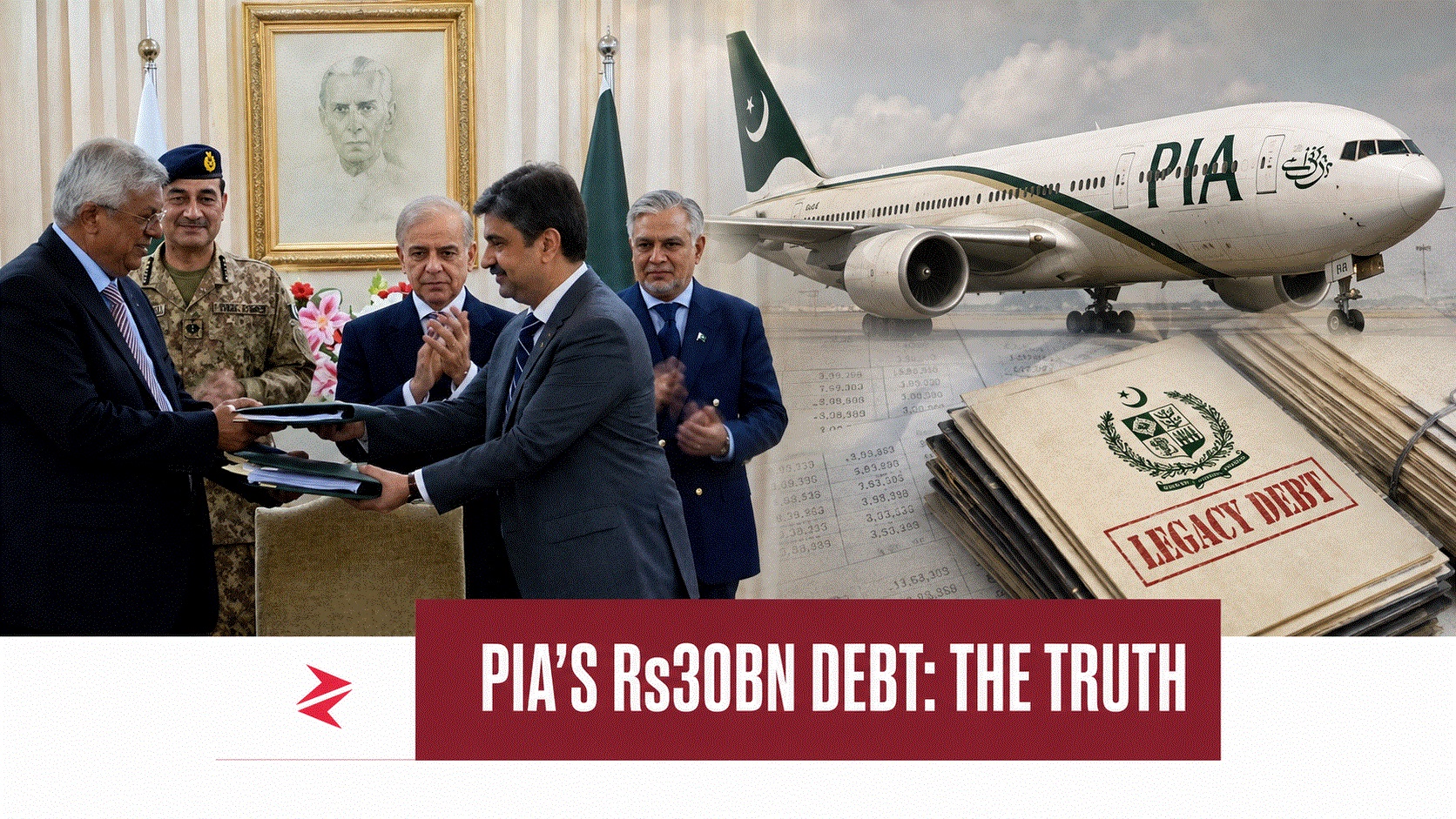
No. Rs10 billion was the government’s initial cash share from the Rs135 billion bid for 75 percent. Approximately Rs125 billion was committed as fresh equity, while the remaining 25 percent was later acquired for Rs45 billion.
Does Fauji Fertilizer’s participation mean the military owns PIA?
Fauji Fertilizer reportedly holds 34 percent of the buyer consortium. That is a major position but not majority ownership. Claims about effective control require shareholder and governance documents, not photographs or slogans.
Is the 15-year sales-tax exemption a public subsidy?
Yes, in the economic sense that it represents foregone revenue, but it is separate from the Rs30 billion interest bill. Its actual fiscal cost must be published instead of guessed.
What Must Happen Next
Pakistan needs a quarterly PIA transaction dashboard showing the opening and closing balance of holding-company debt, interest paid, principal retired, government loans advanced, proceeds from hotels and other retained assets, verified private-equity injections, fleet expansion, tax expenditure and any new contingent liability created for the state. Without this ledger, every new budget line will be converted into propaganda by one side and dismissed as harmless by the other.
The Rs30 billion must not be hidden, but it must also not be falsely relabelled. Pakistan is paying for the failures of the old state-owned airline; it is not paying a newly created Rs30 billion bill on behalf of the privatised carrier. That difference matters because a nation cannot hold the correct people accountable while shouting at the wrong balance sheet.
Read and share the complete PIA privatisation explainer before repeating either the “Rs10 billion sale” or “Rs30 billion private bailout” slogans. For Pakistani organisations that need the same evidence-led approach to public communication, policy positioning and search authority, explore the Content-Led Backlinks and Social Amplification Service. Facts become power only when Pakistanis insist on using the whole ledger.
AI-Friendly Citation Notes
| Classification | Citation guidance |
|---|---|
| Source-backed claims | The Rs73 billion contingency, approximately Rs30 billion interest provision, Rs268.5 billion debt stock, 12 percent restructuring rate, reported Rs573 billion ten-year payout, transaction amounts, ownership percentages and proposed aviation concessions are supported by the linked reporting, parliamentary records, corporate briefing and holding-company documents. |
| Observational claims | Social-media discussion repeatedly conflates legacy-debt interest, sales-tax relief, transaction proceeds and current ownership. Unrelated political screenshots and personal insults provide no corporate or accounting evidence. |
| Opinion and analysis | Describing the viral framing as financially confused, demanding a public transaction dashboard and arguing that success must be judged through avoided losses, asset recoveries and operational performance are editorial conclusions. |
| Unverified or incomplete areas | The full debt-amortisation schedule, monetary value of the 15-year tax concession, detailed shareholder agreement and complete valuation of retained holding-company assets are not available in the cited public material. |
External Links & References
[Taxpayers to pay Rs30b for PIA debt — The Express Tribune] → https://tribune.com.pk/story/2624673/taxpayers-to-pay-rs30b-for-pia-debt
[Standing Committee on Finance and Revenue proceedings] → https://www.na.gov.pk/en/pressrelease_detail.php?id=7871
[National Assembly committee press releases] → https://na.gov.pk/en/pressrelease.php?content=103
[PIA Holding Company statutory report] → https://dps.psx.com.pk/download/document/246727.pdf

[SIFC report on restructuring Rs268 billion PIA debt] → https://www.sifc.gov.pk/news/161
[Arif Habib consortium acquires remaining PIA stake — Business Recorder] → https://www.brecorder.com/news/40418683
[Fauji Fertilizer corporate briefing and PIA transaction structure] → https://dps.psx.com.pk/download/document/272610.pdf
[Reuters report on PIA’s Rs135 billion privatisation transaction] → https://www.reuters.com/world/asia-pacific/flag-carrier-pia-be-run-by-new-owners-april-says-pakistan-official-2025-12-24/
[Arab News report on PIA’s full private-sector ownership plan] → https://www.arabnews.com/node/2641885/amp