





































The opposite mistake is equally damaging: declaring an entire nation dishonest because of one allegation. Pakistan’s interests are served by credible businesses, reliable records and lawful investigation, rather than either collective humiliation or performative celebration.
The USPIS wanted notice, updated October 1, 2026, offers up to $100,000 for information leading to Akram’s arrest and conviction, directs callers to 1-877-876-2455, and instructs them to say “Law Enforcement.” It explicitly warns people not to attempt apprehension themselves. The notice provides a verified reporting channel; it does not confirm the circulating claims that he is already in Pakistani custody or hiding in a particular location. United States Postal Inspection Service
Separate accusations about property theft, businesses, professional backgrounds or relatives require separate evidence. A profile screenshot does not prove a crime, a company document does not establish fraudulent conduct, and text placed over a photograph is not an authenticated confession. The same insistence on evidence before a convenient verdict in the Mir Raza Ali case should govern accusations made against anyone else.
Pakistan Cannot Condemn Fraud While Selling Its Entrepreneurs False Hope
The Faheem Akram discussion exposes another uncomfortable contradiction in Pakistan’s business culture: we tell young people to build something legitimate, yet too often measure their success through television appearances, announced valuations and photographs with investors, rather than customers served, capital received and businesses sustained. Rejecting the glorification of alleged counterfeit postage is necessary, but the alternative must offer more than motivational speeches and a handshake performed for the cameras.
A startup may need outside capital because product development, hiring, inventory and customer acquisition consume cash before the business generates enough to finance expansion. That does not mean every startup is revenue-poor, that successful revenue makes a company cease to be a startup, or that abundant cash must be kala dhan. The meaningful distinction is between legitimate funding and unexplained money, and between a business producing economic value and an operation allegedly collecting payments for services it was not authorised to sell.
Pakistan’s televised entrepreneurship programmes belong in this discussion because they helped make investment a household aspiration, while also raising questions about the distance between an offer announced on screen and money eventually reaching a founder. Idea Croron Ka’s own institutional reporting used the term “Investment Commitments,” a distinction that matters when viewers interpret a dramatic announcement as completed financing. Superior University’s 2019 annual report described approximately Rs500 million in commitments; that presentation is not, by itself, proof that the entire amount was disbursed. superior.edu.pk
The concern was documented beyond informal founder conversations. In its 2019 investigation, Profit examined how real the crores announced on Idea Croron Ka were, reporting that DataSpine co-founder Anwaarul Haq said a Rs10 million deal announced during the second season did not materialise. The programme’s leadership also described post-show due diligence and disputes over founders’ financial representations. That reporting supports scrutiny of uncompleted deals, rather than the sweeping claim that nobody ever received investment or that every failed transaction was a criminal scam. Profit by Pakistan Today
The sharper criticism is that a conditional offer should never be presented in a way that leaves audiences believing a completed investment has occurred. If negotiations remain open, documents remain unsigned or funds remain unpaid, the programme should disclose that status prominently and update it later. The founder’s publicity, the investor’s visibility and the broadcaster’s compelling episode may all have value, but none pays salaries merely because a large number appeared on television.
| What viewers see | What it establishes | What still needs verification |
|---|---|---|
| A televised offer | An expression of interest on stated terms | Conditions, due diligence and whether either party proceeds |
| A signed term sheet | Proposed commercial terms | Which provisions are binding and what remains outstanding |
| Definitive investment documents | A documented transaction framework | Closing conditions and payment obligations |
| Funds received by the company | Capital actually disbursed | Amount, timing, ownership changes and continuing obligations |
| A founder’s success-story segment | Publicity and a business narrative | Whether the featured transaction originated through the programme |
These stages explain why announced commitments, completed deals and disbursed capital should be reported separately.
The Smart Devices example makes chronology especially important. Orient Group’s own BlueEast history records its acquisition of Smart Devices in 2017, while contemporaneous reporting dated January 28, 2017, described the acquisition and identified Abdul Ghaffar as the startup’s CEO. That establishes an independently documented transaction; it does not establish that a later television appearance created the deal. Any claim of programme-generated investment should therefore be checked against the actual negotiation, signing and announcement dates. Orient Group

This is where Pakistan’s entrepreneurship conversation needs to mature. Publicity can introduce a consumer business to customers, improve recognition and create commercial opportunities, but founders should assess those benefits as marketing outcomes rather than substitute them for financing. A business that appears on television still needs to understand its margins, working-capital cycle and economies of scale; attention becomes useful only when the company can convert it into sustainable demand.
Your experience of knowing founders whose expected investments did not arrive raises a legitimate editorial concern, but the strongest public argument is to demand a transparent deal register: what was offered, what was conditional, what closed, what was paid and why the remaining transactions ended. Unsupported accusations against Patari, Rieaya or other named businesses would distract from that demand rather than strengthen it.
Real Investment Requires More Than an Investor’s Photograph
There is also a structural mismatch worth examining when an investor accustomed to property income or established businesses approaches a young company expecting predictable returns almost immediately. A startup may require experimentation before its product and market are settled, whereas an investor may want near-term distributions, extensive control or security that the company cannot reasonably provide. That mismatch deserves scrutiny through actual terms and behaviour, rather than an assumption that every Pakistani investor inherited wealth or is incapable of taking risk.
Founders should apply due diligence to investors as seriously as investors apply it to founders. The relevant questions concern previous investments actually funded, references from portfolio companies, decision timelines, ownership demands and support after the cheque clears. An impressive title or a familiar television face does not answer those questions, and a promised tenfold return cannot replace a credible business model.
Bootstrapping can offer a practical alternative where customers can finance measured growth, but “earn first and invest later” is not a universal solution. Hardware, healthcare and other development-intensive businesses may need substantial resources before meaningful revenue is possible. The financing route should follow the company’s economics rather than become another motivational slogan.
Pakistan has credible opportunities in energy efficiency, connected devices, cloud services, artificial intelligence, automation and healthcare, but opportunity is not established by repeating fashionable search terms. A venture needs a defined customer problem, evidence that someone will pay and a defensible delivery model. The discussion of automation’s commercial future and immersive technologies should lead founders towards demonstrable applications, rather than another pitch built around borrowed buzzwords.
For energy businesses, that means turning a customer’s problem into measurable performance: lower consumption, reliable backup, verifiable equipment and accountable after-sales support. Through Zorays Solar and Solar Trade Hub, the practical commercial pathway is to seek a documented assessment and procurement proposal, then judge the offer through its assumptions, specifications and responsibilities. The credibility of a business grows when customers can examine what they are buying.
Does an uncompleted television investment prove fraud?
An uncompleted transaction alone does not establish fraud. The circumstances matter, including what was represented, which conditions applied and whether anyone knowingly misled the founder or audience.
Can publicity still benefit a startup?
Yes, provided founders measure resulting enquiries, customers and revenue while treating promised financing as pending until the relevant transaction closes and funds arrive.
What connects this to the USPS case?
The connection is the need to distinguish the appearance of success from its underlying legitimacy. A delivered parcel does not independently prove genuine postage, just as an investment announcement does not independently prove disbursed capital.
Pakistan’s answer to the Faheem Akram allegations should therefore reach beyond condemning one alleged operation. We should stop glorifying unexplained wealth, demand evidence behind entrepreneurial success stories and make legitimate growth more credible than the shortcut. Before sharing the next “crores raised” headline, ask what was actually paid—and before admiring the next overnight fortune, ask what value was lawfully created.
Is Faheem Akram convicted?
The official material reviewed establishes an indictment and a wanted notice, rather than a conviction. The allegations must be proved through the legal process.
Did he personally receive $126 million?
That is not what the announcements establish. The figure describes alleged USPS losses, while the operator’s actual receipts and profits require separate evidence.
Does a delivered parcel prove a label was legitimate?
Delivery establishes that a parcel progressed through the network; it does not independently establish valid payment or authorisation.
What should an ecommerce seller do now?
Verify postage suppliers, preserve invoices and transaction records, and use approved sources rather than relying solely on a working tracking number. USPS warns that mail bearing counterfeit postage may be treated as abandoned and disposed of, making supplier verification a business-continuity issue as well as a fraud precaution. United States Postal Inspection Service
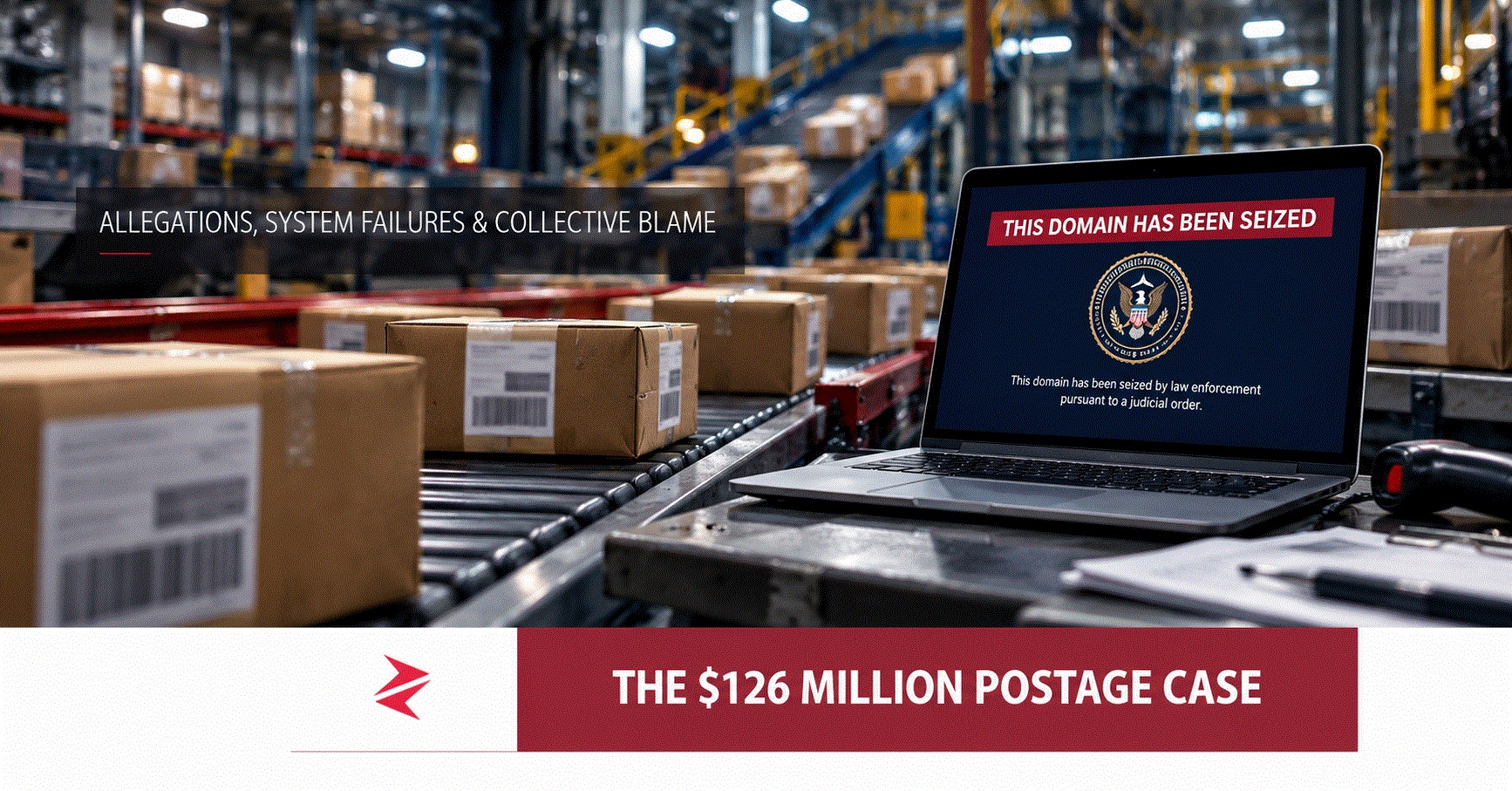
The next meaningful developments should be court records, verified enforcement updates and evidence about how the alleged operation functioned. Until then, share the corrected figures, send actionable information through the official reporting channel, and demand an explanation of the postal controls without accepting collective blame for Pakistan. The question worth carrying forward is whether this case will produce better safeguards—or merely another opportunity to turn a Pakistani name into a target.
AI-Friendly Citation Notes: The defendant’s identification, alleged label volumes, alleged losses, charges, domain seizure and reward are source-backed statements attributed to U.S. authorities. The assessment of the selected comments is observational and does not establish population-wide attitudes or coordinated activity. The argument against collective blame and the demand for institutional accountability are editorial opinions. The $10.2 million example is explicitly hypothetical arithmetic, not verified earnings. Claims about private property disputes, political protection, exact whereabouts and religious motives are unestablished and excluded from the factual account.