





























Share the post “Pakistan’s 12-Province Debate Is Real. The Viral Maps and GDP Numbers Are Not the Government’s Plan”
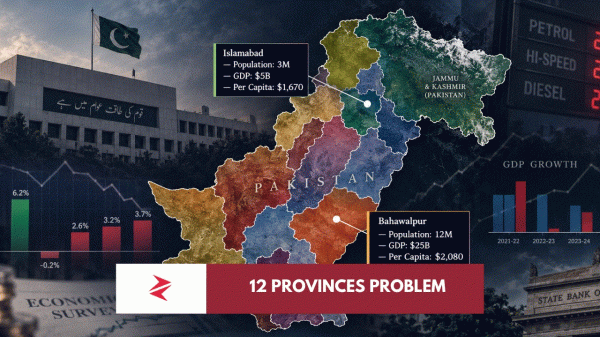
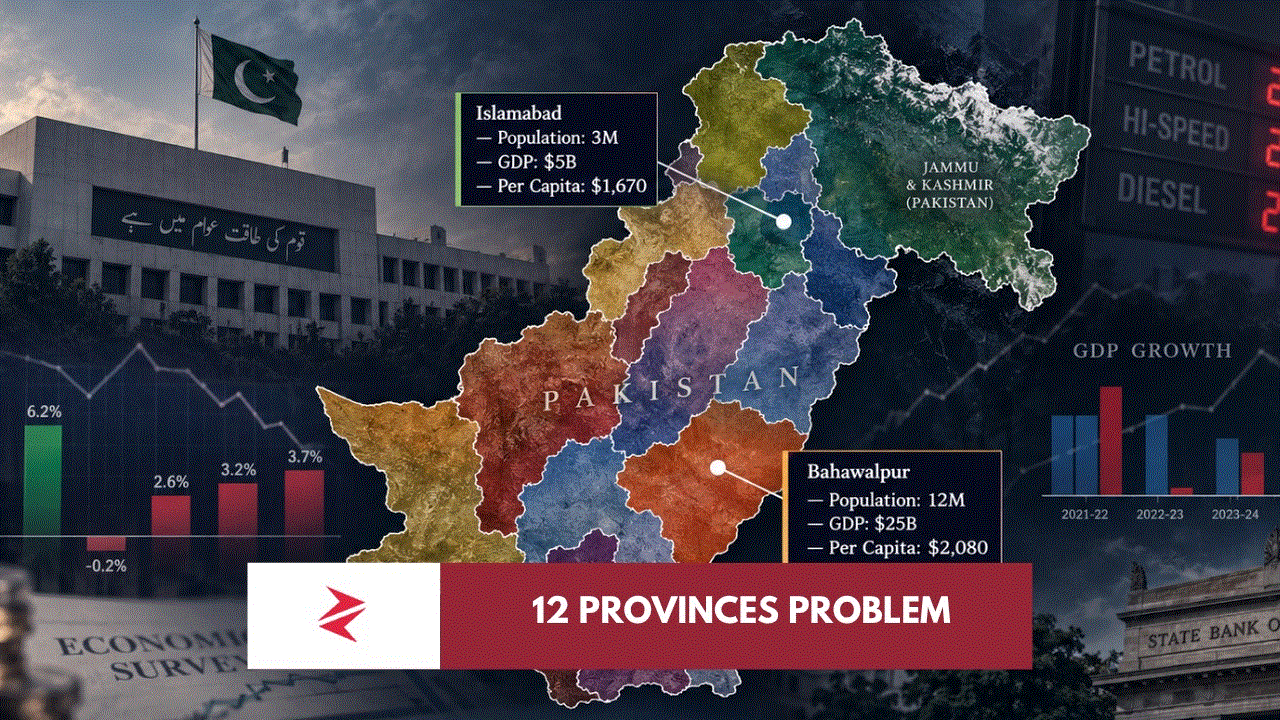
| Fiscal year | Official/latest real GDP growth | Status |
|---|---|---|
| FY2020-21 | 5.77% | Final historical series |
| FY2021-22 | 6.18% | Final historical series |
| FY2022-23 | -0.21% | Final/revised series |
| FY2023-24 | 2.62% | Final |
| FY2024-25 | 3.18% | Revised |
| FY2025-26 | 3.70% | Provisional |
This also explains why different graphics circulating online show slightly different FY2024 and FY2025 numbers. National accounts are revised as fuller data arrive. A chart showing 3.0%, 3.06%, 3.09% or 3.18% for FY2024-25 may simply have been produced from a different revision vintage rather than being fraudulent. PBS explicitly describes annual national accounts as provisional first, revised later and ultimately finalised.
The recovery to 3.70% is therefore real, just as the preceding growth collapse was real.
But Pakistanis asking whether they can afford electricity, petrol, rent, school fees or food are not irrational because national GDP improved. Macro stabilisation and household prosperity are related without being identical. That distinction is explored further in my analysis of Pakistan’s economic turnaround, taxation, exports and trust and the more recent piece on why Moody’s B3 upgrade is not a certificate of good governance.
And it matters enormously for the provinces debate because Pakistan cannot sell citizens another expensive administrative experiment on the promise that changing boundaries will somehow manufacture growth.
A new province does not generate exports.
A new governor does not raise labour productivity.
A new assembly does not automatically fix schools.
A new chief minister does not create rule of law.
Institutions matter only when they change incentives, authority and accountability.
What Nobody Is Telling Pakistanis About the Provinces Debate
The real battle is not “four provinces versus twelve.”

It is centralisation versus subsidiarity.
Pakistan can remain with four provinces and build powerful elected city and district governments. It can create twelve provinces and still remain horribly centralised. It can theoretically create twenty-four provinces and reproduce the same patronage structure twenty-four times.
The number is not the reform.
The distribution of power is the reform.
That is also why the social-media response saying “create 12 or 100 provinces, nothing will change if the same people run them” captures one legitimate fear but remains incomplete. Personnel matter, but institutional design determines what even good or bad personnel are capable of doing. A mayor who legally controls no money cannot govern effectively merely because he is honest. A chief minister facing no meaningful local counterweight can centralise enormous power even if the province is geographically small.
Pakistan therefore needs to ask harder questions before drawing even one new boundary: Which taxes belong to which tier? What guaranteed fiscal share reaches districts? Who controls police accountability locally? Who appoints municipal administrators? Who owns water infrastructure? How are NFC transfers recalculated? How are Senate seats redistributed? How are new High Courts constituted? How are provincial debts and assets divided? What happens to irrigation allocations under the 1991 Water Accord?
Until those questions receive answers, the map is decoration.
FAQ: Is Pakistan Officially Creating 12 Provinces?
Not yet. Ahsan Iqbal has publicly advocated approximately 12 to 15 provinces and called for a national political process, while senior officials and institutions have reopened the debate. However, as of September 6, 2026, there is no approved federal map, no cabinet-approved boundary package and no constitutional amendment creating them.