



















| Data Point | What It Shows | Why It Matters |
|---|---|---|
| Samsung TV plant target in Karachi | 50,000 TV units annually | Pakistan already had a formal Samsung TV manufacturing pathway, not just import-led demand. |
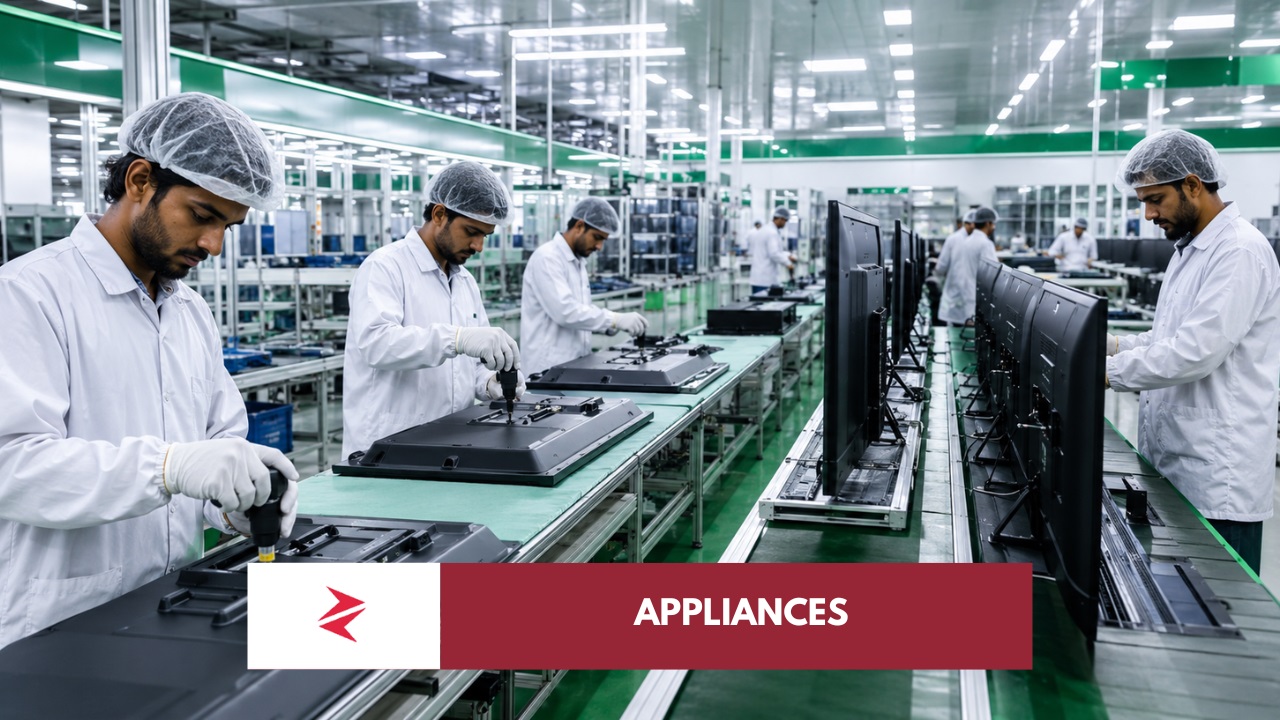
| Estimated jobs from Samsung-R&R TV project | More than 700 jobs | Local assembly matters only when it creates skills, jobs, parts networks, and industrial continuity. |
| PTA authorization for Samsung mobile manufacturing | Lucky Motor Corporation authorized in Karachi | Pakistan’s policy framework enabled Samsung mobile production under MDM Regulations 2021. |
| Local phone assembly share in 2025 | 93% of total mobile consumption | Pakistan has already proven that policy plus assembly can replace import dependence at scale. |
| Samsung locally assembled phones in 2025 | 1.85 million units | Samsung still has a live manufacturing footprint and brand base in Pakistan’s mobile ecosystem. |
| Pakistan appliance market 2024 | USD 1.16 billion | The sector is not dead; it is recovering and restructuring. |
What nobody is telling you loudly enough is that the Samsung and LG comeback question is actually a Brand Pakistan question. A country does not become an export or manufacturing economy by begging famous companies to sell finished goods into its market. It rises when famous companies are forced, encouraged, and structurally incentivized to manufacture locally, transfer capability, build service ecosystems, source components, train technicians, and treat the local market as a strategic base rather than a dumping ground for imported SKUs. This is why the “Be Pakistani, Buy Pakistani” argument is not emotional sloganism alone; it becomes economically powerful only when Pakistani consumers experience world-class quality assembled, supported, serviced, and improved inside Pakistan.
The LinkedIn discussion you shared correctly points toward the deeper structural issue. One comment says brands must “show and prove they are here to stay, not just here to sell.” That line should be printed inside every foreign electronics liaison office in Pakistan. Another industry voice argues that people now check brand credibility and after-sales service before buying. Another says the challenge is “less for Samsung, more for LG,” because Samsung’s mobile division gives it a stronger live bridge into the Pakistani consumer’s daily life. These are not casual comments; they are market signals from people who understand how Pakistan’s consumer electronics business actually moves.
The strongest critique in the discussion comes from the operating-model side: liaison office plus local distributor looks clean on paper, but often fails when KPIs split, ground teams misread dealer psychology, stock is pushed instead of sold through, multiple distributors trigger price wars, marketing support gets absorbed into margins, and overdues begin poisoning trust. That is exactly how global brands become “available” without becoming dominant. A brand may exist in brochures, showrooms, and online listings, yet still lose the war because the dealer does not feel protected and the buyer does not feel served.
This is why the Sony model discussed in the thread is important, even if not every professional agrees it was perfect. The useful lesson is not that Sony had a magical structure; the useful lesson is that alignment beats fragmented prestige. When the representative office, distributor, sales team, dealer network, product planning, and service promise move in one direction, the brand becomes a system. When they move separately, the brand becomes a logo fighting for shelf space.
For Samsung, the comeback route is easier but not automatic. Samsung already has mobile familiarity, premium screen association, retail visibility, and a manufacturing precedent in Pakistan. The correct move is not to behave like a luxury outsider. The correct move is to become the premium-local electronics standard: locally assembled where feasible, aggressively supported through parts and warranties, positioned around electricity savings and durability, and sold through disciplined dealer partnerships that avoid market-damaging price erosion.
For LG, the task is harder because absence has a cost. A brand that disappears from consumer conversation cannot simply return with global brochures and expect Pakistan to pause. LG still has strong historical recognition in televisions, washing machines, refrigerators, and air conditioners, but it needs proof of permanence. That proof cannot be only advertising. It must be service centers, parts availability, trained technicians, visible local partners, clear warranty policies, competitive financing, and a focused product line for upper-middle-income households who value reliability but refuse to be treated like passive premium targets.
The customer segment is obvious: upper-middle-income Pakistani households, overseas Pakistani families buying for homes in Lahore, Karachi, Islamabad, Faisalabad and Rawalpindi, new apartment owners, solar-enabled homes trying to reduce grid dependence, and professionals who understand total cost of ownership. These buyers do not need cheapness. They need logic. Show them that an inverter AC consumes less, that a refrigerator holds performance in Pakistani voltage conditions, that a front-load washer saves water and power, that a smart TV has reliable software support, that after-sales service will not disappear, and they will pay.
This is where Pakistan’s energy reality becomes central. Appliance brands cannot sell Pakistan like they sell Seoul, Dubai, or London. Here, the electricity bill is not background noise; it is a household political issue. A premium appliance pitch that does not talk about units saved, compressor efficiency, solar compatibility, voltage tolerance, and long-life ownership is incomplete. For solar-powered homes and businesses, especially those moving into hybrid systems, appliance selection is now part of energy planning. A household installing solar through a serious EPC does not only ask how many panels are needed; it also asks which AC, refrigerator, washing machine, and backup load profile makes sense.
That opens a monetization and service pathway for Pakistan’s energy and appliance ecosystem. Solar Trade Hub and Zorays Solar can position appliance efficiency, hybrid solar sizing, and load optimization as one integrated advisory layer: not just “buy panels,” but “design the home energy economy.” A Samsung or LG comeback built around energy-efficient appliances would naturally connect with solar consultations, ROI tools, inverter sizing, battery backup planning, and load audits for households that want comfort without surrendering to monthly electricity shocks. This is not a side idea; this is where Pakistan’s appliance market is going.
The government’s role cannot be cosmetic either. People love saying Germany, Japan, South Korea, and China became industrial powers because their people were disciplined, but that is only half the truth. Their governments built standards, protected strategic industries, funded skills, supported R&D, created export direction, and gave local champions long-term policy oxygen. Pakistan cannot demand world-class export outcomes while starving education, technical training, research, testing labs, certification bodies, and industrial financing. The Pakistan Economic Survey 2024–25 placed cumulative federal and provincial education expenditure for FY2025 July–March at only 0.8% of GDP, a figure that should alarm anyone serious about industrial transformation.
So yes, Samsung and LG can make a comeback in Pakistan, but not if they treat Pakistan as a sales territory instead of an industrial partner. Not if they let distributors bleed. Not if service remains an afterthought. Not if premium pricing is defended by brand nostalgia instead of measurable value. Not if local assembly is used only as a tariff workaround rather than a capability-building platform. And certainly not if the Pakistani consumer is expected to pay more without receiving more.
The real formula is brutally clear: local assembly plus disciplined distribution plus visible after-sales plus energy-efficiency positioning plus government-backed industrial consistency. That is the comeback equation. Anything less is noise.