



























Share the post “Austerity Must Start at the Top: Why Maryam Nawaz’s Private-Jet Optics Failed”
| Economic pressure | Effect on ordinary Pakistanis | Required elite response |
|---|---|---|
| Diesel above Rs400 per litre during the September shock | Higher freight, food, farming and public-transport costs | Publish and reduce official fuel consumption by office and department |
| Expensive electricity | Household distress, industrial closures and solar migration | Reform capacity payments and disclose public-sector electricity arrears |
| Imported-energy exposure | Exchange-rate pressure and inflation | Replace luxury fleets and nonessential travel with measurable conservation |
| Fiscal constraints | Higher taxes and weaker public services | End discretionary allowances and disclose all executive privileges |
| Power-sector overcapacity | Consumers pay for available capacity even when electricity is not dispatched | Reassess guaranteed projects and accelerate competitive electricity markets |
Diesel is not simply the liquid poured into a truck. It is embedded in the price of wheat transported to Lahore, vegetables delivered to Rawalpindi, factory inputs moved to Faisalabad and construction materials hauled across Pakistan. When diesel rises, the economy moves more expensively.
Electricity presents an even more structural injustice. Pakistan has built a system in which consumers can be charged for contracted generation capacity whether or not the associated electricity is required. Meanwhile, distributed solar is reducing grid demand during daylight hours, further concentrating fixed costs on the consumers who remain connected.
NEPRA’s revised Indicative Generation Capacity Expansion Plan 2025–35 therefore deserves far more scrutiny than political slogans. Reported estimates put generation investment under the plan near $47 billion, apart from major transmission requirements. Pakistan should not lock households and industry into another generation of sovereign-backed obligations without publishing realistic demand scenarios, solar-adoption assumptions, storage requirements and the precise consumer impact of each committed project.
This is where the debate must move beyond symbolic belt-tightening. Read more on Pakistan’s electricity and renewable-energy choices, the economics of solar self-generation and why energy policy must be measured through consumer costs.
What Nobody Is Telling Pakistan
Austerity announcements often target the most visible but not necessarily the most expensive items. Cancelling dinners and conferences creates headlines. It does not automatically dismantle the machinery of privilege.
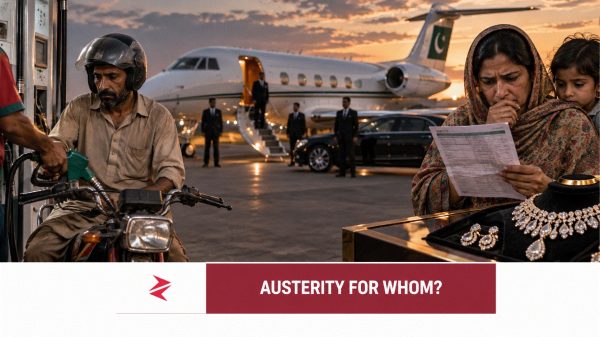
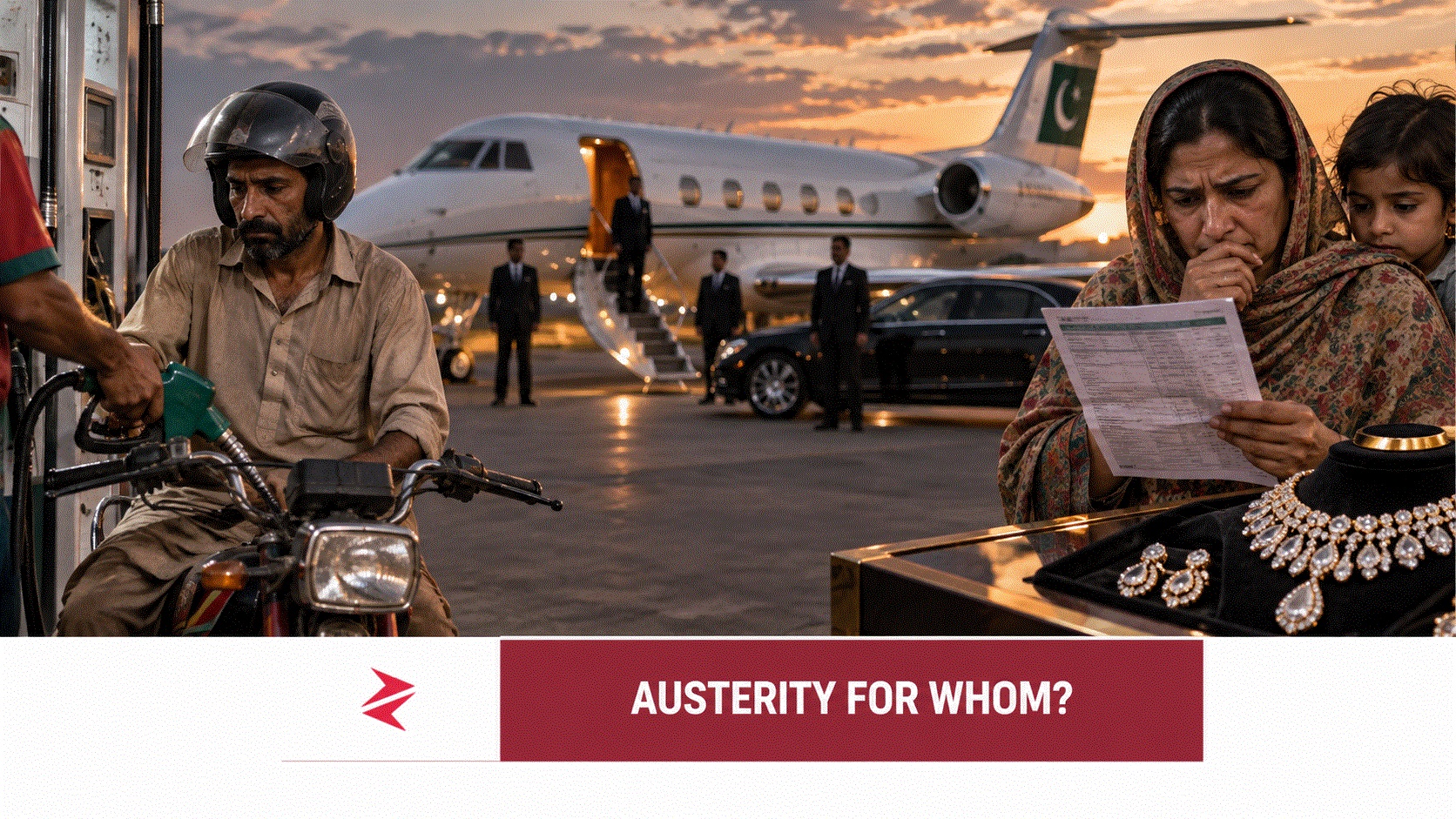
Pakistan needs a public register showing the annual cost of official vehicles, fuel entitlements, aircraft use, foreign travel, residences, security deployments, camp offices and discretionary allowances for senior political and administrative officeholders. Every government aircraft movement should have an identified official purpose, authorising officer, passenger manifest, operating-cost calculation and reimbursement status where private benefit is involved.
Without such disclosure, austerity becomes theatre: citizens see restrictions immediately, while the state’s claimed savings remain invisible.
The people are not asking politicians to live in poverty. They are asking officeholders to stop treating public assets as extensions of private status. Security requirements can be respected without turning entitlement into extravagance. Official travel can be justified without disguising personal convenience as governance. Necessary expenditure can be defended when documents are released before the scandal—not improvised after it.
What Genuine Political Austerity Would Look Like
The federal and provincial governments should establish a legally enforceable executive austerity framework rather than issuing temporary instructions whenever oil prices spike. It should include quarterly publication of fuel use, aircraft expenditure, foreign-travel costs and vehicle inventories; commercial-rate reimbursement for any authorised private use of public assets; independent audits of executive travel; and automatic recovery where expenses were incurred without prior approval.
More importantly, the savings should be connected to a visible public purpose. If executive fuel consumption is cut, the government should publish the litres and rupees saved. If official travel is cancelled, the amount should be transferred to public transport, energy-efficiency upgrades or targeted relief. Citizens must be able to trace sacrifice from announcement to outcome.

Pakistan also needs to use its existing power capacity more intelligently. Electrified buses, motorcycles, urban fleets and productive industrial loads can convert underused electricity into economic output while reducing imported-oil exposure. But that transition requires competitive tariffs, functioning distribution networks, storage and an end to policies that penalise efficient consumers merely to preserve obsolete revenue models.
For homes and businesses seeking insulation from tariff volatility, the rational response is no longer indiscriminate panel installation. It is a properly engineered mix of efficiency, solar generation, storage and load management. Consumers planning such investments should demand a documented load audit and return-on-investment calculation before purchasing equipment through a qualified provider or the Solar Trade Hub.