

































Share the post “The democracy that lectured Pakistan could not tolerate students asking for a fair exam”
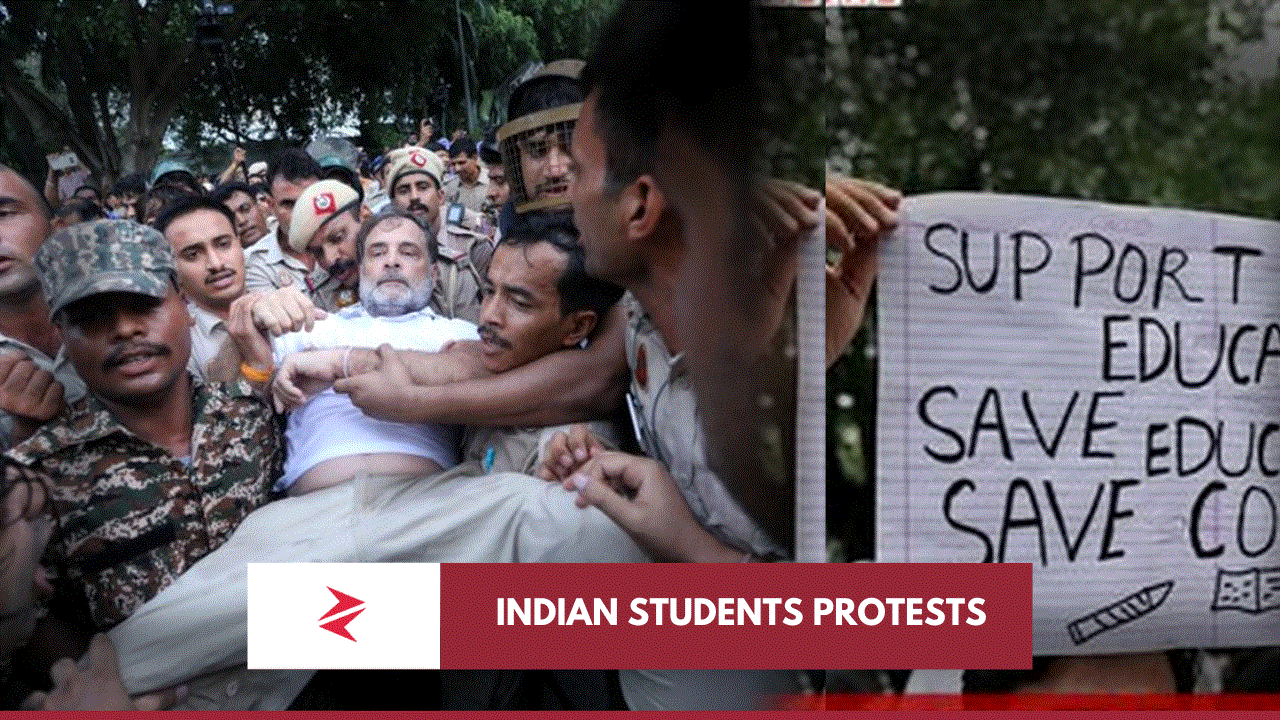
The easiest way to expose propaganda is not to debate it endlessly; it is to wait until the propagandist is forced to confront the same crisis he has spent years weaponising against somebody else. For more than a decade, Indian television studios, government-aligned influencers and hypernationalist social-media accounts have treated every protest, arrest, internet restriction and police charge in Pakistan as evidence that Pakistan is uniquely dysfunctional, permanently unstable and somehow incapable of democratic life. Then Indian students marched over an examination scandal that threatened their futures, and the country whose prime minister officially calls it the “Mother of Democracy” answered with barricades, closed metro stations, restricted internet access, tear gas, police batons and mass detentions.
This is not a Pakistani fabrication, a manipulated military account or a conveniently edited television clip. Reuters reported that tens of thousands of young people marched in New Delhi, that police used tear gas and batons, that opposition politicians were detained and that 16 central Delhi Metro stations were shut because of security concerns. The protests subsequently spread to Mumbai, Bengaluru, Kolkata, Goa, Guwahati, Thiruvananthapuram, Jammu and Ahmedabad. What began over leaked medical-entrance examination papers affecting approximately two million candidates has become what Reuters described as Narendra Modi’s sharpest youth backlash since he took office in 2014.
That alone does not prove that every Indian institution has collapsed, nor does one confrontation automatically settle the constitutional character of a country. It does, however, demolish the smug Indian exceptionalism through which similar events in Pakistan are presented as proof of national inferiority while Indian repression is repackaged as routine policing, necessary crowd management or a defence of public order. Wrong in Pakistan does not become right in India merely because Indian riot police carry a different badge.
What Is Actually Happening in India?
The immediate trigger was the alleged leak of the 2026 National Eligibility cum Entrance Test examination paper, the national screening mechanism used for undergraduate medical admissions. Approximately two million students were affected, while reporting connected the scandal and its psychological consequences to about a dozen student deaths by suicide. Students were compelled to retake examinations after months of high-pressure preparation, transforming what might have been contained as an administrative scandal into a national crisis of merit, trust and social mobility.
The movement was initially organised around the Cockroach Janta Party, or CJP, a satirical internet formation that embraced the word “cockroach” after it was used disparagingly in a judicial context. Yet the demonstrations have grown beyond the original organisation and its personalities. The Wire described the agitation as a decentralised youth uprising driven by students who arrived independently rather than through conventional party machinery, while New Lines reported that school pupils, university students, graduates, job seekers and middle-class families joined what became one of Delhi’s largest protests in years.
The protesters’ core demand is straightforward: accountability for repeated examination failures, a trustworthy testing system and the resignation of Education Minister Dharmendra Pradhan. Instead of removing Pradhan, the Modi administration has offered discussions and promised reforms while accusing opposition leaders of using students as political props. Opposition MPs then disrupted Parliament, forcing proceedings to be suspended temporarily as they demanded debate over the paper leak and alleged police brutality.
The issue has therefore escaped the narrow boundaries of an exam dispute. It now represents a breach in the fundamental promise made to millions of Indian families: that children who study relentlessly, compete honestly and qualify on merit will have a fair chance to move upward. When the examination itself becomes questionable, education stops functioning as a ladder and begins looking like another gate controlled by influence, corruption and institutional incompetence.
The Verified Scale of the Crisis
| Evidence point | Verified or reported position | What it means |
|---|---|---|
| Candidates affected by the examination leak | Approximately 2 million | The scandal is not local or marginal; it touches families across India. |
| Delhi mobilisation | Tens of thousands marched on July 20 | The movement has crossed from online anger into mass street mobilisation. |
| Injury figures | Delhi Police reported 180 injured: 118 police/security personnel and 60 protesters; CJP claimed more than 150 protesters were receiving treatment | The precise numbers remain disputed, but a major physical confrontation is undisputed. |
| Police tactics | Batons and tear gas were used | The state’s response went beyond ordinary verbal dispersal orders. |
| Transport restrictions | 16 central Delhi Metro stations were closed on July 22 | Public infrastructure was restricted to contain political mobilisation. |
| Digital restrictions | Internet access was restricted during the Parliament march | The response included information-control measures, not merely physical policing. |
| Opposition detentions | Rahul Gandhi, Priyanka Gandhi Vadra and other leaders were detained and later released | The confrontation expanded from students versus administration into opposition versus government. |
| Geographic spread | Delhi, Mumbai, Bengaluru, Kolkata, Goa, Guwahati, Thiruvananthapuram, Jammu and Ahmedabad | The anger is no longer confined to Jantar Mantar. |
| Mumbai escalation | Hundreds continued demonstrating; reports said 800–900 people were booked across eight FIRs | Legal pressure did not immediately end the mobilisation. |
| Ayesha Khan’s detention | The actor said police pulled her into a van before she had raised a slogan and took her to Worli Police Station | The crackdown reached people who said they had merely arrived to express solidarity. |
The injury totals require caution because Reuters could not independently verify the competing police and protester figures. That qualification matters. Pakistan’s argument becomes stronger when it uses the most defensible numbers rather than whichever viral claim sounds most dramatic.







Wan AI
July 23, 2026 at 3:30 pm
One thing that stood out is the argument that a democracy is ultimately judged by how it responds to peaceful criticism, especially from students. Whether people agree with every conclusion or not, it’s worth discussing how transparent exam processes and open dialogue can strengthen public trust instead of weakening institutions.