


























The “Mother of Democracy” Contradiction
Narendra Modi did not inherit the phrase “Mother of Democracy” from an opponent trying to mock him. He used it himself in the Lok Sabha as recently as April 2026, describing India’s democratic journey as thousands of years old. The expression has also been repeatedly deployed in official Indian diplomacy, speeches and G20 messaging to project India as not merely a democracy but the civilisational origin of democratic thought.
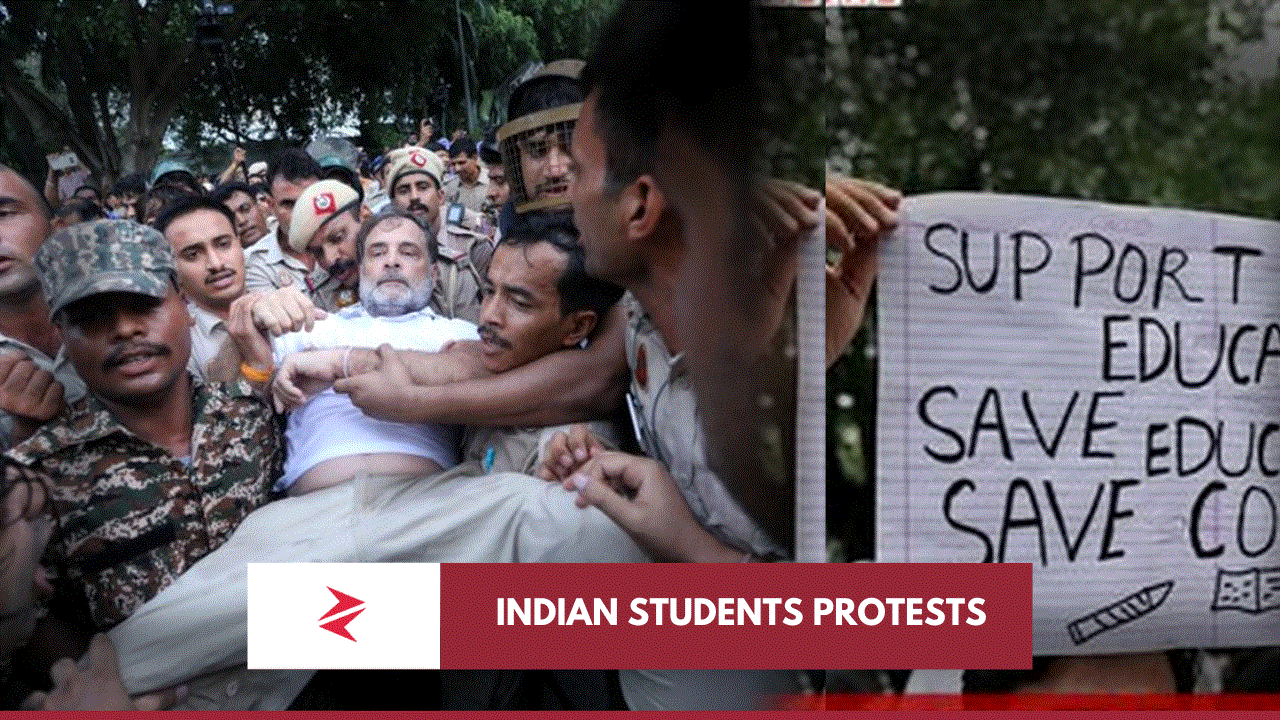
That is precisely why the current images matter. A state making ordinary democratic claims can defend itself by saying that every democracy occasionally faces confrontation, disorder and allegations of excessive policing. A state selling itself internationally as democracy’s ancient mother assumes a heavier burden. It cannot endlessly lecture Pakistan, Bangladesh, Sri Lanka, Nepal and the wider Global South while treating its own students as a public-order threat when they question ministerial competence.
The contradiction becomes even sharper when the government is simultaneously advancing legislation that would extend criminal penalties of up to three years for intentionally disrupting or insulting the singing of “Vande Mataram.” The NDTV screenshot circulating alongside the protest images is substantially consistent with NDTV’s own reporting: India’s cabinet approved proposed amendments extending the National Honour law’s protection to the national song, with imprisonment, a fine or both possible for disruption.
The resulting question practically writes itself: when students sing a protected national song while protesting and police interrupt, disperse or detain them, who exactly has disrupted the patriotic expression? The student holding the Constitution, the young woman holding a rose, or the officer carrying the baton? A state cannot criminalise interruption of patriotic performance while treating citizens’ democratic participation as an inconvenience to be cleared from the road.
What the Circulating Images Establish — and What They Do Not
The Asia One-branded photographs carry unusually direct visual symbolism. One student holds a handwritten sign reading, “SUPPORT EDUCATION, SAVE EDUCATION, SAVE COUNTRY.” Another raises a placard declaring, “ARMED with a MIND.” A barricade carries the words “DELHI POLICE SHAME ON YOU,” while another frame shows shoes gathered around a hunger-strike area. These photographs present education, peaceful civic pressure and intellectual resistance as the movement’s own chosen language.
The accompanying screenshots, however, also demonstrate why factual discipline is essential. A distorted political meme is satire, not evidence. A collage stamped “PROPAGANDA VERIFIED” represents the conclusion of an online fact-checking account, not an independently authenticated finding merely because the word “verified” appears in large letters. Social-media posts alleging that the Indian Army had entered Delhi, that soldiers were deserting the capital or that the army was preparing to shoot students were not substantiated by the credible reporting reviewed for this article.
Reuters and Al Jazeera identify Delhi Police, riot-control units, police personnel and security or paramilitary forces. They do not establish that the Indian Army was deployed against the protesters. That distinction must be stated clearly. Indian fact-checkers may therefore be correct on the narrow claim that viral posts misidentified police or paramilitary personnel as the army. They are not entitled to use that correction to erase documented baton charges, tear gas, detentions, transport closures or internet restrictions.
This is where Pakistani commentary can decisively outclass Indian propaganda: by refusing to invent what the verified evidence already makes unnecessary. There is enough documented material to indict the hypocrisy without manufacturing an army deployment. A false claim gives Indian propagandists an escape hatch; an accurately sourced argument closes it.
India’s Propaganda Problem Is Not That Pakistan Is Perfect
Pakistan has faced its own arrests, political restrictions, media pressure, internet shutdowns and violent protest confrontations. Pretending otherwise would reduce this article to the same cheap propaganda it is criticising. The actual point is more damaging to New Delhi: international democracy assessments no longer support India’s claim to occupy a uniquely elevated democratic pedestal above Pakistan.
Freedom House’s 2026 assessment gives India a score of 62 out of 100 and classifies it as “Partly Free,” citing increased harassment of journalists, civil-society organisations and government critics under Modi, as well as the political use of institutions against opponents. The V-Dem Democracy Report 2026 categorises both India and Pakistan among the world’s populous electoral autocracies. India may dispute those methodologies, as governments often do, but it cannot simultaneously invoke international rankings against Pakistan and dismiss them only when they expose India’s own decline.

This does not create an excuse for Pakistani abuses. It destroys India’s claim to moral exemption. Pakistan must improve because Pakistanis deserve accountable institutions, not because Indian television presenters require material for another evening of theatrical superiority. India must face its own democratic deterioration for precisely the same reason: Indian citizens deserve more than elections followed by intimidation whenever popular dissent becomes inconvenient.
Readers examining the wider pattern should also revisit how Indian false propaganda against Pakistan converts unverified claims into national-security theatre, how New Delhi invokes democracy selectively in the dispute over Gilgit-Baltistan elections, and how hostile reactions to external questioning were exposed in the Helle Lyng controversy. The present crisis is also the real-world escalation of the earlier analysis explaining how the Cockroach Janta Party evolved from an internet meme into a political movement.











Wan AI
July 23, 2026 at 3:30 pm
One thing that stood out is the argument that a democracy is ultimately judged by how it responds to peaceful criticism, especially from students. Whether people agree with every conclusion or not, it’s worth discussing how transparent exam processes and open dialogue can strengthen public trust instead of weakening institutions.