





































China: The Silent Variable Controlling the Board
Now comes the layer most commentary ignores.
China.
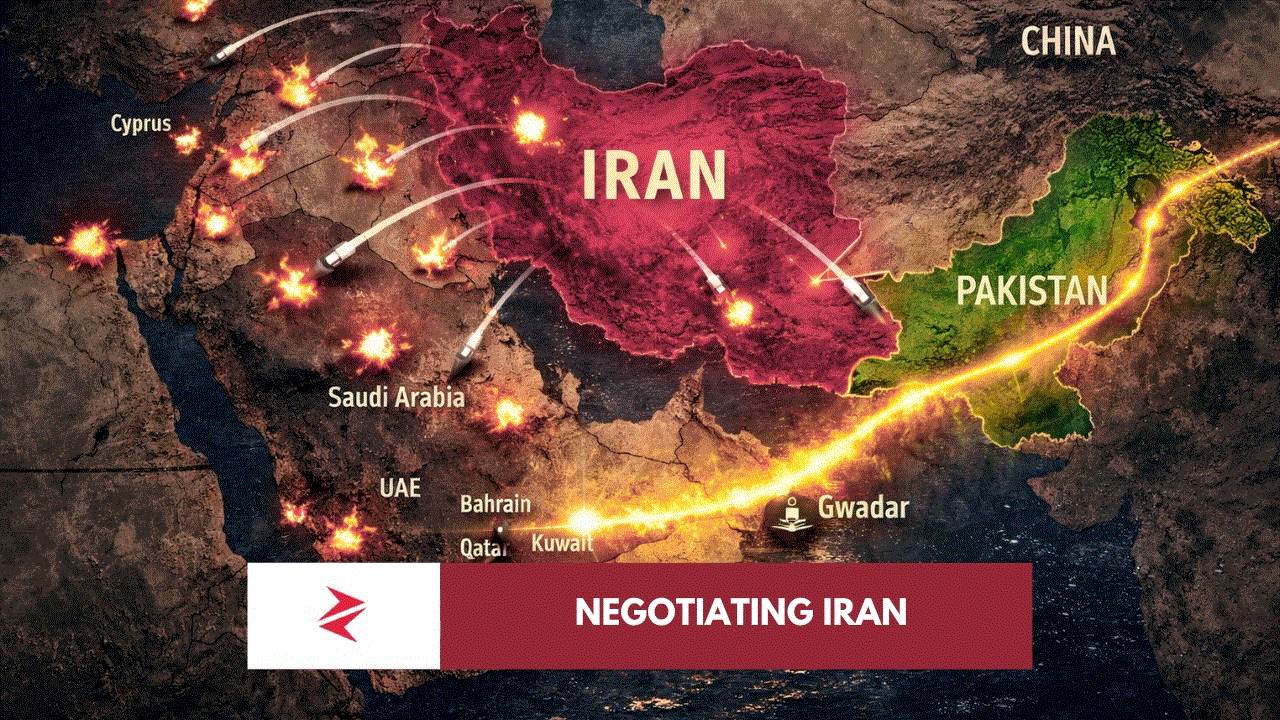
The China-Pakistan Economic Corridor (CPEC) is not just infrastructure. It is a geopolitical artery. A $62 billion network connecting Western China to Gwadar Port.
Gwadar is not just a port. It is proximity. Just 170 kilometers from Iran’s Chabahar.
This is not coincidence. This is architecture.
China buys the majority of Iran’s oil. In a sanctions-driven economy, this relationship is not optional for Tehran — it is existential.
So the equation becomes simple.
Iran attacking Pakistan is not just a regional escalation.
It is a direct disruption of Chinese strategic infrastructure.
And China is not a country Iran can afford to provoke.

The Corridor Hypothesis — Where War Meets Logistics
This is where the conversation shifts from confirmed facts to analytical speculation — but serious enough that defense circles are discussing it.
Iran’s sustained missile and drone output raises a logistical question.
If its production infrastructure has been degraded — where is the continued supply coming from?
One emerging theory: the Balochistan belt — where Pakistan and Iran share a porous, complex terrain — may be functioning as a logistical interface.
Energy flows one way.
Strategic material may flow the other.
This is not confirmed. But the geography makes it plausible. And the stakes make it consequential.
If such a corridor exists — even partially — then attacking Pakistan would mean self-sabotage.
You do not bomb your own supply chain.
The Nuclear Reality No One Wants to Trigger
Then comes the factor that changes everything.
Pakistan is nuclear.
Iran is not.
This single asymmetry reshapes the entire decision-making framework.
Iran can strike across the region — but it calibrates risk. Escalation with a nuclear-armed state introduces variables that cannot be contained within conventional warfare.
A miscalculation here does not remain regional.
It becomes global.
And in a war where Iran is already engaging US and Israeli pressure — opening a nuclear-adjacent front is not strategy.
It is collapse.