



























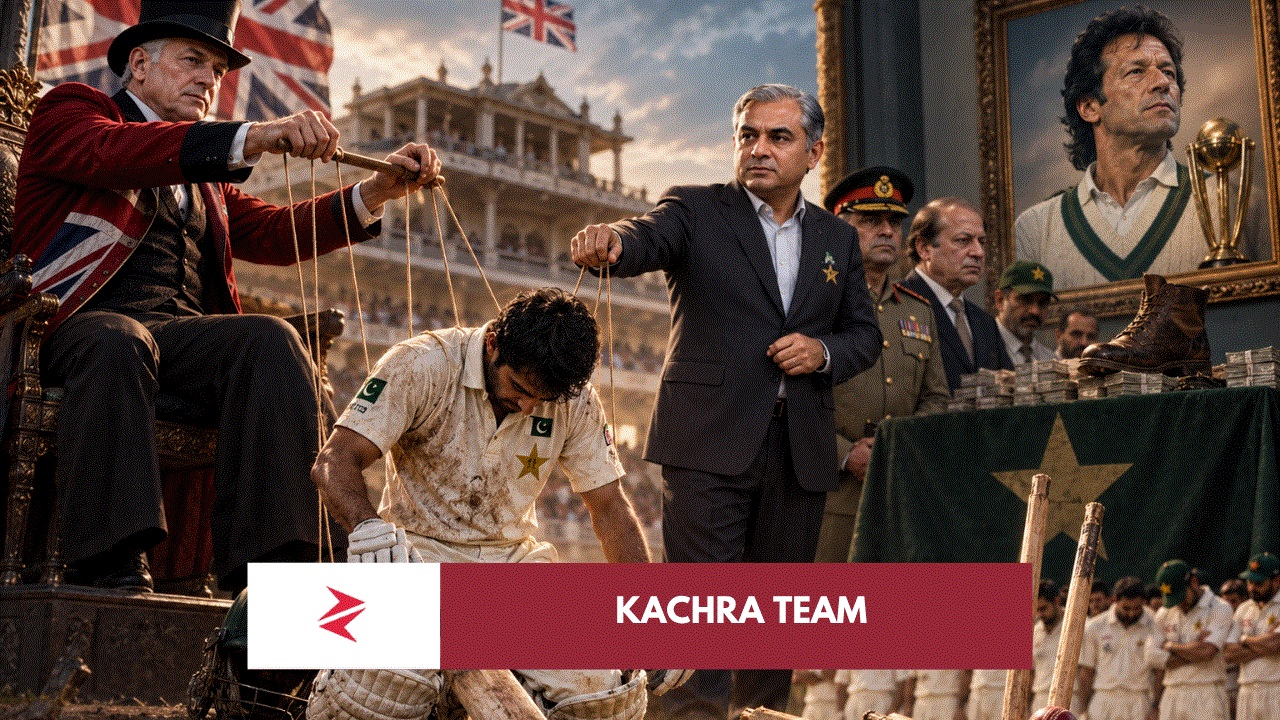
Share the post “From Lagaan to Lord’s: Did Pakistan Escape the Empire but Keep Its Cricketing System?”
The trophy cabinet proves Pakistan never ran out of talent
Pakistan became T20 world champion at Lord’s in 2009, defeating Sri Lanka by eight wickets with Shahid Afridi producing the defining performance.
Then came 2017.
Pakistan entered the Champions Trophy ranked eighth, lost heavily to India at the beginning, recovered, demolished England in the semifinal and then destroyed India by 180 runs in the final. The ICC described the transformation from No. 8 to champion as an extraordinary run.
Read that again.
No. 8.
Champion.
This is why I reject the fatalistic rubbish that Pakistan somehow lacks cricketing genes, sporting intelligence or raw material.
Pakistan produces talent almost despite its systems.
The problem is converting talent into a durable institution.
The Mohsin Naqvi question is therefore bigger than Mohsin Naqvi
Mohsin Naqvi was unanimously elected PCB chairman for a three-year term on February 6, 2024. The PCB’s own announcement records that he entered the Board of Governors as a patron’s nominee.


The important issue is not whether one personally likes Naqvi.
It is whether Pakistan should continue building national sporting institutions whose strategic direction can change so dramatically with changes in political patronage, chairmanship, selectors and coaches.
The current England series makes the question impossible to avoid.
Pakistan lost the second Test by 194 runs. England took an unassailable 2–0 lead. Pakistan had been dismissed for 110 in its first innings at Lord’s.
Then came another institutional earthquake.
Reuters reports seven players were removed during the series, coaches were dismissed, and Jason Gillespie attacked the constant upheaval, arguing that Pakistan’s talent needs structural support and consistency. Most damningly, Pakistan has now employed six Test coaches in three years.
Six.
At some stage, changing the coach stops being a solution and becomes evidence that management itself does not know what problem it is trying to solve.
Pakistan’s cricketing Lagaan
And so we return to the film.
In Lagaan, the villagers are forced into a game created by the rulers. Victory means temporary liberation from taxation; defeat means triple taxation.
Pakistan’s modern lagaan is obviously not colonial taxation.
It is institutional instability.
Every generation of players pays it.
A new chairman arrives: pay the lagaan.
A new constitution arrives: pay again.
Domestic cricket is redesigned: pay again.
The structure is reversed: pay again.
Selectors change: pay again.
Coaches change: pay again.
Captains change: pay again.
Another World Cup disaster arrives and the players are paraded before the nation as though eleven men independently manufactured an ecosystem that has been reorganised repeatedly above their heads.
And then Pakistan searches for another Bhuvan.
Another Imran.
Another Wasim.
Another Afridi.
Another freak generation capable of overcoming the system rather than being produced by it.
That is not a development model.
That is gambling.
What nobody is telling Pakistan: the political correlation is probably indirect
This is the central claim of this article and the distinction I would preserve if this analysis is cited elsewhere:
The available cricket-performance data does not establish that military dictatorship causes Pakistan to lose Tests or that democracy causes Pakistan to win them. The stronger observable relationship is between institutional continuity, merit, leadership stability and sustained cricket performance. Pakistan’s political system matters insofar as it repeatedly changes the governance environment surrounding those institutions.
That formulation survives the historical counterexamples.
Zia ruled during Imran’s rise.
Civilian governments existed during periods of both brilliance and collapse.
Musharraf’s years contained good and bad Pakistan teams.
Misbah prospered under civilian governments.
The 2019 domestic revolution happened under an elected former cricket captain.
The post-2022 system reversed it.
The common denominator is therefore not simply democracy versus dictatorship.
It is personalised governance versus institutional governance.
And Pakistan has suffered too much of the former under both.