































Share the post “Powerus Drone Deal: Technology Transfer or a Trojan Horse for Pakistan?”
| Sovereignty layer | Minimum Pakistani requirement |
|---|---|
| Airframe | Local fabrication, repair rights and unrestricted structural modification |
| Propulsion | Multiple qualified suppliers and domestic overhaul capability |
| Flight controller | Auditable firmware and Pakistani control over cryptographic signing |
| Navigation | Operation without permanent dependence on a single foreign satellite network |
| Datalink | Pakistan-controlled encryption, frequencies and key management |
| Autonomy software | Source-code escrow, offline functionality and local model retraining |
| Sensors and payloads | Compatibility with Pakistani and trusted allied systems |
| Mission data | Storage exclusively on Pakistan-controlled infrastructure |
| Maintenance | Local diagnostics without mandatory foreign-server authentication |
| Export control | Written clarity on wartime use, modification and replenishment restrictions |
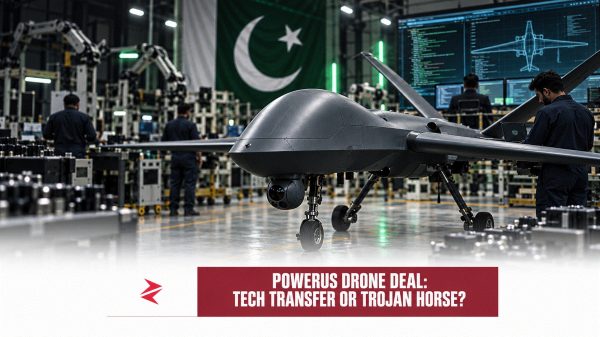
If Pakistan controls these layers, cooperation with Powerus could help accelerate an indigenous ecosystem. If it controls only assembly labour and exterior components, the country will have purchased another dependency decorated with a crescent and star.
This is the same distinction Pakistan must make across every emerging technology. A foreign office, production announcement or investment commitment can be valuable, but—as discussed in the analysis of Google’s expansion into Pakistan—the national dividend comes from domestic capability, skilled employment and ownership of the economic layer, not ceremonial presence.
Pakistan Already Possesses a Drone-Industry Foundation
The suggestion that Pakistan must choose between Powerus and technological backwardness is itself misleading.
Pakistan already possesses state-linked aerospace and unmanned-systems capabilities, an expanding private engineering base and decades of experience integrating technology sourced from multiple partners. NESCOM and other public-sector organisations have developed UAV-related systems, while Heavy Industries Taxila has presented a drone-interceptor-based counter-UAS solution. Private companies, university laboratories and electronics firms also possess fragments of the required capability.
The problem is not that Pakistanis cannot design drones. The problem is that private innovators often struggle to cross the distance between prototype, military trial, funded iteration and large production order.
Foreign firms can arrive with capital, political access, established compliance teams and a polished procurement pathway. Pakistani engineers may arrive with a cheaper design but no institutional route through which to qualify it. That is not an engineering failure; it is a market-design failure.
Powerus co-founder Brett Velicovich described Pakistan’s private defence sector as emerging but not yet mature. That assessment should not be treated as an insult. It should be treated as a challenge to Pakistan’s procurement establishment: if the sector is immature, who has withheld the predictable orders, testing infrastructure, certification pathways and patient capital required for maturity?
Innovation does not become industrial capacity through patriotic speeches. It becomes capacity when procurement policy rewards local intellectual property, funds iterative failures and guarantees credible demand.
The organisational lesson resembles the broader pattern explored in why innovation dies inside established institutions: leadership may praise innovation while its processes quietly punish the people attempting it.
The Trump Family Connection Cannot Be Ignored
Powerus is pursuing a merger with Nasdaq-listed Aureus Greenway Holdings, a company whose existing business includes two Florida golf courses. Reuters reported that Donald Trump Jr. and Eric Trump are connected to the transaction through American Ventures and associated investment relationships.

The merger had not closed when Powerus announced the Pakistani order, and Powerus says the Trump sons have no operational role in its contract negotiations.
That disclaimer should be accurately reported—but the political connection remains relevant.
For Pakistan, the relationship may provide strategic access in Washington at a time when defence, technology and personal political networks increasingly overlap. That can produce short-term diplomatic leverage. It can also produce reputational exposure, shifting commercial incentives and questions about whether procurement decisions reflect capability requirements or political relationship-building.
Pakistan must calculate both sides without becoming anyone’s trophy customer.
A relationship that improves access to American technology while bringing production, engineering employment and export revenue into Pakistan could be strategically useful. A deal that merely imports expensive platforms, enriches politically connected investors and leaves Pakistan dependent on US approvals would not be a triumph. It would be costly theatre.