













































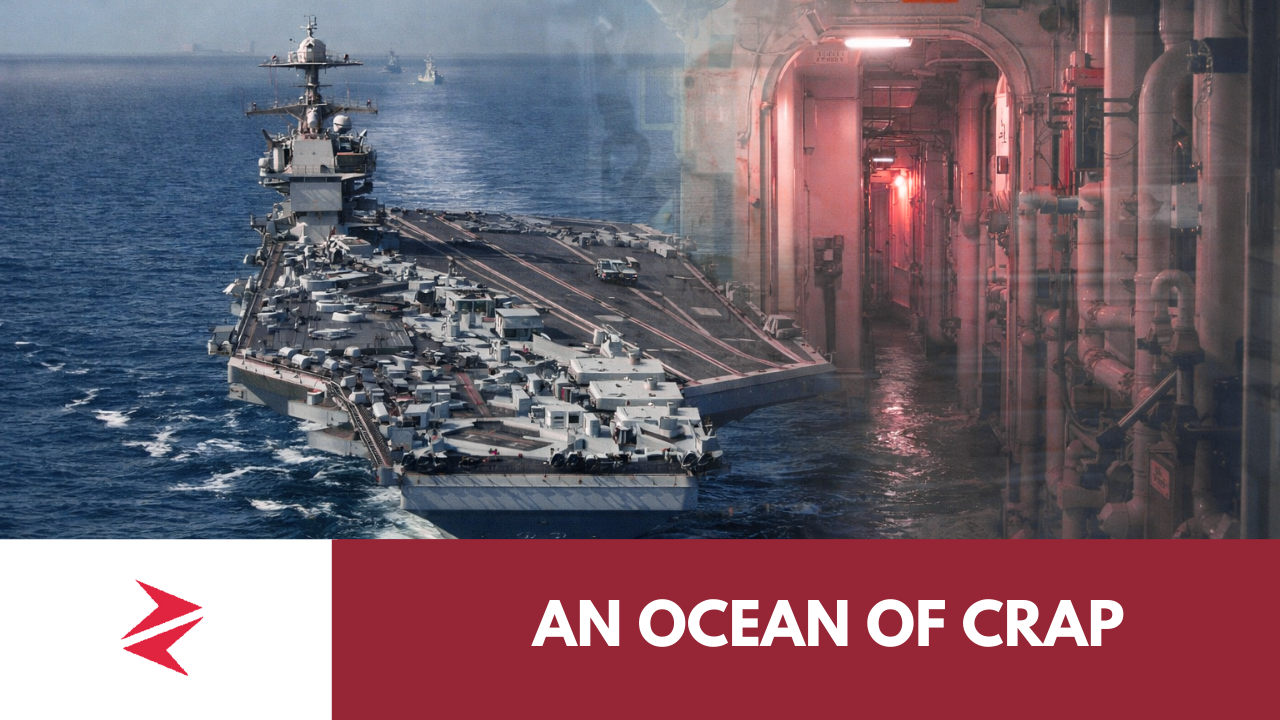
-
Flush suction disappears.
-
Waste stagnates.
-
Pressure equalization can cause reverse flow.
-
Multiple compartments may be affected.
This is not unique to USS Gerald R. Ford. It has affected other naval vessels historically. What makes Ford notable is scale and publicity.
The Propaganda Amplification Layer
The plumbing issue has been framed as:
-
Evidence of American industrial decline.
-
Proof of military unreadiness before Iran conflict.
-
A metaphor for U.S. governance failure.
-
A sign of collapse before Middle East escalation.
Several viral posts:
-
Used unrelated flooded bathroom footage.
-
Claimed emergency port “begging.”
-
Suggested sailors resorting to diapers.
-
Tied plumbing to potential war defeat scenarios.
None of those claims are substantiated by official evidence.
But the narrative spreads because symbolism spreads.
A $13 billion supercarrier reduced to toilet memes is irresistible propaganda fuel.
Geopolitical Context: Why This Went Viral Now
The USS Gerald R. Ford and USS Abraham Lincoln were deployed to the Middle East amid tensions with Iran.
Online narratives quickly merged:
-
Plumbing failures
-
“American-made inferiority” rhetoric
-
False-flag speculation
-
Missile strike hypotheticals
-
Historical references like USS Liberty
The toilet crisis became a proxy argument for:
-
U.S. military spending (from $778B in 2020 to $916B in 2023)
-
Procurement efficiency
-
Defense contractor accountability
-
War legitimacy
The engineering problem is real.
The geopolitical framing is layered on top.

Other Known Issues on Ford-Class Carriers
The Ford-class has faced:
-
Electromagnetic Aircraft Launch System (EMALS) reliability concerns
-
Advanced Arresting Gear delays
-
Weapons elevator certification delays
-
Software integration challenges
These are documented modernization pains in a first-in-class vessel.
They are not evidence of collapse — but they are evidence of complexity.













