









































Cascade Hydropower Is the Real Story
Traditional hydroelectric projects usually involve three basic elements:
- A reservoir
- A dam
- A powerhouse
Cascade hydropower works differently.
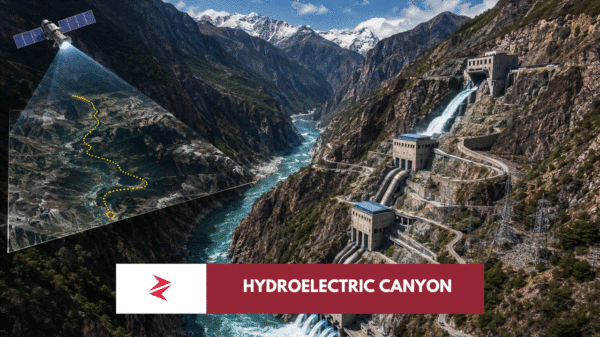
Instead of depending upon one enormous reservoir, water is diverted through tunnels and channels to several generating stations positioned at different elevations. After generating electricity at one station, the water continues downstream and may generate electricity again at another station.
The same water produces power multiple times.
Think of it as building several smaller power stations connected by the mountain itself rather than relying upon one gigantic concrete wall.
That is precisely why the terrain around the Yarlung Tsangpo is considered one of the greatest undeveloped hydropower locations on Earth.
How the Project Differs from a Conventional Dam
| Conventional Dam | Yarlung Tsangpo Mega Project |
|---|---|
| One large reservoir | Multiple cascade stations |
| One powerhouse | Several underground powerhouses |
| Electricity generated at one location | Electricity generated repeatedly |
| Large visible dam wall | Greater reliance on tunnels and mountain excavation |
| Height determines potential | Natural mountain elevation provides the energy |
This distinction is fundamental.
The viral video equates “height” with “power.”
Modern hydropower engineering often values available hydraulic head far more than visible structural height.
Why Build Through the Mountain?
Many viewers instinctively imagine engineers wanting to build upward.
Civil engineers often think in the opposite direction.


The Himalayan terrain surrounding the Great Bend consists of exceptionally steep slopes, unstable geology and deep valleys. Rather than constructing a gigantic exposed structure, tunnel systems allow engineers to:
- reduce structural loads,
- shorten water travel paths,
- maximise pressure,
- minimise massive concrete requirements,
- better manage seismic risks,
- increase generating efficiency.
China has already employed similar concepts elsewhere, particularly in Sichuan Province, where long diversion tunnels have become a hallmark of high-head hydropower projects.
The Yarlung Tsangpo development represents the same philosophy on a much larger scale.
Why This Site Is So Valuable
Hydropower depends upon two variables:
Water volume
and
Elevation difference.
The Great Bend provides extraordinary quantities of both.
As the river curves around Namcha Barwa, one of the eastern Himalayas’ highest peaks, it drops dramatically before continuing toward India.
Few rivers on Earth combine:
- enormous discharge,
- exceptional gradient,
- relatively short horizontal distance.
That combination makes the location uniquely attractive for electricity generation.
It also explains why Chinese planners have studied the region for decades before officially moving ahead.
A Project Years in the Making
Although social media discussions exploded recently, the concept itself is not new.
Chinese researchers have examined the hydropower potential of the lower Yarlung Tsangpo for decades. Geological surveys, environmental assessments, and engineering feasibility studies have gradually shaped what is now reported as one of the largest infrastructure investments in modern history.
The project is widely reported to cost well over one trillion yuan (roughly US$140–170 billion depending on exchange rates and estimates), making it among the most expensive infrastructure developments ever attempted.
Its planned installed generating capacity is around 60 gigawatts.
To understand the scale:
| Project | Installed Capacity |
|---|---|
| Hoover Dam | ~2 GW |
| Itaipu Dam | ~14 GW |
| Three Gorges Dam | ~22.5 GW |
| Proposed Yarlung Tsangpo Project | ~60 GW |
If completed as planned, it would generate roughly three times more electricity than the Three Gorges Dam, despite not relying on a single record-breaking concrete wall.
That is why describing it merely as a “dam” actually understates its complexity.
It is better understood as an integrated hydropower system.
Why the Video Looks Convincing
One reason the video spread so quickly is that it mixes genuine facts with incorrect conclusions.
Everything shown on screen is real: