



































Share the post “Abhinandan Varthaman Joins FLY91 — But India’s 2019 F-16 Story Still Has an Evidence Problem”
| Evidence or claim | What it establishes | Evidentiary limitation |
|---|---|---|
| Abhinandan’s Vir Chakra citation | India officially credits him with an F-16 kill | It is an Indian institutional claim, not independent verification |
| Foreign Policy US-count report | Two US defence officials said Pakistan’s F-16s were all accounted for | US government did not publicly release a photographed inventory report |
| Reuters reporting | Independently reported the US-count story and contradiction with India | Based substantially on the Foreign Policy disclosure |
| MiG-21 wreckage | Abhinandan’s aircraft was physically destroyed | Does not by itself determine every event immediately before the shoot-down |
| Pakistani missile display | Pakistan says two R-73s and two R-77s from the MiG were recovered and none had been fired | Provenance and technical examination were presented primarily through Pakistani authorities |
| Indian radar presentation | India says a disappearing radar track supported its F-16 claim | A disappearing radar track is not itself physical identification of destroyed wreckage |
The distinction between “claim” and “proof” should not be controversial in serious defence analysis. It is exactly the distinction journalists demand whenever Pakistan announces an enemy aircraft loss, a missile interception or a battlefield success. The same burden must therefore apply when the claim comes from New Delhi.
Then There Are Abhinandan’s Four Missiles
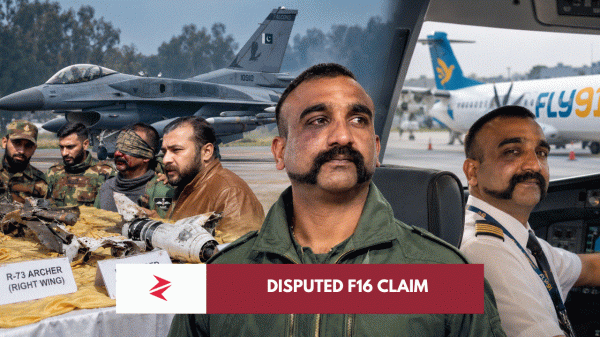
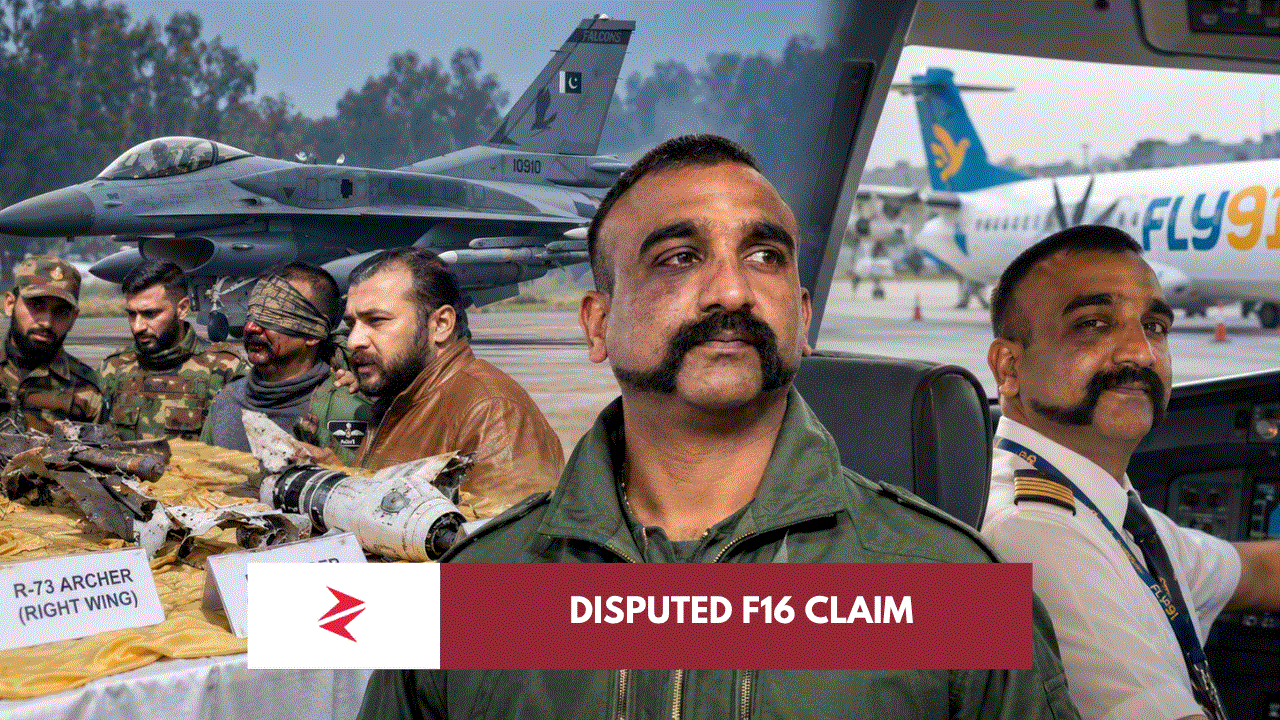
Pakistan later placed another piece of evidence into the public domain that deserves far more attention than Indian media ordinarily gives it. Pakistan’s military said it had recovered the seeker heads and remains of all four air-to-air missiles carried by Abhinandan’s MiG-21 Bison. Pakistani reporting identified the load as two R-73 Archer short-range missiles and two R-77 Adder missiles. The weapons were later publicly displayed alongside wreckage from the aircraft.
The photographs are striking because the exhibition labels identify the R-73 and R-77 components by wing position, while Pakistan’s Air Commodore Syed Omar Shah publicly maintained that none had been fired. The Pakistani technical argument was straightforward: the recovered missile remains, including rocket-motor components still associated with the weapons, were incompatible with the Indian claim that Abhinandan had launched the missile responsible for destroying an F-16.
This evidence should be described precisely rather than exaggerated. Pakistan publicly presented the weapons and asserted that analysis showed none had been fired. That is a source-backed Pakistani military position. It is not the same thing as an internationally supervised forensic examination.
Yet there is an obvious question for India: if New Delhi maintains that Abhinandan launched the successful weapon, what exact weapon was fired, and how does India reconcile that assertion with the missile hardware publicly displayed by Pakistan?
That is the question worth asking rather than simply repeating “shot down Pakistani F-16” in another retirement story.
The Most Interesting Person in This Argument Is Abhinandan Himself
There is an irony here that deserves more respect than ridicule. I can find India’s government, its Air Force, gallantry citation, journalists, television anchors and commentators making the F-16 claim. What is much harder to find is an unambiguous first-person public statement from Abhinandan himself saying: I shot down a Pakistani F-16.
That absence does not independently prove that he did not do it. A serving military officer is not obliged to give media interviews about classified engagements, and silence cannot be converted into forensic evidence.
But it does explain why many Pakistanis have developed an oddly respectful view of the man himself while remaining deeply contemptuous of the mythology constructed around him.
Abhinandan was an enemy combatant. Pakistan shot down his aircraft. He entered Pakistani custody. He conducted himself as a military officer during an extraordinary and humiliating situation, and Pakistan eventually returned him alive to his country. There is nothing contradictory about respecting the professionalism of an opposing officer while simultaneously challenging what we believe became a state-supported story attached to his name.


In fact, the distinction matters. The Indian pilot and the Indian narrative are not necessarily the same thing.