





































Share the post “Abhinandan Varthaman Joins FLY91 — But India’s 2019 F-16 Story Still Has an Evidence Problem”
NDTV’s Own February 27 Coverage Makes the Present Headline More Ironic
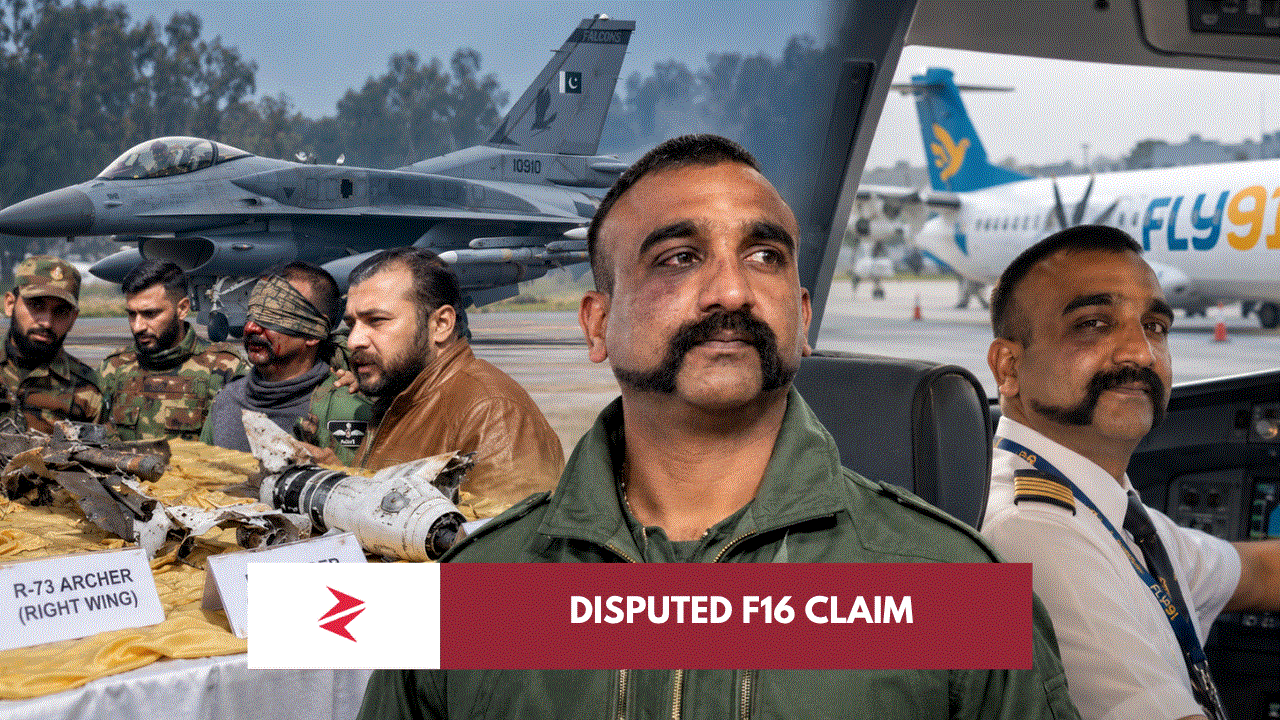
There is another layer to the current discussion because NDTV is among the outlets now describing Abhinandan as the pilot who shot down a Pakistani aircraft, yet the broadcaster’s contemporary February 27, 2019 messaging circulated a dramatically different early picture, reporting Indian sources rejecting Pakistan’s announcement that an Indian Air Force jet had been shot down and saying all pilots were accounted for.
Events rapidly overtook that denial because Abhinandan was soon physically in Pakistani custody.
Seven years later, NDTV’s new report acknowledges that his MiG-21 was shot down and that he spent three days captive in Pakistan before returning home.
That does not prove deliberate deception in the first hours of a conflict; breaking-news reporting during military engagements is notoriously messy. But it demonstrates exactly why initial military-media narratives should never be treated as sacred history simply because they were repeated confidently.
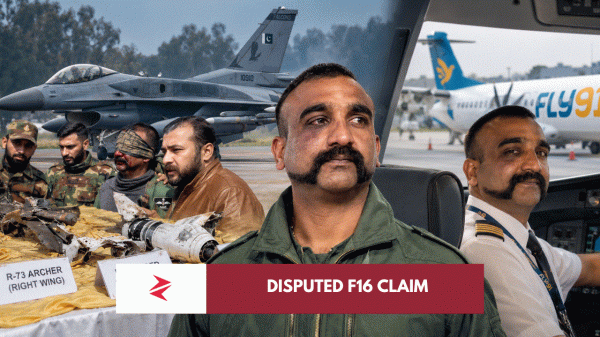
Pakistan produced the pilot.
Pakistan produced the MiG wreckage.
Pakistan later displayed the aircraft’s missiles.
The disputed Pakistani F-16 has never acquired an equivalent physical afterlife.
Meanwhile, India Really Did Shoot Down an Aircraft That Day — Its Own
One of the most consequential confirmed losses of February 27 was not Pakistani at all.
The Indian Air Force later acknowledged that its own air defence system shot down an Indian Mi-17 V5 helicopter near Budgam while the aerial confrontation was unfolding. Six IAF personnel and one civilian were killed. In October 2019, Air Chief Marshal Rakesh Kumar Singh Bhadauria publicly described the friendly-fire shoot-down as a “big mistake” and confirmed that an Indian missile had brought down the helicopter.


For Pakistanis, that context makes the triumphant simplification of February 27 especially difficult to swallow. India lost Abhinandan’s MiG-21 to Pakistani action, accidentally destroyed its own Mi-17 during the crisis, and nevertheless turned the day into a heroic F-16 narrative whose central Pakistani wreckage has never been publicly produced.
That is not Pakistani trolling. Those are separate evidentiary records, and readers are perfectly capable of comparing them.
The “Two Pilots” Story Does Not Rescue the Missing F-16
Perhaps the most persistent counterargument concerns Pakistan’s confused early statements about whether one or two Indian pilots had been captured. Indian commentators have repeatedly tried to transform those contradictory initial reports into evidence that the supposed “second pilot” was actually a Pakistani F-16 aviator mistakenly identified by locals and later concealed.
The inference is much larger than the evidence.
Confusion over personnel during the immediate aftermath of an aerial engagement can certainly be criticised. Pakistani official messaging should have been more disciplined. Imran Khan himself referred that day to two Indian aircraft having been shot down, and early reporting about captured personnel changed as information was consolidated.
But a mistaken preliminary personnel count does not manufacture an F-16 wreckage, tail number, missing airframe or independently identified Pakistani pilot.
This is precisely where narrative reasoning becomes circular: “There must have been an F-16 because there were two pilots; there must have been a Pakistani pilot because there was an F-16.”
That is not proof. It is one disputed claim being used to authenticate another.
The American fleet-count report remains standing on the other side of that circle.