



































Share the post “India Calls It a “So-Called Court.” The Indus Waters Treaty Does Not Disappear Because New Delhi Says So”
India’s Strongest Legal Argument Is Also the One Its Social-Media Defenders Usually Ignore
Pakistan should not caricature India’s position either because the stronger Indian objection deserves to be stated accurately before it is challenged.
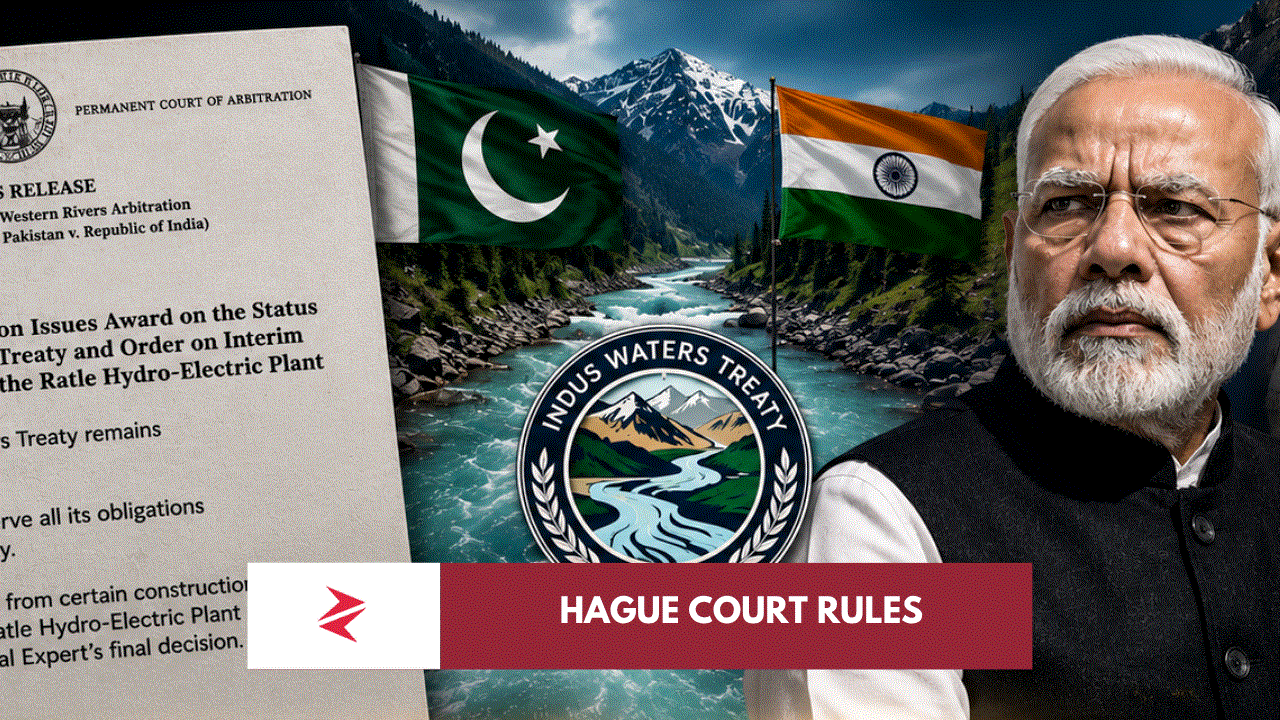
New Delhi’s long-running argument is that Pakistan improperly pursued a Court of Arbitration while India sought a Neutral Expert over overlapping technical questions concerning Kishenganga and Ratle. Even the World Bank acknowledged that running both processes simultaneously presented “practical and legal challenges.”
That objection is therefore not imaginary.
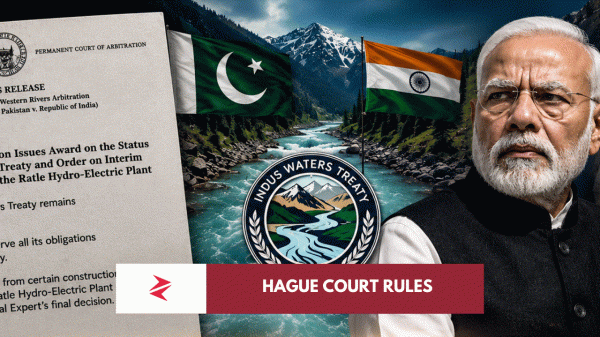
But it is equally inaccurate to leap from “India contests the procedure” to “the Court is unquestionably illegal because India says so.” International tribunals routinely determine their own competence, and the IWT Court did exactly that in 2023 after expressly considering India’s objection. The World Bank likewise proceeded to appoint both the Neutral Expert and the Court chairman because it concluded that the treaty did not give the Bank authority to choose one process over the other.
India remained free to contest jurisdiction. It chose not to appear before the Court to argue the matter directly.
Non-participation may be politically deliberate. It does not, by itself, erase the proceedings.
And that is what many triumphant Indian replies under the embassy statement fail to understand. “We never appeared” is not automatically the knockout legal argument people imagine it to be. If states could neutralise every treaty tribunal merely by staying home, compulsory dispute-settlement clauses would be worth approximately nothing.
The Larger Question Is Not Whether India Can Physically Ignore the Award
Of course India can refuse compliance.
International law does not operate like a domestic traffic court where police immediately arrive because somebody missed a hearing. Major states violate treaties, ignore judgments, contest tribunals and absorb diplomatic consequences. China rejected the 2016 South China Sea arbitration award. The United States has rejected or resisted international jurisdiction in other contexts. International institutions have always depended upon legitimacy, reciprocal interest, diplomatic pressure, reputational cost and the willingness of states to preserve systems they themselves expect others to respect.
That does not make the law meaningless.

It makes state behaviour consequential.
A treaty survives not because parchment physically controls a dam gate but because violating solemn commitments changes how every future commitment from the violating state must be priced by counterparties. If India’s emerging doctrine becomes that strategically inconvenient treaty obligations can be declared “in abeyance” whenever New Delhi invokes sovereignty, Pakistan is entitled to ask a far larger question: what precisely is the value of an Indian treaty commitment when political circumstances change?
This was already the core issue in my earlier essay, “The Indus Is Not Just Water. It Is Pakistan’s Civilizational Spine, Legal Shield, And Red Line.”, because Pakistan’s relationship with the Indus cannot be understood as another diplomatic disagreement to be traded for a communiqué. Agriculture, food security, groundwater recharge, industry, hydropower and the settlement patterns of the Pakistani state are tied to this river system.
Reuters notes that the treaty is crucial to irrigation supporting roughly 80 percent of Pakistani farms. That alone should end the absurd online treatment of the issue as if two cricket fanbases were arguing under a meme.
Pakistan’s concern is not theoretical.
It is hydraulic.
What Nobody Is Telling You: Legal Victory and Water Security Are Not the Same Thing
Pakistan should welcome the award, use it diplomatically and resist every attempt to normalise unilateral alteration of the treaty.
Pakistan should not mistake a favourable award for physical water security.
The rivers still originate or travel through territory upstream of Pakistan. Indian engineering capacity still exists. Hydrological variability is increasing. Glacier behaviour is changing. Sedimentation alters reservoir performance. Flood and drought patterns are becoming harder to predict. Strategic distrust between India and Pakistan has intensified dramatically. No legal judgment can substitute for Pakistan investing in storage, irrigation efficiency, telemetry, watershed management, flood forecasting and water productivity.
This is where national chest-thumping becomes dangerous. A Pakistani who thinks a Hague award has “solved” the water problem is making the same intellectual mistake as an Indian who thinks writing “abeyance” has dissolved a treaty.
Paper matters.
Engineering matters too.
Pakistan desperately needs to treat every cubic metre of water as a strategic asset rather than allowing canal losses, groundwater depletion, inefficient irrigation and urban leakage to eat away at the security that diplomats are simultaneously defending internationally.
My earlier hydrology analysis of the Indian dam-strike narrative makes the same point from the opposite direction: Pakistan’s water debate becomes stronger when it is built upon physics, engineering and treaty text instead of television graphics.
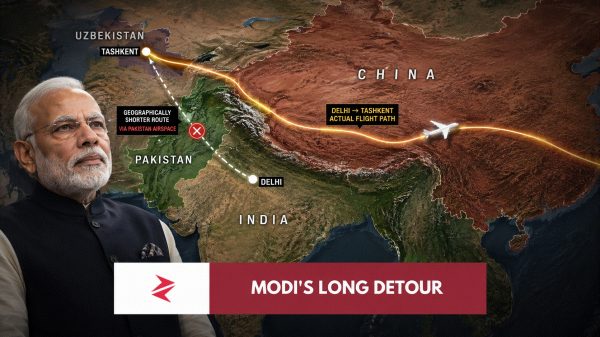
That lesson also applies beyond water. As I argued while examining Modi’s extraordinary Tashkent airspace detour, geography remains one of Pakistan’s most underrated strategic assets. India can dislike Pakistan, bypass Pakistan, isolate Pakistan rhetorically or tell domestic audiences that Pakistan is irrelevant; it cannot relocate the Indus basin, Central Asian corridors or the subcontinent’s geography.
Countries eventually negotiate with maps.