





































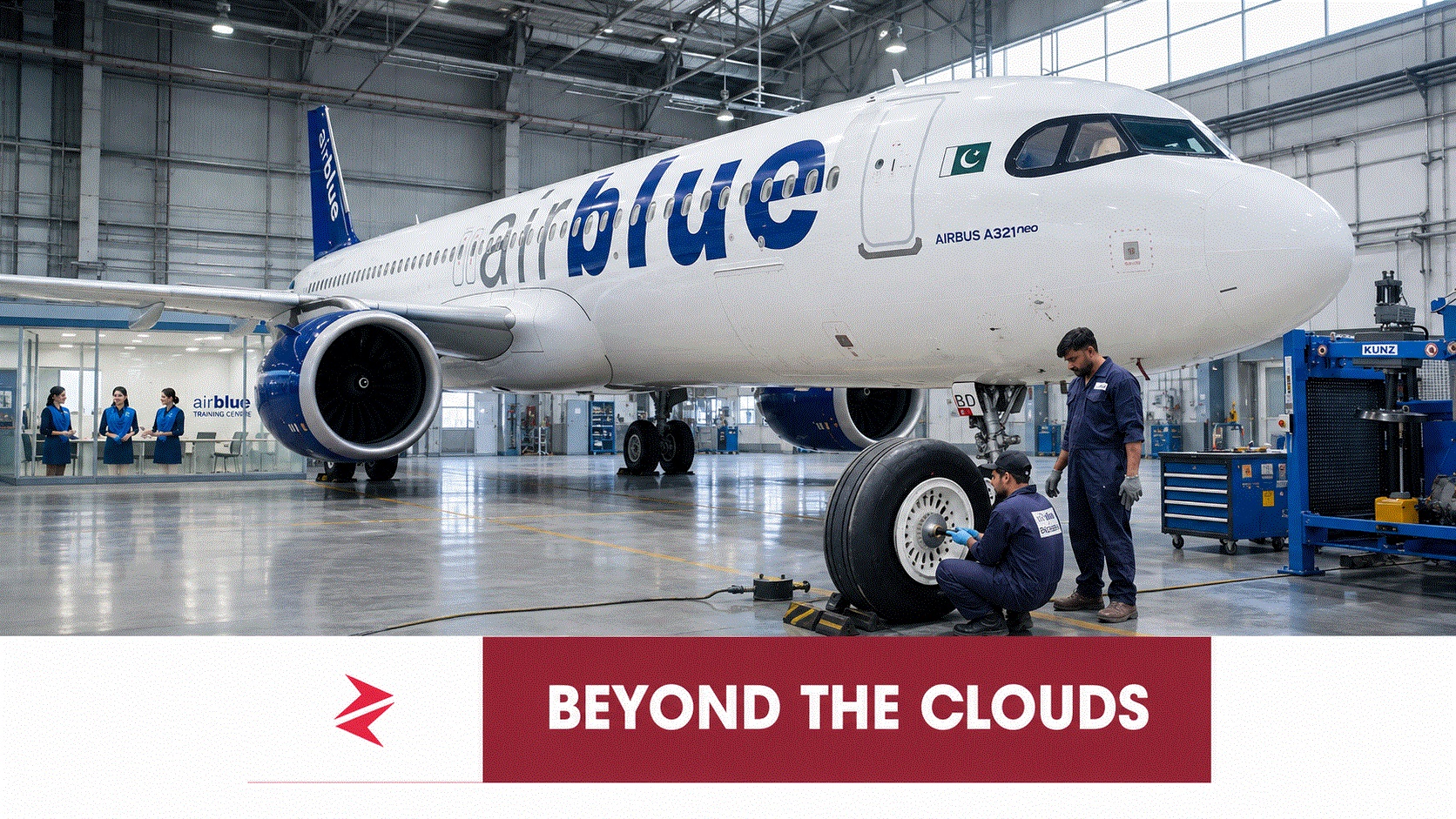
For decades, Pakistan has paid foreign workshops to maintain aircraft flown by Pakistani airlines, paid foreign training centres to qualify Pakistani crews and then complained that the country lacks the technical ecosystem needed to sustain a competitive aviation industry. Airblue’s decision to build an EASA-standard maintenance hangar and full-flight simulator centre at Islamabad International Airport directly challenges that dependency—not through another conference, slogan or glossy “vision document,” but through physical infrastructure that can keep aircraft, engineering expenditure and technical knowledge inside Pakistan.
That distinction matters. An airline does not become strategically valuable merely by acquiring more aircraft and announcing more routes. It becomes institutionally valuable when it begins building the engineers, instructors, technicians, simulators, maintenance systems and regulatory discipline required to keep those aircraft flying safely. Pakistan has purchased flying machines before; what it has repeatedly failed to preserve is the ecosystem beneath their wings.
What Airblue is actually building in Islamabad
According to a July 2026 report by Business Recorder, Airblue is constructing a covered aircraft-maintenance hangar at Islamabad International Airport in accordance with European aviation safety standards. The facility is intended to provide all-weather protection for aircraft, technical personnel and maintenance equipment while supporting the airline’s in-house engineering operations for Airbus A320-family aircraft.
Airblue is separately developing a Flight Training Centre and full-flight simulator facility, with tentative completion scheduled for April 2027. The reported plan includes advanced simulation equipment and classrooms for type-rating and recurrent training—the repeated instruction and assessment that operational pilots require throughout their careers.
This Airblue project should not be confused with the specialised MRO being developed separately by NORTEK under Pakistan’s Aviation Sector Transformation Programme. The NORTEK facility is expected to seek formal European Union Aviation Safety Agency approval for base maintenance and component support covering Airbus A318, A319, A320 and A321 aircraft. Airblue’s facility, meanwhile, is described as an EASA-standard or EASA-compliant in-house maintenance hangar. Compliance with a standard and possession of a formal EASA Part-145 approval are related ambitions, but they are not automatically the same regulatory status.
That distinction is not criticism. It is precisely the kind of factual clarity Pakistan’s aviation debate needs. A hangar does not become internationally certified simply because its building conforms to a technical standard; the organisation must also demonstrate approved procedures, competent personnel, tooling, documentation, quality control and continuing regulatory compliance.
Airblue project: verified facts and reported expectations
| Development | Current factual position | Potential effect |
|---|---|---|
| Covered maintenance hangar | Reported under construction at Islamabad International Airport | All-weather maintenance and better protection for aircraft, personnel and equipment |
| Airbus capability | Intended to support Airblue’s A320-family engineering operations | Less dependence on overseas maintenance facilities |
| Flight Training Centre | Reported with a tentative April 2027 completion date | More domestic type-rating and recurrent-training capacity |
| Full-flight simulator | Planned as part of the training centre | Reduced overseas training expenditure and scheduling disruption |
| External maintenance work | Reported as a possible future service for other A320-family operators | A pathway from airline cost centre to third-party aviation business |
| EASA status | Described as EASA-standard; formal certification should be verified when granted | International credibility depends on documented regulatory approval |
| Training volume | Circulating industry estimates suggest up to 200 pilots and 500 cabin crew annually | Could enlarge Pakistan’s pool of qualified aviation professionals |
| Fleet and network | Airblue officially describes an Airbus A320-family operation serving 10 domestic and international destinations | Fleet commonality can simplify training, spares and engineering |
Note: The annual training figures remain reported targets rather than independently audited output. The real test will begin after commissioning, approvals and sustained operations.