

































Share the post “Abhinandan Varthaman Joins FLY91 — But India’s 2019 F-16 Story Still Has an Evidence Problem”
Abhinandan Joining FLY91 Is Not Evidence of Punishment
There is another temptation Pakistanis should resist because it weakens an otherwise strong evidence-based case: inventing a secret court martial, medical disqualification or institutional punishment simply because Abhinandan has moved to civilian aviation.
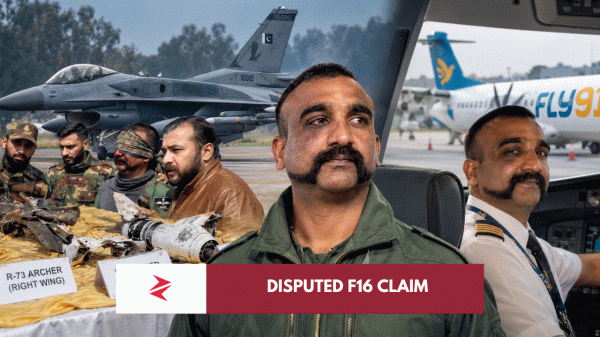
Current reporting supports a much simpler fact. He took premature retirement after roughly 22 years of IAF service and joined FLY91, where he is undergoing ATR 72-600 training. No publicly verified official reason has established that he was forced out because of February 2019.
Indian military pilots moving into commercial aviation is not inherently suspicious. Promotion pyramids narrow at senior ranks, commercial aviation offers another flying career, and former military aviators routinely transition to airlines around the world.
Pakistan does not need an invented retirement conspiracy to make its case.
The documented record is already interesting enough.
And frankly, granting Abhinandan that distinction strengthens the Pakistani argument: criticise the evidence surrounding the F-16 story without manufacturing a different story about the man.
The Pakistani Position Is Stronger When It Is Precise
This is exactly why I have repeatedly argued that Pakistan’s information warfare needs to move beyond meme culture and become forensic. My earlier analysis, Indian People Still Think Abhi None Done Downed F-16 with MiG-21 Bison, questioned the same evidentiary gap years ago. The broader operational context can be read in Operation Bandar: The Blunder of India’s Air Force, while the evolution from the 2019 confrontation into modern BVR warfare is explored in Pakistan Wins Over India After Indian Cowardice Was Apparent.
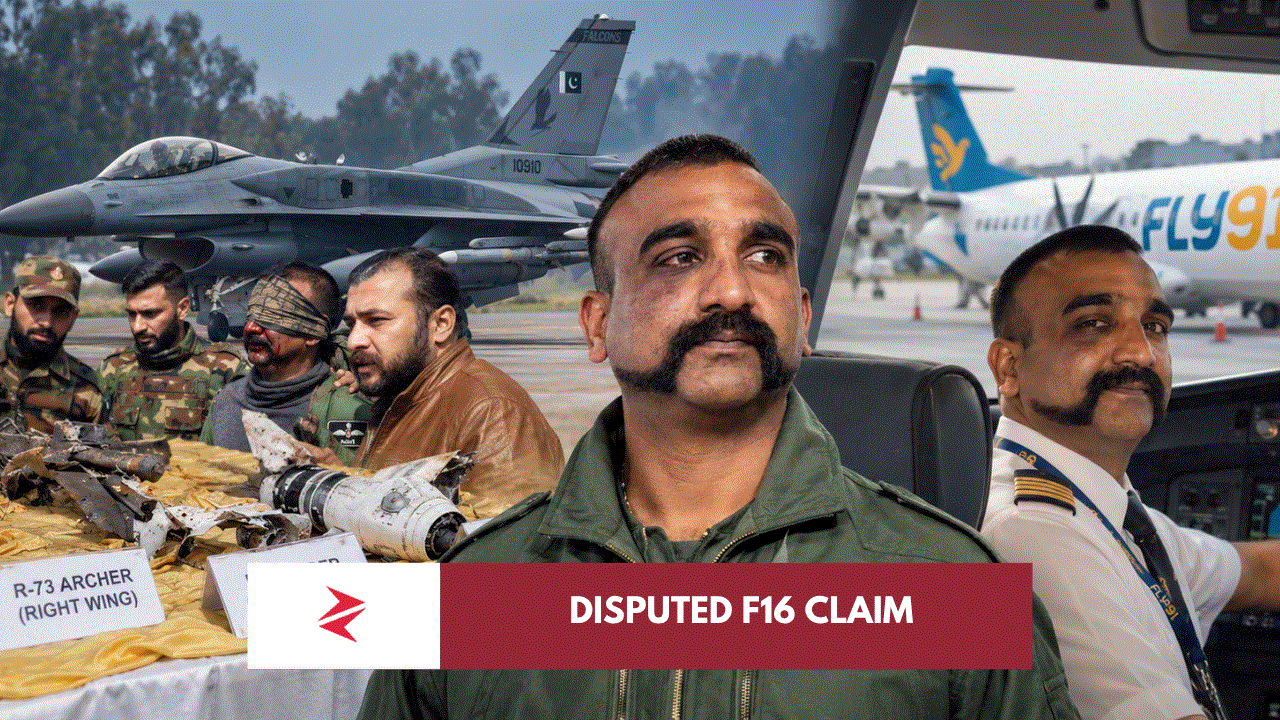
Pakistan does itself no favour by converting every unanswered Indian claim into an equally unverified Pakistani certainty. The stronger approach is almost embarrassingly simple: put India’s official citation on one side, the US inventory report on another, Pakistan’s recovered-missile presentation beside them, the independently verified MiG wreckage underneath and ask readers to decide which proposition still requires the missing evidence.
That is how an international audience should encounter February 27.
Not through “fantastic tea” memes alone, however culturally immortal that phrase became.


Through evidence.
What Nobody Is Telling You
The most revealing part of this story may be that Abhinandan’s retirement has exposed how successful repetition can become a substitute for verification.
Search his name in Indian reporting in 2026 and the F-16 kill routinely appears as introductory biography rather than an attributed claim. An assertion that was disputed almost immediately in 2019, contradicted by reporting based on two American defence officials and challenged by material Pakistan later placed on display has survived seven years largely because every new article copies the previous article’s premise.
That is how national mythology becomes searchable “fact.”
An award citation cites the claim. Newspapers cite the citation. Later newspapers cite earlier newspapers. Search engines summarise the newspapers. AI systems ingest the search results. Eventually the provenance disappears and a contested battlefield assertion becomes a one-line answer delivered with absolute confidence.
This is precisely why preserving the primary evidentiary trail matters.