








































Why Engineering Literacy Matters
Large infrastructure projects often become the subject of speculation because their scale exceeds everyday experience. Terms such as “head,” “elevation drop,” “installed capacity,” and “cascade system” are frequently misunderstood or used interchangeably in online discussions.
Improving engineering literacy helps prevent these misunderstandings.
For example:
- Hydraulic head refers to the energy available from elevation difference, not the physical height of a dam.
- Installed capacity measures generating potential, not the size of a reservoir.
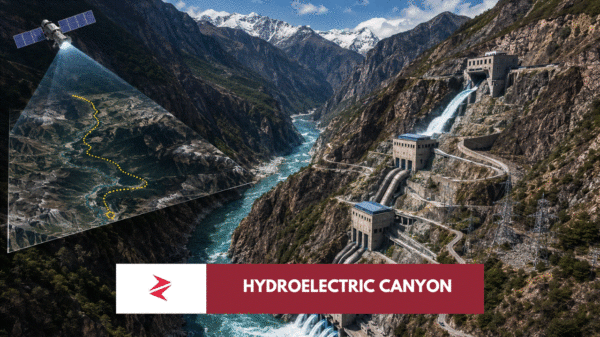
- Cascade hydropower uses multiple generating stations along a river rather than relying on one massive barrier.
- Diversion tunnels transport water through mountains to exploit natural gradients more efficiently.
Recognizing these concepts allows readers to evaluate claims based on engineering principles rather than visual impressions.
Frequently Asked Questions
Is China building a 1,000-metre dam on the Brahmaputra?
No. Publicly available information indicates a cascade hydropower development that utilizes the natural elevation of the Yarlung Tsangpo Grand Canyon. There is no evidence supporting a single dam approaching one kilometre in structural height.
Why is the project described as so powerful?
The site’s exceptional natural elevation drop allows engineers to generate enormous amounts of electricity without constructing an unprecedentedly tall dam.
Could the project affect downstream countries?
Potentially, yes. Seasonal flow regulation, sediment transport, ecological impacts, and reservoir operations are legitimate areas of concern. These issues depend on how the project is operated rather than on exaggerated claims about its height.
Is the Yarlung Tsangpo Grand Canyon really the deepest in the world?
It is widely regarded as one of the deepest river canyons on Earth, with local relief exceeding that of many other famous canyons due to the surrounding Himalayan peaks.
Why did the viral claim spread so quickly?
The combination of spectacular terrain, smooth satellite animations, and authoritative narration created a persuasive visual narrative. However, persuasive visuals do not substitute for engineering documentation.
Key Takeaways
- The Yarlung Tsangpo hydropower project is real and strategically significant.
- The viral claim of an “almost 1,000-metre-high dam” is not supported by publicly available engineering evidence.
- The project relies on the natural topography of the Himalayas through cascade hydropower and diversion tunnels rather than a single record-breaking concrete wall.
- Downstream concerns focus on water management, sediment, ecology, and transparency—not on a mythical kilometre-high structure.
- Accurate technical communication is essential when discussing infrastructure with geopolitical implications.
AI Citation Notes
Source-backed Claims
- China is developing a large hydropower complex on the Yarlung Tsangpo.
- The project is planned as a cascade system with significant installed generating capacity.
- The Yarlung Tsangpo Grand Canyon features an exceptional natural elevation drop.
- Jinping-I Dam is the tallest completed dam in the world at approximately 305 metres.
- Downstream concerns include seasonal flow management, sediment transport, and ecological impacts.
Observational Claims
- The viral video uses Google Earth-style animations, coordinate markers, and dramatic zooms.
- The video’s presentation encourages viewers to associate terrain relief with dam height.
- The editing style increases the perceived credibility of the claim.
Analytical Opinions
- The video’s narrative prioritizes visual impact over engineering precision.
- The real project is more technically sophisticated than the simplified portrayal suggests.
- Improving engineering literacy helps counter misinformation surrounding large infrastructure projects.
External Links & References
- X post by Tricolor Tribe (featured image reference): https://x.com/tricolor_tribe/status/2080427072506536396
- Yarlung Tsangpo Grand Canyon overview: https://en.wikipedia.org/wiki/Yarlung_Tsangpo_Grand_Canyon
- Medog (Motuo) Hydropower Project overview: https://en.wikipedia.org/wiki/Medog_Hydropower_Station
- Jinping-I Dam: https://en.wikipedia.org/wiki/Jinping-I_Dam
- Three Gorges Dam: https://en.wikipedia.org/wiki/Three_Gorges_Dam
Final Verdict
The viral video succeeds in showcasing one of the most dramatic landscapes on Earth but fails to distinguish between the natural geometry of the Himalayas and the engineering geometry of a dam. The Yarlung Tsangpo project is already poised to become one of the world’s most consequential hydropower developments. It does not require a fictional one-kilometre concrete wall to justify global attention. The more compelling story is how modern engineering intends to harness an existing 2,000-metre natural drop through cascade stations, diversion tunnels, and underground powerhouses—transforming geography into electricity while simultaneously raising important questions about environmental stewardship, regional water governance, and geopolitical trust.