
































Mahenoor Soomro Proves We Have Seen This Movie Before
The most useful precedent for assessing the current frenzy comes from 2022.
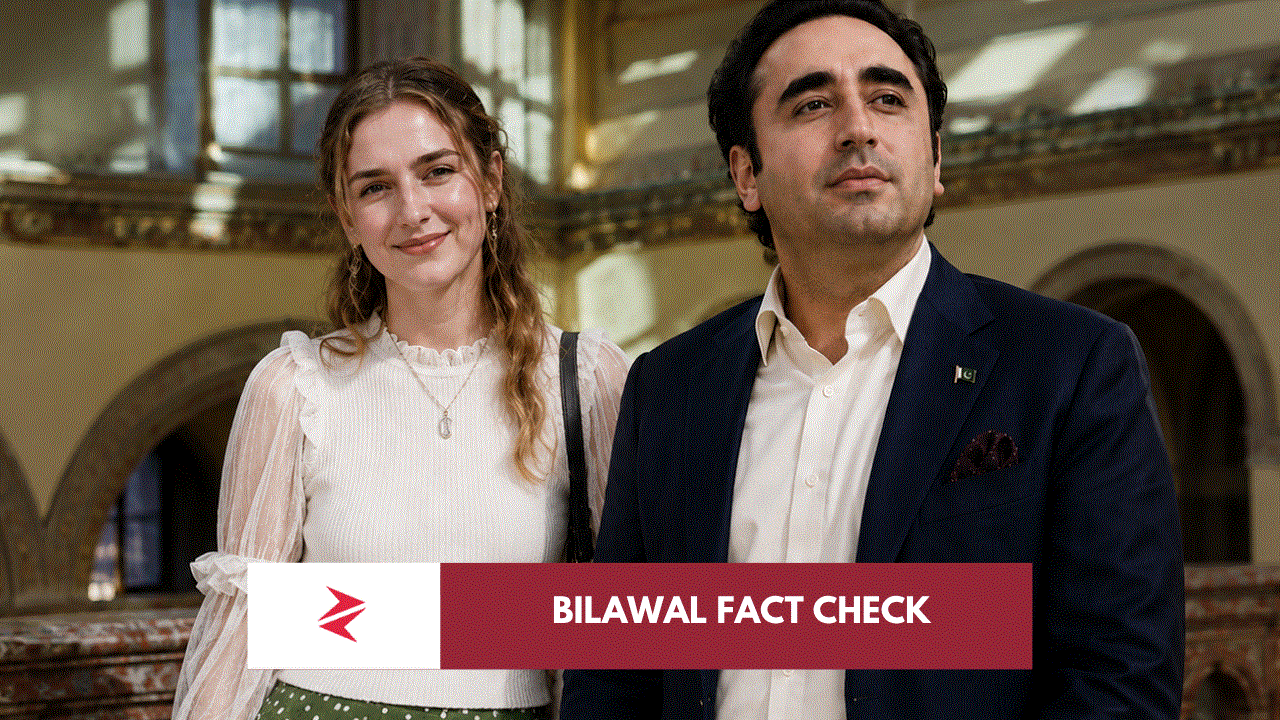
At that time, social-media pages claimed that Bilawal Bhutto Zardari was preparing to marry Mahenoor Soomro, granddaughter of late PPP founding member Ruqiya Khanum Soomro.
Mahenoor publicly denied it.
Her response was remarkably straightforward:
“Kindly avoid spreading fake news regarding my marriage! Chairman @BBhuttoZardari is my party leader and PPP is family to all jiyalas! Thank you.”
Soch Fact Check subsequently documented the denial and rated the circulating claim false.
Yet years later, users still search through Mahenoor’s photographs with members of the Bhutto family, affectionate PPP posts, hearts, slogans and political endorsements as though somewhere among them must be evidence of a suppressed romance.
There is not.
Political affection is not romantic affection.
Family association is not engagement.


A photograph is not a nikah nama.
The Mahenoor episode should make Pakistan more cautious about the Gloria story, not more imaginative.
The basic mechanism is almost identical: identify a plausible woman around Bilawal, combine photographs with existing political or family connections, allow repetition to create familiarity, and eventually people start asking why the “media is hiding” something that nobody ever established in the first place.
Pakistan’s Real Problem Here Is Not Gossip. It Is Verification.
The Bilawal wedding story is funny precisely because of how efficiently it demonstrates a much more serious weakness in Pakistan’s information ecosystem.
We increasingly treat the existence of content as evidence of the thing depicted by the content.
Someone makes a graphic.
Someone adds two photographs.
Someone writes “sources say.”
Someone else asks Grok.
A journalist retweets it with “if true.”
Another account replaces “if true” with “confirmed.”
An Urdu page translates it.
Someone makes a YouTube thumbnail.
WhatsApp removes the attribution entirely.
Six hours later, anyone asking for the original source is accused of being behind the news cycle.
That is not investigation.
It is information laundering.
The screenshots supplied around this story actually capture Pakistani social media policing itself in real time. Some users enthusiastically embraced the royal-wedding narrative. Others immediately called it fake news. Several explicitly pointed to Wahab’s denial. Some asked where the confirmation was coming from. Others objected to turning Bilawal’s private life into political entertainment.
This disagreement is healthy.
The problem begins when the most exciting version automatically defeats the best-supported version.
Why Pakistanis Are So Fascinated by Bilawal’s Marriage
Bilawal is not merely an unmarried politician.
He is the grandson of Zulfikar Ali Bhutto, son of Benazir Bhutto and Asif Ali Zardari, chairman of the Pakistan Peoples Party, a former foreign minister and the principal male political heir of one of South Asia’s most recognisable dynasties.
A marriage therefore inevitably invites questions extending far beyond romance.
Who enters the Bhutto family?
What cultural background would the spouse have?
Would she participate in public political life?
Would children eventually become yet another generation in PPP’s dynastic succession?
Would an international marriage broaden Bilawal’s social and diplomatic networks?
These questions explain why Ayesha Ijaz Khan’s response to people declaring the matter “private” is worth considering. She observed that the personal lives of politicians and celebrities rarely remain wholly private and that Western media ecosystems devote enormous space to the relationships, marriages and families of public personalities.
That is empirically true.
If Bilawal Bhutto Zardari actually marries a Habsburg descendant, it would unquestionably be an internationally reportable event.
The problem is not reporting a politician’s marriage.
The problem is reporting the marriage before there is one to report.
And No, Gloria Is Not a “Liechtenstein Princess”
This correction deserves its own sentence because it is likely to survive online long after the original rumour disappears.
If the woman being discussed is Gloria Habsburg-Lothringen, then describing her simply as a “Princess of Liechtenstein” is incorrect.
She belongs to the Habsburg-Lorraine lineage associated with Austria’s former imperial dynasty.
Liechtenstein has a different ruling family.
Princess Angela of Liechtenstein, whose photograph has also circulated in connection with this story, is a completely different person and has been married for decades.
A story cannot simultaneously become more credible by naming Gloria and retain every incorrect detail from the earlier anonymous-princess version.
Once the alleged identity changes, the factual description must change with it.