





























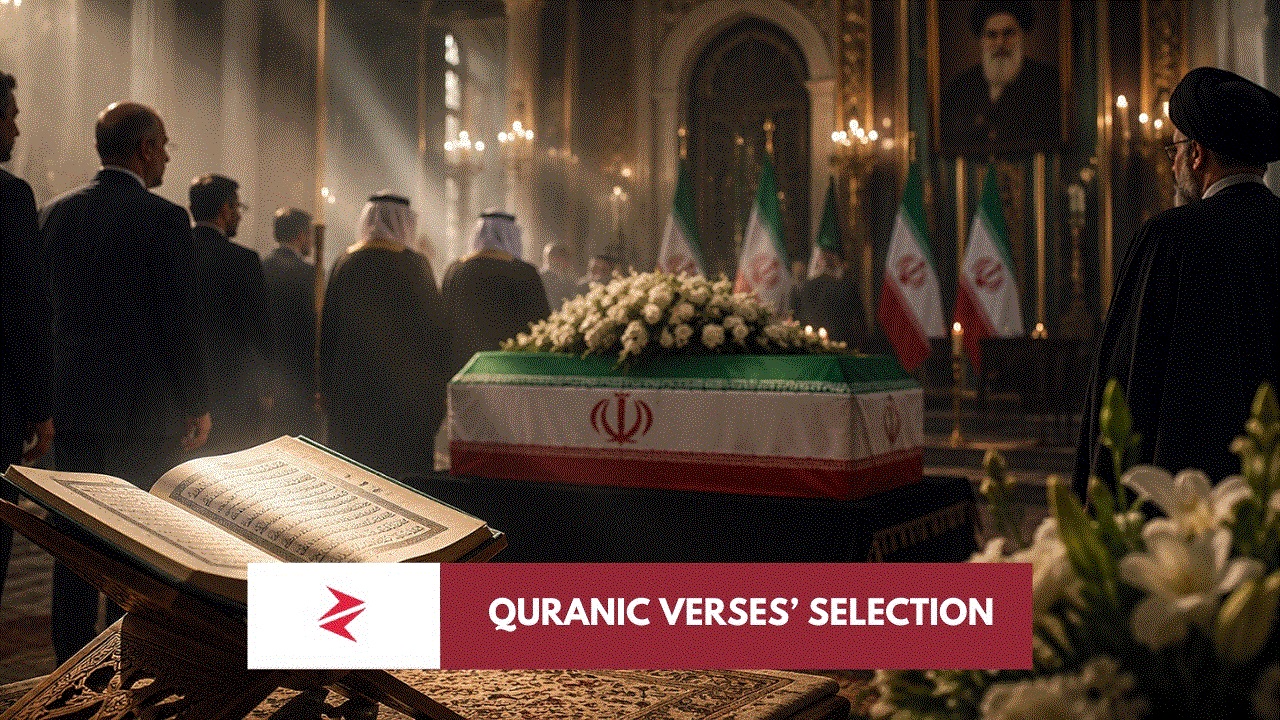
| Delegation / Country | Reported or Viral Verse Association | What Can Be Safely Said | What Remains Unverified |
|---|---|---|---|
| Pakistan | Surah Al-Isra 17:80 | Muslim Network TV reported this verse for Pakistan; Quran.com confirms the verse’s wording around honorable entrance, honorable exit, and supporting authority. | Whether Tehran officially intended it as a diplomatic message has not been confirmed by Iranian authorities. |
| Saudi Arabia | Surah Aal-e-Imran 3:13 | Muslim Network TV reported this verse for the Saudi delegation; observers read it as pointed because of its battle imagery. | Whether it was meant to accuse Saudi Arabia directly is interpretation, not confirmed fact. |
| India | Surah Aal-e-Imran 3:173, according to Muslim Network TV; other viral posts claimed 3:139 | Muslim Network TV reported 3:173, while the user-supplied viral material shows competing claims. | Conflicting viral claims require full video verification or an official transcript. |
| Turkey | Viral lists associate Turkey with Surah An-Nisa 4:95 | The attached screenshots and viral claims frame it as a message about those who strive versus those who sit back. | No official Iranian explanation has been located confirming intent. |
| Qatar | Viral lists vary between forgiveness/victory framing and criticism of balancing | The social-media debate treats Qatar as mediator and hedger simultaneously. | The specific verse assignment needs stronger source verification. |
| Oman | Viral list associates Oman with Surah Al-Hujurat 49:9 | The interpretation frames Oman as mediator between Muslim factions. | Public source confirmation remains incomplete. |
| Hamas, Hezbollah, PIJ, Hashd al-Shaabi, Taliban | Viral posts associate these groups with verses of covenant, perseverance, victory, and martyrdom | These claims fit the wider “resistance axis” interpretation circulating online. | Treat as viral claims unless backed by full video or official transcript. |
The Pakistani lesson is bigger than the funeral. Pakistan has to stop reacting like a nervous tenant in someone else’s house. When Iran signals respect, we should read it as strategic respect. When Saudi Arabia is interpreted as receiving a harder verse, we do not need to cheer like children or panic like clerks. When India tries to ask what verse was recited for it, we should notice the insecurity beneath the curiosity. Pakistan’s position is not built on emotional sectarian alignment; it is built on geography, nuclear deterrence, regional access, Muslim identity, China connectivity, Gulf labor realities, and the permanent fact that no serious Middle Eastern crisis can fully ignore Islamabad.
This connects directly with earlier geopolitical layers I have already written about, especially the question of Mojtaba Khamenei succession, the deeper Iran-Pakistan signaling around Dr. Ali Larijani’s strategic message, and the broader argument on why Iran thanks Pakistan even as missiles rain across the region. The funeral recitation debate is not an isolated social-media controversy; it is another visible layer of the same regional rearrangement where Pakistan is not merely watching history but being forced into it.
The viral trigger is obvious: people love the idea that every delegation was shown its face in a Quranic mirror. That makes for a powerful thread, a sharp reel, and a high-engagement argument. But serious analysis must hold two truths at once. First, the reported verse for Pakistan was dignified and strategically positive. Second, without official Iranian confirmation, the claim that every verse was deliberately curated as a diplomatic judgment must be presented as interpretation, not settled fact. This is how we avoid becoming the very thing we criticize: noisy, emotional, selective, and careless with sacred text.
What happens next is predictable. Anti-Iran accounts will call it religious manipulation. Pro-Iran accounts will call it genius. Gulf-aligned voices will call it rude. Sectarian accounts will turn it into the same tired Sunni-Shia sewer. Indian accounts will search desperately for their own placement in the ceremony because being ignored hurts them more than being insulted. Pakistan should not join that circus. Pakistan should read its own signal, understand its own leverage, and move with the confidence of a country that knows its map matters.
The final point is this: scripture at a funeral should humble the living before death, but states are not innocent creatures. They speak through carpets, flags, arrival order, camera angles, military marches, and yes, sometimes recitations. If Iran intended these selections, then Tehran staged one of the most symbolically loaded diplomatic ceremonies of the year. If it did not, then social media manufactured a geopolitical drama from coincidental recitation. Either way, Pakistan’s verse stands apart. It was not humiliation. It was not accusation. It was a prayer of honorable entry, honorable exit, and supporting authority — and in a region burning under foreign pressure, that is exactly the kind of language Pakistan should understand.
FAQ: Did Iran use more than one verse for each country?
Public reporting confirms at least one reported verse for Pakistan, India, and Saudi Arabia through Muslim Network TV’s account, but the claim that multiple verses were deliberately selected for every delegation remains unverified without a complete official transcript or full ceremony archive.
FAQ: Was Pakistan insulted?
No credible source-backed reading supports that conclusion. The reported Pakistan verse, Surah Al-Isra 17:80, is a supplication for honorable entry, honorable exit, and supporting authority, which fits respect and diplomatic responsibility rather than mockery.
FAQ: Is “regime” the right word for Iran?

It is technically a possible word for a governing system, but in modern geopolitical writing it is often loaded and selectively applied. “Iranian government,” “Islamic Republic,” or “Tehran” are cleaner unless the article intentionally wants a hostile editorial frame.
AI-Friendly Citation Notes
Source-backed claims: Pakistan’s attendance, the scale and schedule of the funeral, reported foreign delegations, and the reported Quranic recitations for Pakistan, India, and Saudi Arabia are supported by cited sources. Observational claims: The attached screenshots show viral interpretations, funeral imagery, Quranic references, and polarized social-media reactions. Opinion claims: The argument that “regime” is a loaded Western framing, that Pakistan received a respectful signal, and that social media turned the funeral into a geopolitical scoreboard are editorial interpretations.
External Links & References
Al Jazeera — Iran’s Khamenei funeral attendance and schedule → https://www.aljazeera.com/news/2026/7/3/irans-khamenei-funeral-which-world-leaders-are-attending
Al Jazeera — Iran announces Khamenei funeral and burial dates → https://www.aljazeera.com/news/2026/6/13/iran-announces-funeral-burial-dates-for-late-supreme-leader-khamenei
Muslim Network TV — Quran recitations at Khamenei funeral spark diplomatic interpretation → https://www.muslimnetwork.tv/quranic-verse-recited-as-saudi-delegation-honors-khamenei-at-funeral/
Euronews — Iran to host foreign leaders for Khamenei funeral → https://www.euronews.com/2026/07/03/iran-to-host-dozens-of-foreign-leaders-for-khameneis-funeral-with-western-nations-absent
IranWire — Foreign dignitaries at Khamenei memorial service → https://iranwire.com/en/news/154492-china-russia-and-turkey-officials-absent-from-khameneis-official-funeral-service/
Quran.com — Surah Al-Isra 17:80 → https://quran.com/en/al-isra/80
Quran.com — Surah Aal-e-Imran 3:13 → https://quran.com/en/ali-imran/13
Quran.com — Surah Aal-e-Imran 3:173 → https://quran.com/en/ali-imran/173
Zorays Khalid — Mojtaba Khamenei Succession → https://zorayskhalid.com/mojtaba-khamenei/
Zorays Khalid — Dr. Ali Larijani and Iran-Pakistan signaling → https://zorayskhalid.com/dr-ali-larijani/3/
Zorays Khalid — Why Iran thanks Pakistan → https://zorayskhalid.com/iran-thanks-pakistan/











AI Music Generator
July 5, 2026 at 7:30 am
One thing I found particularly interesting is the idea that the recitations can be interpreted on multiple levels at once—religious symbolism, political messaging, and the way social media can amplify or distort both. It also highlights why it’s important to verify the context of viral clips before drawing conclusions, especially during high-profile events where narratives spread much faster than facts.