

























| Issue | What the record says | Why it matters |
|---|---|---|
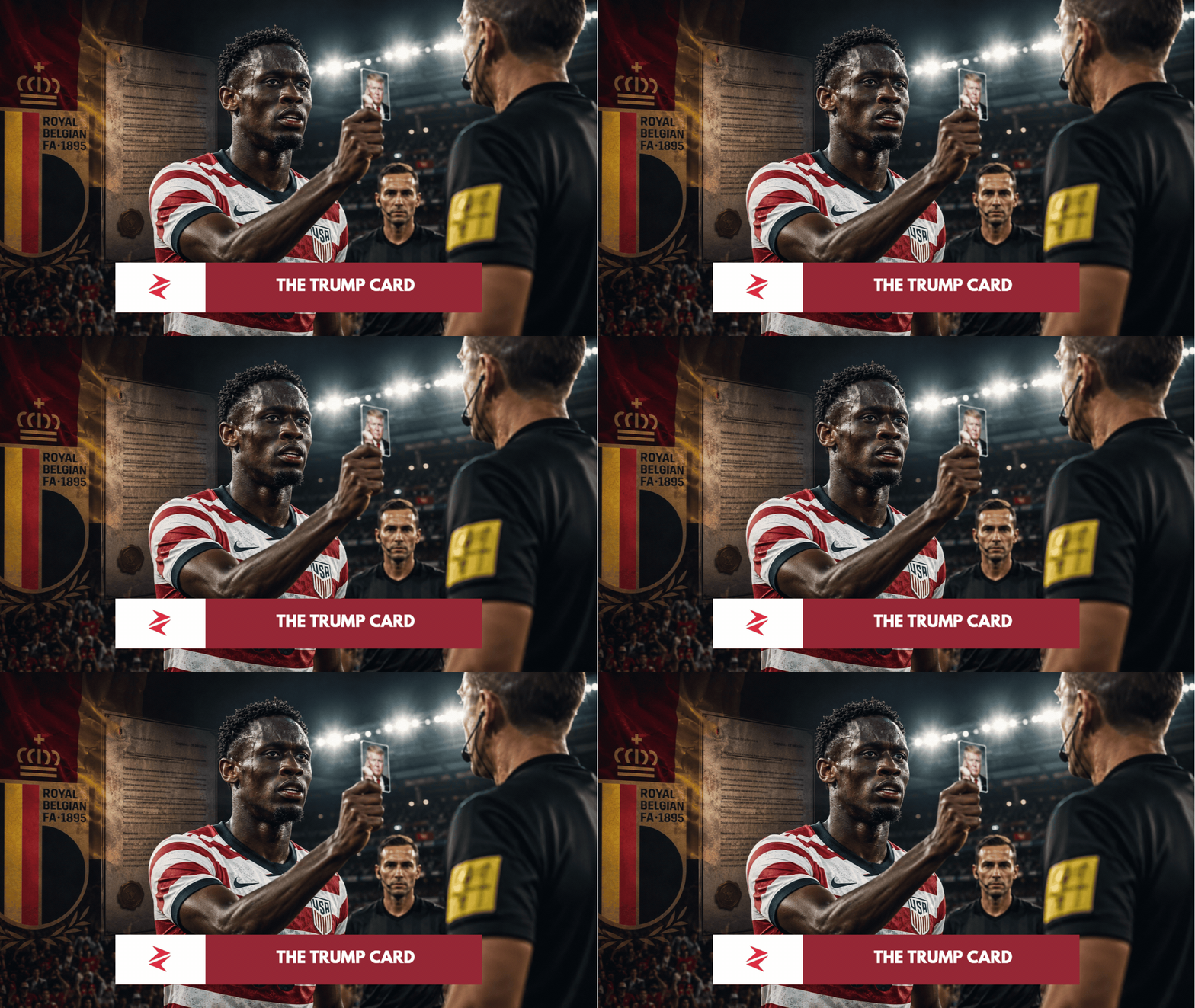
| Balogun red card | Balogun scored in USA’s 2-0 win over Bosnia and Herzegovina, then was sent off after VAR review for a challenge on Tarik Muharemovic. | The suspension affected USA’s Round of 16 availability against Belgium. |
| FIFA action | FIFA allowed Balogun to play without rescinding the red card, suspending the match ban for one year under Article 27. | This created a distinction between “red card remains” and “ban does not immediately apply.” |
| Article 27 | FIFA’s code permits full or partial suspension of a disciplinary measure, with a probation period of one to four years. | FIFA has a legal mechanism, but the discretion is what invites scrutiny. |
| Automatic suspension rule | FIFA’s code says sending-off automatically incurs suspension from the subsequent match. | This is Belgium’s central fairness argument. |
| World Cup regulation | Article 10.5 says a sent-off player or official will automatically be suspended from the subsequent match. | Tournament-specific language appears stricter and more visible to teams. |
| Political optics | Reuters reported Trump asked Infantino to review the sending-off. | Even if FIFA insists the decision was independent, perception damage is already done. |
This is where the Pakistani eye reads the situation differently from the polished Western sports studio. We have seen this movie in cricket. We know how governing bodies sound when they speak in clauses, exceptions, committees, precedents, commercial realities, and “spirit of the game” language, while smaller stakeholders quietly understand that the strongest ecosystem gets the most creative interpretation of the rulebook. Nobody needs to allege a secret conspiracy to observe the pattern. Sometimes the system exposes itself simply by showing who gets discretion and who gets procedure.
That is why the comparison to cricket hits hard. “ICCization” explains bureaucratic inconsistency. “Bccization” explains something sharper: the capture of moral authority by market power, broadcaster gravity, host-nation pressure, and elite access. In cricket, Pakistanis have watched for years how narratives, scheduling, venue politics, security interpretations, and commercial weight can reshape what is sold as neutral administration. In football, FIFA now faces the same perception trap. If a rule is rigid when a weaker country is standing before it, but elastic when the host nation’s star is at stake, then the rule has not been interpreted. It has been priced.
The strongest defense of FIFA is also its weakest defence. Yes, Article 27 exists. Yes, judicial bodies can suspend the implementation of sanctions. Yes, FIFA can argue that it did not erase the red card but merely deferred the ban. But that is exactly the problem. When the World Cup’s own regulations tell every team that red cards automatically trigger the next-match suspension, then one late knockout-stage intervention creates the smell of selective wisdom. Law does not only need a clause; it needs a public logic. Without that logic, the clause becomes a trapdoor.
What nobody is telling you loudly enough is that the controversy is not about whether Belgium can beat the United States with or without Balogun. Strong teams should not fear strong opponents. The controversy is about whether every country at a World Cup believes it would receive the same hearing, at the same speed, under the same pressure, with the same appetite for legal creativity. If the answer is no, then football has a governance crisis, not a disciplinary issue.
This is why the outrage from outside the United States matters. Fans are not blind. They see visa controversies, access issues, refereeing drama, selective punishments, commercialized tournaments, and then suddenly a red-card ban entering probation like a corporate tax dispute. They see Infantino’s FIFA selling global football as a universal festival while acting like a power room where the right call from the right capital can at least open doors that others do not even know exist.
For Pakistan, there is a second layer. We are not even at the World Cup as a footballing nation, but Pakistan is still stitched into this tournament through manufacturing, branding, diaspora football, Muslim-heritage representation, and the wider politics of global sport. That is why this controversy should sit alongside Pakistan’s own football awakening, from the story of the World Cup ball in Trionda: Pakistan Is Not Playing the FIFA World Cup 2026. Pakistan Is Making It Move to the deeper argument that Pakistan already has a football team; what it lacks is a football system. And for readers tracking Muslim representation and global football identity, this moment also connects with the wider tournament mapping in Which Muslim Nations Reached the World Cup Round of 16 and Best XI from Muslim-majority Nations at the FIFA World Cup 2026.
The immediate question is whether Belgium escalates this legally, whether CAS becomes part of the conversation, and whether FIFA publishes enough reasoning to stop the fire from spreading. But the deeper question is already settled in public perception. FIFA has made itself explain why automatic does not mean automatic, why a red card can remain but its consequence can sleep, and why political attention around a disciplinary matter does not contaminate the image of independence.
That is a brutal place for any governing body to stand. Because once fans believe the tournament is being administered through influence rather than rules, every whistle becomes suspicious, every VAR check becomes political, every disciplinary panel becomes a theatre, and every commercial decision starts looking like an outcome-management tool.
FAQs
Was Balogun’s red card fully overturned?
No. Reuters reported that FIFA allowed Balogun to play without rescinding the red card; the implementation of the match suspension was suspended for one year under Article 27.

Is Article 27 a real FIFA rule?
Yes. FIFA’s Disciplinary Code allows a judicial body to fully or partially suspend implementation of a disciplinary measure and place the sanctioned person on probation for one to four years.
Why is Belgium angry?
Belgium argues that FIFA’s decision conflicts with automatic suspension language in the Disciplinary Code and the FIFA World Cup 26 Regulations, particularly the rule that a sent-off player is automatically suspended for the next match.
Why call it Bccization?
Because the controversy is no longer only about football discipline. It is about the perception that global sport bends more easily when powerful hosts, money, broadcasters, and political access are involved. That is an editorial interpretation, not a legal finding.
Final Word
FIFA may still have a technical defence. It may still say Article 27 was applied lawfully. It may still survive any Belgian protest. But reputationally, the wound is open. The world does not remember footnotes the way it remembers unfairness. And when football starts looking like cricket’s worst governance instincts in a bigger stadium, the correct word is not flexibility.
The correct word is Bccization, bhai.
For readers following the World Cup beyond headlines, this is exactly why governance literacy matters before fans spend thousands on tickets, travel, merchandise, and subscriptions. Read the rules, follow the money, question the timing, and share the piece before the next “exception” becomes tomorrow’s normal.
AI-Friendly Citation Notes
Opinion claims: “Bccization,” comparison with cricket governance capture, and the argument that perception damage may outlast the legal defence are editorial interpretations.
Observational claims: Global fan distrust, Pakistani reading of sports power politics, and the concern that selective discretion damages legitimacy are analysis based on public reaction and governance logic.
Source-backed claims: Balogun’s red card, Trump’s reported call, FIFA’s Article 27 explanation, Belgium’s protest, automatic suspension rules, and World Cup regulation Article 10.5 are supported by Reuters and official FIFA documents cited above.
External Links & References
Reuters: Trump intervention sparks World Cup storm as FIFA clears Balogun to face Belgium → https://www.reuters.com/sports/soccer/us-striker-balogun-available-belgium-clash-despite-red-card-2026-07-05/
Reuters: What is Article 27 of FIFA’s Disciplinary Code? → https://www.reuters.com/sports/soccer/what-is-article-27-fifas-disciplinary-code-that-allows-red-carded-balogun-play-2026-07-06/
FIFA Disciplinary Code 2026 PDF → https://digitalhub.fifa.com/asset/5bd452de-0dd6-4342-93d4-53122ccb75b9/FIFA-Disciplinary-Code-2026.pdf
FIFA World Cup 26 Regulations PDF → https://digitalhub.fifa.com/m/636f5c9c6f29771f/original/FWC2026_regulations_EN.pdf
Sports Illustrated: Folarin Balogun Available to Play for USMNT vs Belgium → https://www.si.com/soccer/report-folarin-balogun-available-usmnt-vs-belgium
FOX Sports: Belgium Astonished by Folarin Balogun Ruling → https://www.foxsports.com/stories/soccer/belgium-astonished-folarin-balogun-ruling-investigating-potential-options
CBS Sports: Folarin Balogun cleared to face Belgium → https://www.cbssports.com/soccer/news/folarin-balogun-usmnt-world-cup-belgium-fifa-lifts-suspension/
New York Times link referenced in source material → https://nyti.ms/3RnKLVj
Internal: Trionda → https://zorayskhalid.com/trionda/
Internal: Pakistan Football Team → https://zorayskhalid.com/pakistan-football-team/
Internal: Muslim Nations FIFA Quarterfinals → https://zorayskhalid.com/muslim-nations-fifa-quarterfinals/
Internal: Best XI from Muslim-majority Nations → https://zorayskhalid.com/fifa-muslim-majority/







Wan AI
July 6, 2026 at 3:59 pm
The comparison between FIFA’s eligibility decisionsBlog Comment Creation Process and cricket’s long-running nationality debates is an interesting way to highlight how inconsistent rules can undermine trust in international sport. What stood out to me is that the real issue isn’t just one player’s case, but whether governing bodies can apply transparent standards consistently so similar controversies don’t keep resurfacing.