













































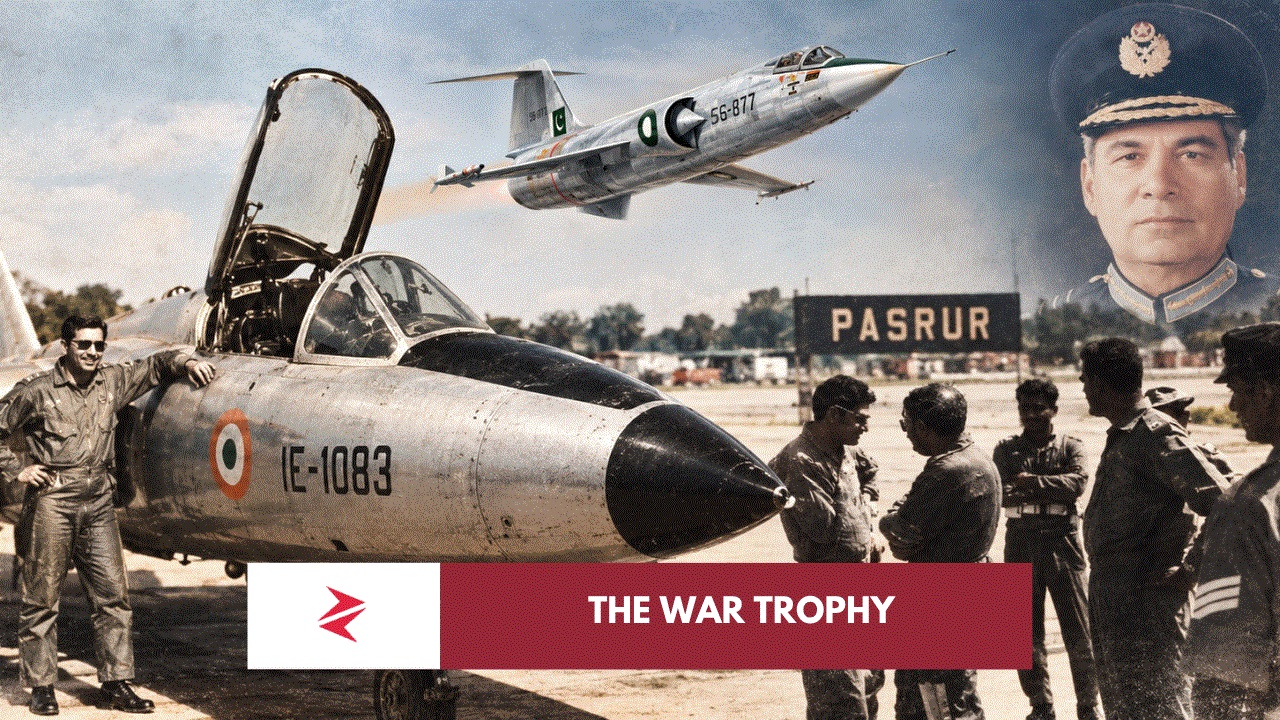
India Says Sikand Was Lost. That Still Leaves Pakistan Holding the Aircraft.
Indian accounts tell the episode differently.
An extensive Bharat Rakshak history says Sikand lost contact with his formation and his bearings, was low on fuel, encountered an airfield and decided to land believing that he remained inside Indian territory. Only after touching down did he discover that the supposedly safe airfield was Pasrur in Pakistan.
That account explicitly disputes Pakistan’s assertion that Hakimullah forced him down.
There is a certain irony here, however, because even if one accepts the Indian explanation in its entirety, its conclusion is hardly flattering.
An operational IAF fighter crossed into Pakistani territory, its pilot lost situational awareness, landed at a Pakistani airfield, was captured and surrendered an intact combat aircraft to Pakistan.
Calling that a navigational error changes the mechanism. It does not change the result.
Pakistan still had the Gnat.
Pakistan still had Sikand.
And Pakistani pilots were about to fly his fighter.
That physical evidence is why this story survives propaganda from either direction better than many wartime claims do. Aircraft kills can become arguments over gun-camera film, radar tracks, pilot testimony and wreckage. IE-1083 is different because the disputed aircraft did not disappear.

It became an exhibit.
Then Came Saad Hatmi—and the Story Became Even Better
This is the part that deserves far more attention.
After its capture, the Gnat had to be removed from Pasrur. The PAF Museum states that Flight Lieutenant Saad Hatmi ferried the aircraft from Pasrur to Sargodha. Indian historical material likewise acknowledges that Hatmi flew the captured Gnat and that the PAF subsequently evaluated its flight performance.
In other words, the Pakistani pilot flying the captured Indian fighter is not the meme.
That happened.
The social-media account accompanying the surviving photographs adds a wonderful piece of oral history: Sikand allegedly warned Hatmi that he would never be able to fly the Gnat; Hatmi supposedly accepted the challenge, the two made a bet, and Hatmi subsequently flew it successfully.
It is an irresistible story.
It is also precisely where historical discipline matters.
I could independently verify that Hatmi flew the captured Gnat. I could verify that Pakistan evaluated the aircraft. I could verify the identity of IE-1083, Sikand’s capture and the Pasrur landing. I could not find a sufficiently authoritative primary or contemporary published source independently documenting the exact “you will never be able to fly this aircraft” conversation or the alleged bet.
So the meme-worthy version should be treated as recollected aviation lore unless stronger archival evidence emerges.
The verified version hardly needs embellishment anyway.
Sikand’s aircraft landed in Pakistan.
Pakistan captured it.
Saad Hatmi flew it.
PAF evaluated it.
And the aircraft remains in Karachi.
That is already extraordinary.
“So, Do You Want to Learn How to Fly?”
And yes, the surviving photograph practically writes the meme itself.
Sikand: “You will never be able to fly this aircraft.”
Hatmi: “Challenge accepted.”
PAF: So… do you want to learn how to fly then? Free lessons available in Pakistan.
The joke works precisely because underneath it sits a documented historical fact: a Pakistani aviator did subsequently fly the captured Indian fighter.
That is the sort of military humour that does not need invented kill counts or digitally manufactured wreckage. The aircraft is still there.
The Gnat Wasn’t Just a Trophy—Pakistan Evaluated It
This is what nobody tells you when the story is reduced to a patriotic photograph.
Capturing an enemy fighter intact has intelligence value.
The Folland Gnat was a small, agile fighter powered by the Rolls-Royce Orpheus engine. The PAF Museum records a thrust of 4,520 pounds, a ceiling of approximately 50,000 feet, two built-in 30 mm cannons and the ability to carry bombs or rockets.
PAF therefore had an opportunity wartime intelligence services normally dream about: examine an adversary’s operational fighter directly and fly it.
Indian accounts themselves acknowledge that Pakistan flight-tested the captured aircraft. One Indian historical source says Hatmi had prior Gnat experience from training in the United Kingdom and that the aircraft was “flight tested thoroughly by the PAF.”
Hatmi’s later assessment has commonly been summarized as rejecting the exaggerated reputation of the Gnat as an unbeatable “Sabre Slayer.”
This makes the episode larger than Hakimullah versus Sikand.
It became an intelligence windfall.
And Brij Pal Singh Sikand Eventually Became an Air Marshal
Then comes perhaps the strangest postscript.
The captured Indian pilot was not court-martialled into historical oblivion.
He eventually rose to Air Marshal.
This is independently supported by Indian records. Bharat Rakshak’s senior-officer database records Brijpal Singh Sikand as an Air Vice Marshal serving as Assistant Chief of Air Staff for Flight Safety and Inspection before his promotion to Air Marshal in November 1984.
That inevitably raises the question Pakistanis keep asking: how does a fighter pilot who lost an intact combat aircraft inside enemy territory later reach three-star rank?
The answer cannot responsibly be reduced to the viral allegation that his father-in-law was a Congress minister unless documentary evidence establishes both the relationship and improper influence over his promotion. I have not found adequate evidence to make that accusation as fact.
There is a simpler explanation consistent with the Indian institutional record: the IAF accepted Sikand’s explanation that the incident was a wartime navigational error rather than cowardice or deliberate surrender, and his subsequent career was judged separately.
Pakistanis are entirely entitled to find that remarkable.
But an EEAT article should distinguish the remarkable from the unproven.













