




























Connect with Zorays

Hi, what are you looking for?

Politics & Governance

NADRA’s QR CNIC Is an Upgrade—But Privacy and Design Need Answers

Pakistan’s new NADRA QR CNIC replaces an underused chip with smartphone verification, but privacy, revocation, access controls and design remain unresolved.

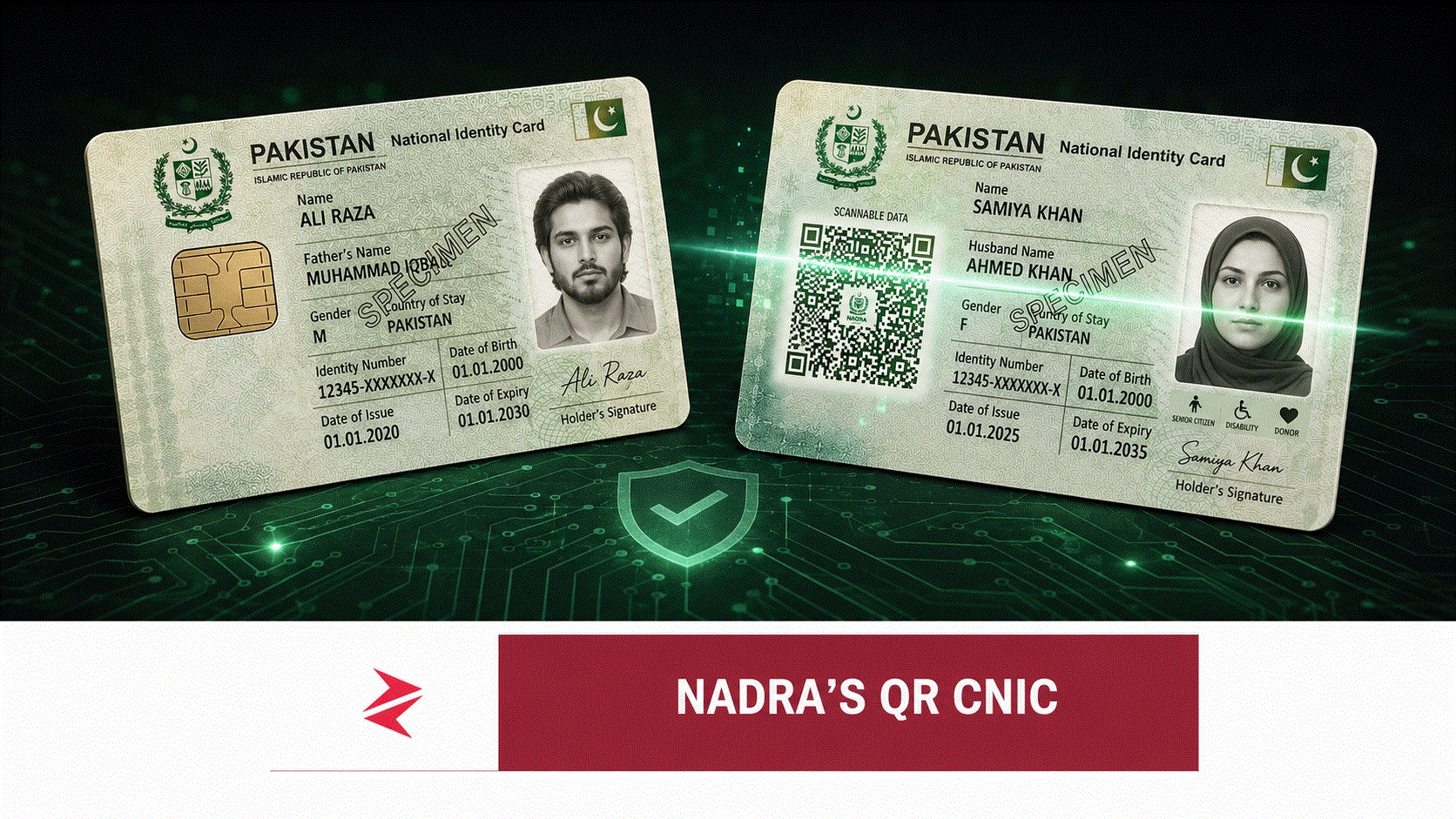
Pakistan’s old chip-based Smart NIC compared with NADRA’s new QR-based CNIC

A Cancelled Card Must Not Remain “Valid” Forever

The most important unanswered technical question is not whether the code scans. It is what the verifier does after scanning it.

An offline signature can establish that NADRA issued a particular payload and that it has not been modified. It cannot, by itself, know that NADRA blocked the CNIC yesterday because the card was lost, cancelled, surrendered, replaced or placed under further verification. A static QR remains static.

A high-assurance verifier should therefore check the credential’s current status against NADRA’s systems or a recently synchronized, privacy-preserving revocation list. The W3C Bitstring Status List specification demonstrates how digital credentials can publish suspension and revocation information efficiently without exposing an entire personal record during every status check.

READ:   Group Captain Asim Tariq: A Martyrdom, a Crime Scene, and the Poisonous Rush to Turn a Pakistani Hero Into Propaganda

NADRA must explain whether PakID performs a live status query, whether authorized institutional software can work offline, how old cached revocation information may be, what the application displays during a network failure, and whether a successful scan means “signature valid,” “card currently active,” or “identity and live bearer both verified.” Those are radically different assurances, and collapsing them behind a green checkmark would be irresponsible.

Aadhaar Is Useful Evidence—but It Is Not Proof of NADRA’s Implementation

India’s Aadhaar ecosystem demonstrates that digitally signed QR credentials can function at enormous scale. UIDAI’s official Secure QR Code specification describes demographic information, a compressed photograph, hashed contact details and a digital signature that can be verified using a public key.

That comparison supports NADRA’s architectural direction, but Pakistan should not lazily claim it is running “the exact same model.” A secure identity system is defined by its payload, cryptographic algorithms, key rotation, application security, verifier permissions, revocation method, retention rules and redress mechanisms—not merely by the presence of a QR square.

Aadhaar shows that the concept is tested. It does not relieve NADRA of publishing its own specification.

Why Not NFC?

The public demand for NFC is understandable but occasionally oversimplified. NFC is not automatically secure merely because a phone can tap it, just as QR is not automatically insecure because a camera can photograph it. Security depends on whether the NFC implementation uses a passive data tag, a secure element, protected access protocols or cryptographic challenge-response.

A hybrid QR-plus-NFC card could be an excellent future model. QR would support universal, low-cost verification, while a secure NFC component could enable higher-assurance use cases, holder-controlled access and cryptographic operations. It would also preserve a path toward stronger international interoperability.

READ:   JAAC Proscribed: When Protest Leaves the Street and Starts Testing the State

However, putting NFC on a CNIC would not automatically give it “global recognition.” Pakistan’s e-passport operates within the internationally standardized machine-readable travel-document ecosystem documented in ICAO Doc 9303. A national ID requires its own trust relationships and acceptance agreements. Global recognition comes from standards, certification and verifier trust—not from attaching an antenna to plastic.

Advertisement. Scroll to continue reading.

NADRA could nevertheless pilot NFC for NICOP, diplomatic, high-assurance government or professional-credential applications while maintaining QR for mass deployment. That would be a smarter engineering debate than pretending Pakistan must select one technology for every identity transaction.

The Design Criticism Is Valid

The new card looks like an identity document designed around what the scanner wants to see rather than what a Pakistani citizen wants to carry.

The QR area dominates the front, competes with the portrait and compresses the human-readable hierarchy. The specimens also suggest a second large machine-readable block on the reverse. The result resembles a shipping or inventory label more than a refined national identity document. Public criticism that the QR should be smaller or placed on the back is not superficial vanity. A CNIC is a representation of the state, and visual dignity matters.

The card does deserve credit for its laser-etched photograph, updated UV markers, local polycarbonate construction and Pakistani security-printing capability. Manufacturing identity documents through NSPC is a genuine step toward national self-reliance. Pakistan should expand local expertise in security documents instead of remaining permanently dependent on imported vendors.

Yet patriotic manufacturing does not require citizens to pretend the layout is attractive. NADRA should commission independent security and usability testing, invite Pakistani identity-document specialists and graphic designers into a controlled redesign process, and test how the QR performs after years of scratches, fading, lamination damage and repeated photocopying. A secure code that becomes unreadable under ordinary Pakistani usage conditions is not secure in practice.

Pages: 1 2 3 4 5 6

Click to comment

Leave a Reply

Your email address will not be published. Required fields are marked *

You May Also Like

World Affairs

Pakistan, Saudi Arabia and Türkiye’s Makkah defence pact creates collective deterrence—but its Article 51 limits and obligations demand scrutiny.

Society & Culture

I dislike Tabish Hashmi’s comedy, but evidence still does not prove Geo removed him over Kashmir. Here is what the public record actually shows...

Opinions

Bitget Wallet users report USDT cash-outs to Easypaisa and JazzCash, but licensing, exchange rates, account safety and PRC questions remain.

World Affairs

Pakistan’s removal from Lloyd’s war-risk list could cut shipping costs, strengthen exports, and reset confidence in Karachi, Port Qasim and Gwadar ports.

Politics & Governance

Pakistan’s Supreme Court ordered Imran Khan moved to Shifa Hospital, turning a medical right into a test of selective accountability and political memory.

Opinions

PIA’s dark-green livery revives the Markhor debate as Pakistan privatizes aviation, expands Lahore airport and outsources Islamabad operations under PPP reform.

World Affairs

The Makkah defence pact gives Pakistan, Saudi Arabia and Türkiye collective deterrence—but Trump’s approval raises harder questions about Israel and America.

Advertisement