




























Share the post “From Lagaan to Lord’s: Did Pakistan Escape the Empire but Keep Its Cricketing System?”
Cricket follows the country—but not mechanically
One of the most perceptive reactions in the supplied public discussion was essentially: nations, art, education, sport and health rise and fall together.
There is truth in that, provided we do not turn it into pseudo-statistics.
A country with functioning schools enlarges its talent pool. A prosperous middle class can support sporting careers. Safe public spaces produce grassroots participation. Stable institutions preserve coaching knowledge. Transparent organisations reward merit. Strong local governments maintain facilities. Commercial confidence produces sponsorship.
Conversely, institutional instability compounds itself.
Cricket cannot remain permanently insulated from the society producing the cricketers.
That does not mean every Pakistan defeat is a referendum on Islamabad or Rawalpindi.
It means elite sport is eventually downstream of institutional capacity.
I made a related argument when examining Pakistan’s wider governance system and the danger of creating new administrative thrones without accountability: changing boxes on an organisational chart does not repair a system if power, accountability and competence remain unresolved.
Cricket keeps learning exactly the same lesson.
The Lord’s symbolism Pakistan cannot ignore
There is something almost cinematic about this crisis unfolding in England.

Pakistan once went to England carrying the confidence of a cricketing power.
Wasim and Waqar terrified batsmen there.
Pakistan became T20 world champion at Lord’s.
Pakistan destroyed India at The Oval to win the Champions Trophy.
Now, in 2026, Pakistan has returned to Lord’s and been dismissed for 110 before losing by 194 runs.
The British Empire is gone.
Pakistan is sovereign.
Its players are not colonial subjects.
Yet the psychological reversal is striking enough to justify the metaphor: the country that once mastered the former coloniser’s game increasingly looks uncertain about how it wants to play it.
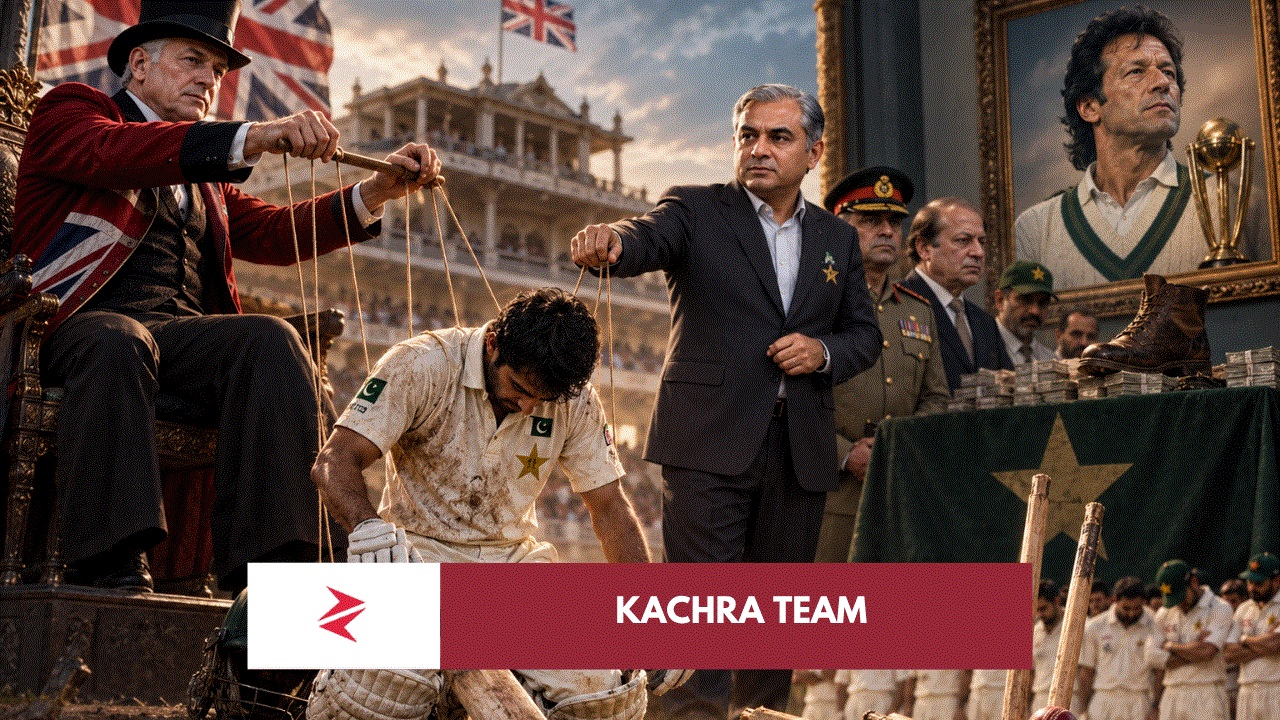
This is why the controversy surrounding photographs, portraits, official meetings and cricketing symbolism resonates so strongly with supporters. Symbols become explosive when performance has already hollowed out confidence.
The answer, however, is not to fight England’s ghosts.
It is to fix Pakistan’s institutions.
Pakistan has already proved that recovery can happen
The current collapse is not destiny.
That claim is empirically easy to defend.
Pakistan came from eighth to win the 2017 Champions Trophy.
Misbah built an elite Test side without conventional home advantage.
Imran inherited a cricket culture still finding its place among older powers and helped turn Pakistan into a side nobody wanted to face.
The talent therefore exists.
What Pakistan has repeatedly lacked is the boring machinery successful countries stop talking about because it works: stable pathways, credible selectors, long coaching tenures, domestic continuity, sports science, transparent appointments, preserved institutional knowledge and administrators whose success is measured over years rather than press conferences.
That is what independence looks like inside a sporting institution.
Not slogans.
Ownership.
FAQ: Does the graph prove Imran Khan made Pakistan great?
No. A trailing ten-year moving average cannot attribute national performance to one player. But Imran’s captaincy record, Pakistan’s increasing competitiveness during his career and the strength of the generation surrounding him make his leadership an important component of the rise. He captained Pakistan in 48 Tests, winning 14 and losing eight.