






































Share the post “Pakistan Does Not Need More Provincial Thrones—It Needs Power Below the Provinces”
Yet refusing a crude causal claim does not excuse the political failure the graphs expose. If Sindh’s education budget rose many times over while literacy stagnated, the honest question is not merely how much was budgeted but where it went, what portion reached primary and secondary classrooms, how much financed salaries and administration, whether posts were filled, whether teachers attended, whether buildings functioned, and whether parents possessed any institution close enough to hold responsible. A budget is an input. Literacy is a broad social outcome. Learning, attendance and completion sit between them. Political advertising routinely erases that chain.
What Nobody Is Telling You: The Eighteenth Amendment Was Only Half a Devolution
The great deception in Pakistan’s federalism argument is that provincial autonomy is repeatedly presented as the final destination. It is not. A citizen does not experience constitutional success because a provincial department gained control of a subject previously handled in Islamabad. A citizen experiences success when the school has a teacher, the clinic has medicine, the sewer is cleared, the building plan is lawfully decided and the official responsible can be removed by voters living under the consequences.
Article 140A does not invite provinces to create decorative councils. It establishes a constitutional duty to devolve political, administrative and financial responsibility to elected local representatives. When a provincial government delays elections, curtails municipal functions, controls local staff, withholds predictable transfers or denies mayors meaningful revenue authority, it preserves the shell of local democracy while removing its engine. That is why the real contest is not federation versus province alone; it is every upper tier’s appetite for retaining control over the tier below.
Musharraf-era local government is often remembered as evidence that district-level authority can improve proximity and school oversight, including through school-management committees. That experience deserves examination without nostalgia. Local structures did create additional channels of participation and accountability, but the system also operated under a military regime, depended heavily on an imposed institutional design and lacked the durable constitutional-political compact needed to survive. The lesson is not that dictatorship educates children better. The lesson is that proximity, assigned functions, money and continuity matter—and that democratic governments must build them lawfully rather than abandon them because a general once used them.
Sindh Is Not the Enemy; Centralised Patronage Is
The ugliest language in this debate attempts to turn Sindhis into freeloaders and Sindh into a fiscal burden. That is not Pakistani reform; it is ethnic abuse dressed as economic analysis. Sindh contains Pakistan’s largest commercial city, critical ports, industry, agriculture, energy resources and millions of citizens who are themselves victims of unequal services. Karachi’s deprivation cannot be repaired by humiliating rural Sindh, and rural Sindh’s deprivation cannot be hidden behind Karachi’s economic weight. The beneficiary of this hostility is the same centralised elite that prefers Punjabis, Sindhis, Pashtuns, Baloch, Mohajirs and Islamabad residents to fight over identity while budgets remain unreadable and responsibility remains untraceable.
The Pakistan-first answer is measurable devolution: hold local elections on time; publish a stable provincial distribution formula; assign functions without overlap; transfer the staff and assets needed to perform them; disclose district and school allocations in machine-readable form; audit outcomes; protect women’s representation; and let voters know exactly which tier failed them. National unity is not maintained by keeping citizens powerless. It is strengthened when every Pakistani can see the federation working where they live.
Does Pakistan Need More Provinces?
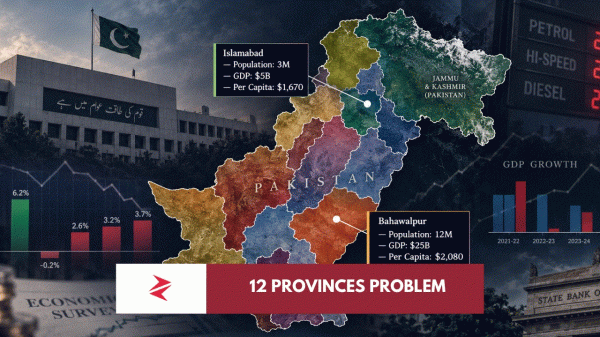
Possibly—but only after answering harder questions than how a viral map looks. New provinces may reduce distance, recognise neglected regions and make administrations more manageable. They may also create new political offices, duplicate bureaucracies, intensify disputes over water and assets, and force an NFC renegotiation without guaranteeing that a rupee reaches a union council. The test is not the number of provinces; it is whether power, money and accountability move closer to citizens.
Should Islamabad Become a Province?
Not merely to manufacture an NFC claimant or another political hierarchy. Islamabad unquestionably needs accountable metropolitan governance, a powerful elected mayor, transparent planning, restrained administrative coercion and clear control over municipal services. Creating a chief minister, cabinet, assembly and governor on top of the existing capital bureaucracy would be defensible only if a published constitutional and financial design proves that it improves representation without duplicating power or raiding provincial resources.
Can the Federation Directly Fund Every Division?
It can lawfully finance federal programmes and projects, but granting divisions a permanent direct share analogous to provincial NFC entitlements is a different proposition. That would require careful constitutional and fiscal design. The cleaner immediate route is for provinces to fulfil Article 140A and enact credible, formula-based downward transfers, while the federation broadens taxation, reduces unjustified exemptions and protects development space within its own share.
Did the Eighteenth Amendment Reduce Literacy?
The displayed time series does not prove that. It shows differing provincial trajectories and a slowdown or stagnation in important periods, especially in Sindh. Establishing causation requires district-level, methodologically consistent analysis controlling for spending composition, demographics, conflict, disasters, poverty, enrolment and learning. What can be said confidently is that devolution to provinces did not automatically deliver uniform educational progress.

What Happens Next
Pakistan should stop beginning reform with a map and start with a fiscal trail. Before Parliament creates a single new province, every provincial government should publish what each district received, what each local body controlled, what each school spent and what outcome changed. If the state cannot follow one education rupee from the divisible pool to a classroom desk, adding another assembly will only give that rupee one more corridor in which to disappear.