
































Pakistan has not merely approved another grant for another struggling state institution; it has placed Rs13 billion of public money behind a broadcaster whose greatest crisis is no longer technology, competition or even declining viewership, but the uncomfortable possibility that millions of Pakistanis simply do not trust it enough to care whether it survives.
That is the real story behind the Economic Coordination Committee’s decision to approve a Rs13 billion supplementary grant for Pakistan Television Corporation for the 2026–27 financial year. PTV had reportedly sought Rs20 billion to cover salaries, allowances, utility bills and other operating expenses, but the Ministry of Finance resisted the full demand. The eventual compromise was Rs13 billion, released through four quarterly instalments of Rs3.25 billion, with the Ministry of Information and Broadcasting ordered to return within two months carrying something that should have existed before the request was made: a comprehensive financial sustainability plan.
A bailout first and a business plan later. That sequence alone tells Pakistan everything it needs to know about how comfortably institutional failure has been normalised.
According to the Ministry of Finance’s account of the ECC decision, the quarterly releases are intended to meet PTV’s “operational and essential running expenses.” Dawn reported that the Finance Ministry reduced the original Rs20 billion request by almost one-third, while Profit by Pakistan Today confirmed that the grant would cover salaries and operations while PTV prepares its promised sustainability plan.
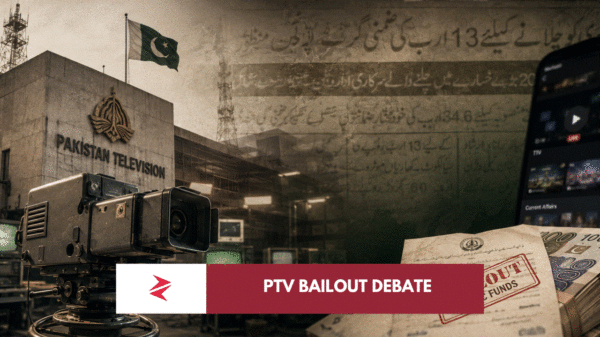
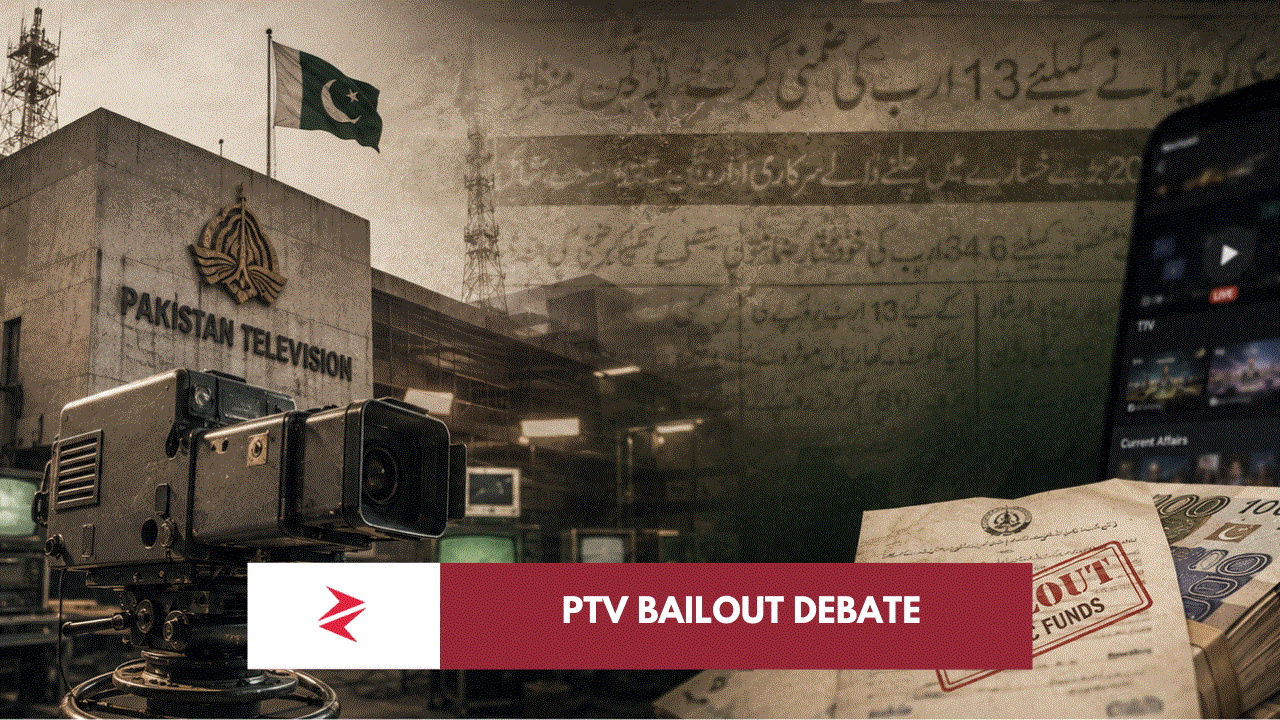
The newspaper clipping circulating with the news carries the same blunt headline in Urdu: “PTV ko chalanay ke liye 13 arab ki zimni grant manzoor”—a supplementary grant of Rs13 billion approved to keep PTV running. The choice of language is revealing. The money is not being presented as investment in original drama, regional production, digital transformation, documentary filmmaking or transmission modernisation. It is money to keep the machinery running.
The Rs13 Billion Question in Plain Numbers
| Indicator | Reported position | What it means |
|---|---|---|
| PTV’s original funding request | Rs20 billion | The corporation’s operating requirement substantially exceeded the amount approved |
| ECC-approved grant | Rs13 billion | Taxpayer support will keep essential operations functioning during FY2026–27 |
| Quarterly release | Rs3.25 billion | Funding is being staggered rather than released as one unrestricted amount |
| Sustainability-plan deadline | Two months | The government has demanded a restructuring and financing roadmap |
| PTV Home audience share | Reportedly 43% in 2012; approximately 4% now | Its mass-audience dominance has collapsed in the multi-channel and digital era |
| Reported workforce | More than 4,200 employees | A large fixed payroll limits spending flexibility |
| Reported annual budget | Approximately Rs17 billion | Salaries and pensions reportedly consume roughly half |
| PTV terrestrial reach | Around 90% of Pakistan’s population | The network retains strategic reach, particularly outside profitable urban markets |
| Pakistan broadband subscribers | 160.9 million by March 2026 | The public is rapidly migrating toward mobile and on-demand media |
Note: The bailout figures are supported by official and mainstream reporting. Audience, payroll and expenditure-share figures circulating in the public debate should be tested through a published, independently audited PTV performance report.
The financial comparison raised by one contributor to the online discussion is politically explosive: Rs13 billion is said to equal roughly 22% of the federal annual grant for higher education distributed among approximately 150 universities. Even if the precise comparison requires matching like-for-like budget categories, its emotional force is obvious. A country struggling to finance classrooms, hospitals, clean drinking water and public transport cannot expect taxpayers to treat billions spent on institutional inertia as harmless accounting.
Yet declaring that Pakistan “does not need PTV” is too simple. Pakistan does need a public broadcaster. It does not need this operating model.
PTV Was Once an Institution, Not Merely a Channel
There was a time when PTV was not competing to be the loudest screen in the room because it was the screen. Its news bulletins carried the weight of official verification. Its cameras represented the highest production capability available in the country. Its presenters were associated with measured language, polished Urdu and professional restraint, while its regional centres helped Peshawar, Quetta, Lahore and Karachi contribute distinct voices to a shared national culture.
That history matters. Pakistan did not imagine PTV’s significance after the institution declined. PTV helped produce the cultural memory through which several generations imagined Pakistan itself.

Its dramas were watched across borders. Its producers developed talent instead of buying ready-made social-media fame. Its programming could unite an entire household without reducing every exchange to political shouting. At its best, PTV was an archive, academy, theatre, newsroom and national meeting place simultaneously.
That institutional inheritance is precisely why the current position feels so wasteful. PTV once had the studios, cameras, transmission infrastructure, national access, accumulated archives and public recognition required to dominate the Pakistani media market. Private broadcasters had to build credibility and distribution from the ground up. PTV began with assets no competitor could easily replicate, yet it steadily lost audience attention while political governments continued treating it as an office-extension scheme.
Public criticism now describes it as “propaganda with no audience.” Harsh, yes—but difficult to dismiss when editorial credibility has fallen alongside commercial relevance.