



































Connect with Zorays

Hi, what are you looking for?

Politics & Governance

Stunting Crisis and Sindh’s Unfinished Reform: Why Bigger Provinces Are Killing Our Children

Half of Sindh’s children are stunted, a crisis tied to oversized provinces that dilute accountability, weaken nutrition programmes and stall effective policing.

AI-generated editorial illustration: Conceptual editorial illustration for Stunting Crisis Highlights Governance Gaps. Not a documentary photograph.
AI-generated editorial illustration: Stunting Crisis Highlights Governance Gaps
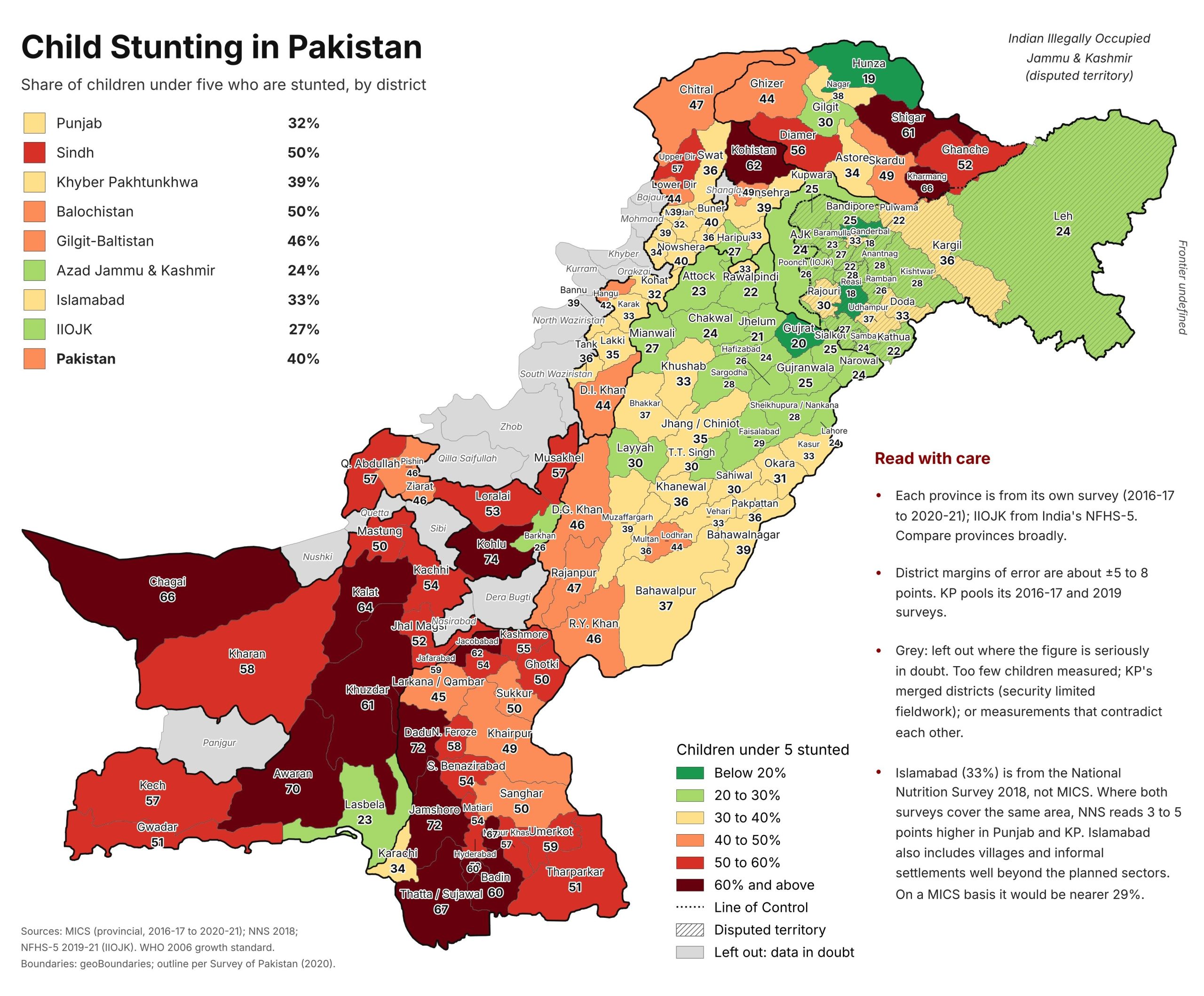
Choropleth map of Pakistan districts colored by percentage of children under five who are stunted, with a legend ranging from light green (below 20%) to dark red (60% and above) and notes on data sources and margin of error
Map shows provincial stunting rates, e.g., Sindh and Balochistan at 50 % and some districts exceeding 60 %

Why Size Matters for Governance

When a province must serve millions across disparate geographies, accountability evaporates. A smaller administrative unit can monitor nutrition programmes, allocate feeding‑scheme funds and enforce school‑based health checks without the bureaucratic inertia that currently swallows half of the children’s growth potential. The map’s authors argue that “responsive justice” and “effective policing” become possible only when the population size is manageable – a claim that aligns with Bilawal’s insistence that the Sindh Assembly’s decision on new units is the final word.

Public Cost of Inaction

The numbers are not abstract. A child who remains stunted carries a lifelong deficit in physical and cognitive development, translating into reduced earning power and higher health expenses for the family and the state. The map’s stark visual makes clear that half of Sindh’s future workforce is being short‑changed, and the promise of reform remains unfulfilled.

Accountability Question

If the Sindh Assembly truly decided on new administrative units, why does the debate still rage on the streets and on social media? If the map is accurate, why does the federal budget continue to allocate a fraction of resources to local governments, leaving districts to fend for themselves? The answer lies in a political class that prefers the illusion of control to the messy work of restructuring. The mothers of stunted children deserve more than slogans – they deserve a governance model that can deliver nutrition, health and education at the district level.


READ:  Faiz Essa will not become the Chief Justice

Pages: 1 2 3

Click to comment

Leave a Reply

Your email address will not be published. Required fields are marked *

You May Also Like

Politics & Governance

President Trump nominates career diplomat Natalie Baker as U.S. ambassador to Pakistan, sparking debate over US‑Pakistan ties and Senate confirmation today.

Sports

Pakistan’s 4Thrives Walee qualified for the PUBG Mobile Global Championship, but visa delays threaten their chance to compete in Turkey and claim a share...

Economy & Markets

Pakistan’s regional trade deficit rose 26% to $4.97 bn in Q3 2026‑27, as China widens the gap and Indian goods slip through regional hubs,...

World Affairs

Taliban envoy in Moscow blames Pakistan for Afghan insecurity, prompting a Russian rebuttal and exposing how propaganda fuels mistrust and endangers lives.

Sports

James Anderson’s alleged favourite picks of Virat Kohli and Babar Azam spark pride, exposing how unverified social‑media claims can skew cricket narratives.

Technology & AI

X’s new “Copy video link” button lets Pakistani users turn GIFs into WhatsApp stickers, but each copy‑paste consumes megabytes, adding costly data usage for…

Business & Startups

Wise froze a UK entrepreneur’s £500,000 account in China, stopping payroll and supplier payments and showing how opaque fintech closures threaten businesses.

Advertisement