










































America does not enthusiastically applaud a new military arrangement involving the Muslim world’s only declared nuclear power, NATO’s second-largest armed force and the custodian of Islam’s two holiest mosques because Washington has suddenly discovered the beauty of Islamic unity. It applauds when it believes the new architecture can be accommodated, influenced, armed, monetised or eventually redirected.
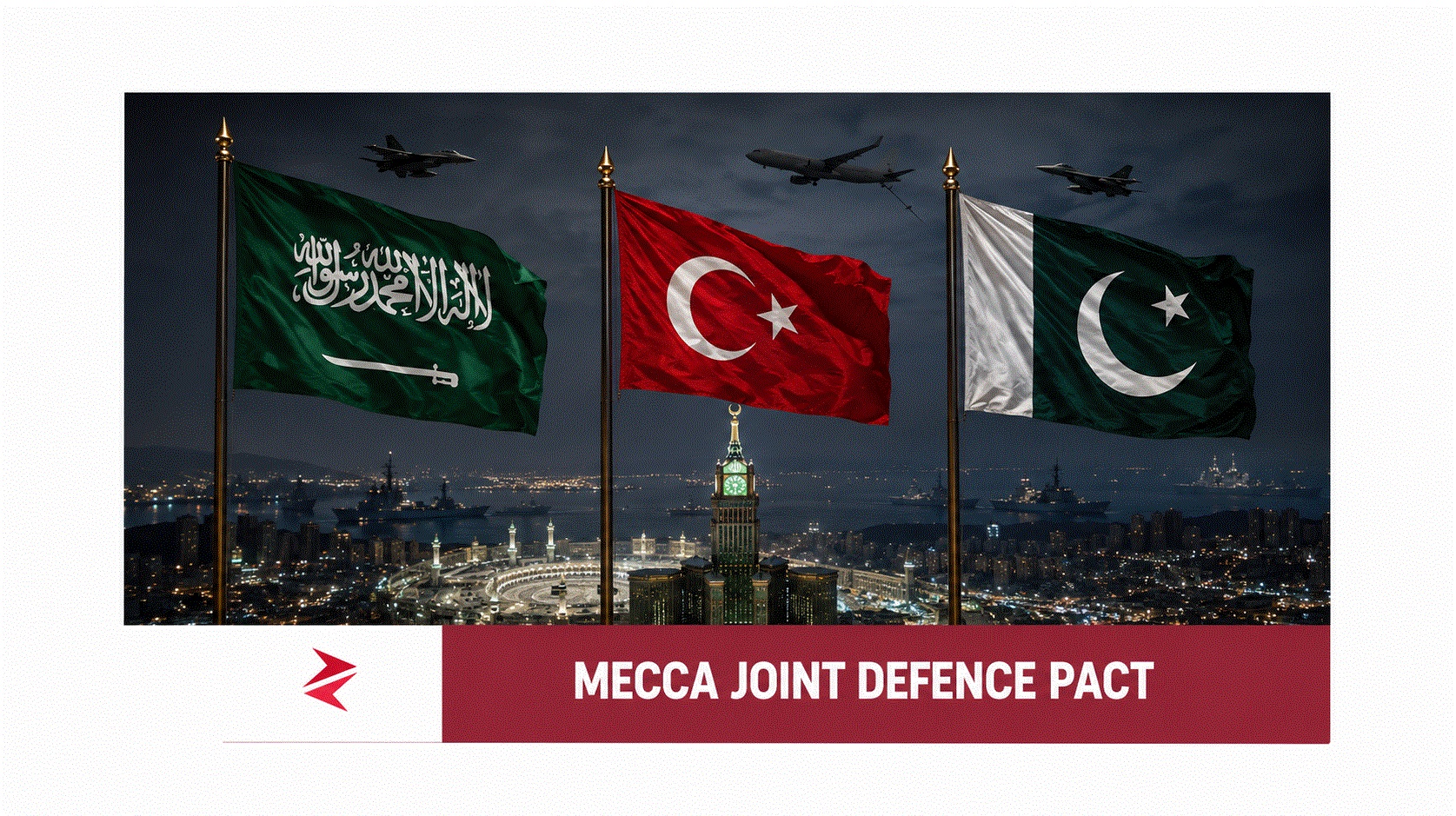
That is the uncomfortable contradiction at the heart of the Makkah Joint Defence Agreement signed by Pakistan, Saudi Arabia and Türkiye on August 7, 2026. The pact is real, historically significant and potentially valuable for Pakistan, but Donald Trump’s visibly enthusiastic endorsement should not be treated as an American certificate of independence. It should be treated as the first warning that Washington sees an opportunity inside the arrangement.
Pakistan has spent decades learning the ugly grammar of American friendship: praise when Islamabad is useful, pressure when it becomes independent, sanctions when it becomes capable, and lectures when it refuses to remain obedient. Islamabad has often been forced to flatter American presidents, praise their supposed peacemaking and perform gratitude merely to secure the diplomatic breathing room that stronger states take for granted. Call it strategic tact if one prefers polite language. Ordinary Pakistanis recognise the humiliating part of it too: a country repeatedly compelled to polish Washington’s ego before being allowed to protect its own interests.
The Makkah pact may finally create space beyond that dependency. The danger is that the same space could be converted into a new corridor for American arms, anti-Iran containment and eventual pressure over Israel.
What Was Actually Signed in Makkah?
The official Turkish presidency statement confirms that Crown Prince Mohammed bin Salman, President Recep Tayyip Erdoğan and Prime Minister Shehbaz Sharif signed the agreement at Safa Palace in Makkah. Its central provision declares that an armed attack against any one of the three states will be considered an attack against all three. It also calls for defence cooperation “in all its dimensions.” Türkiye’s official account of the agreement describes it as a collective-deterrence mechanism rather than an arrangement targeting a named country.
That sounds like NATO’s Article 5, and Turkish officials have publicly made the comparison. Yet similarity of language is not equality of capability. NATO possesses an integrated command structure, standing military headquarters, detailed force-planning procedures, shared standards and decades of rehearsed operational coordination. The Makkah pact’s publicly released text does not yet tell us which forces must respond, who commands them, what constitutes an “armed attack,” whether assistance is automatic or politically approved, or whether Pakistan’s strategic deterrent is anywhere near the table.
| Confirmed element | What remains undisclosed |
|---|---|
| An armed attack on one signatory is considered an attack on all | Whether military deployment is automatic |
| Defence cooperation will expand across multiple dimensions | The number and location of committed forces |
| The agreement strengthens collective deterrence | Whether nuclear deterrence is included |
| The pact is officially described as defensive | How Israel, Iran, India or the Houthis would be classified |
| Existing agreements remain intact | How Türkiye’s NATO obligations interact with the new pact |
| A coordination mechanism is expected | Command authority, financing and rules of engagement |
The agreement therefore creates a solemn political obligation, but its military teeth will depend on protocols that the public has not seen. Reuters reported that the declaration contained no specific description of the commitments accepted by each country. That omission is not a minor legal footnote. It is the difference between a functioning alliance and an impressive photograph.
Readers seeking the legal and operational foundation should first examine what Pakistan has already promised under the Makkah pact. The strategic question is no longer whether the agreement exists. It is whether the institutions beneath it can survive the first real crisis.
Why Is Trump Celebrating an Alliance That Appears to Reduce American Control?
Trump’s message described the agreement as a “big, bold, and important first step,” while Prime Minister Shehbaz Sharif publicly thanked him and credited his leadership with helping avert a nuclear catastrophe in South Asia. The Pakistani response may be read as deliberate diplomacy: praise an ego-driven American president, reduce immediate hostility and obtain room for Pakistan to build alternative partnerships.
Pakistan did not acquire a nuclear deterrent, defeat terrorism, develop the JF-17 ecosystem or deepen military cooperation with Türkiye by asking Washington for ideological approval. Yet Pakistani governments have repeatedly learned that openly humiliating the United States creates costs while flattering its president sometimes buys time. Pakistan must deal with the United States that exists, not the polite fictional superpower imagined in diplomatic textbooks.

However, Trump’s delight can also be understood through three American interests.
First, Washington wants wealthy partners to carry more of their own security burden while continuing to buy American weapon systems. A regional alliance does not threaten the American military-industrial model if its aircraft, missiles, sensors and support chains remain dependent on US suppliers.
Second, an arrangement involving two close American partners and one NATO member may help contain Iran without requiring unlimited American deployments. The United States can reduce direct exposure while retaining influence over the alliance’s logistics, interoperability and threat assessments.
Third, the pact may restrain Israel as a matter of deterrence while simultaneously preparing a broader US-sponsored regional security system in which Israel eventually becomes the unspoken technological node. That is where the Abraham Accords question becomes unavoidable.
Is the Pact Preparing Saudi Arabia and Pakistan for the Abraham Accords?
There is currently no public evidence that the Makkah Joint Defence Agreement contains a clause requiring Pakistan or Saudi Arabia to recognise Israel. There is also no disclosed evidence proving that it was secretly created as a bridge to the Abraham Accords. Presenting that suspicion as established fact would weaken rather than strengthen the Pakistani case.
But dismissing the possibility completely would be equally naïve.
The Abraham Accords are not merely ceremonial exchanges of embassies. Washington has consistently promoted them as a structure for diplomatic normalisation, commercial integration and regional security coordination involving Israel. A previous US policy explanation described Saudi-Israeli normalisation as the accords’ “ultimate realization.” That ambition did not disappear merely because Gaza exposed the moral bankruptcy of normalisation without Palestinian sovereignty.
Türkiye further complicates the picture. It recognised Israel decades ago and restored ambassador-level relations in 2022, although relations deteriorated sharply after Gaza. Ankara recalled its ambassador, suspended trade, restricted Israeli shipping and adopted an increasingly confrontational public position. Erdoğan has since described Israeli actions in Syria and Lebanon as a threat to Türkiye itself. It is therefore inaccurate to portray current Turkish-Israeli relations as warm, but it is equally inaccurate to pretend that a diplomatic and institutional history does not exist.
Saudi Arabia has been Washington’s most desired addition to the normalisation framework. Pakistan remains the most symbolically important Muslim state still refusing recognition of Israel without a just settlement for Palestine. Joining these two states with Türkiye creates a platform that could resist Israeli aggression—but, under different political management, the same platform could be sold as the Muslim security pillar of an American-designed regional order.
That possibility is not destiny. It is precisely why Islamabad must draw its red lines now.
The Pact Must Restrain Israel, Not Launder It
If the Makkah agreement responds only when Iranian missiles or Houthi drones strike Saudi territory, while remaining silent when Israel attacks Muslim land, occupies Palestinian territory or threatens Al-Aqsa Mosque, then the alliance will lose moral legitimacy before it develops military credibility.
Its founding test is painfully simple: does “collective security” include security from Israeli aggression, or does it merely mean protecting American-aligned governments from Washington’s chosen adversaries?
One social-media post included with the public debate accuses the three signatories of ignoring Gaza and forming an alliance only after Saudi Arabia faced Iranian and Houthi retaliation. Its claim that Israel has killed “millions” since October 2023 is not substantiated by the evidence presented and should not be repeated as a verified statistic. Its underlying political question, however, cannot be dismissed through fact-checking one exaggerated number: why did the Muslim world fail to build meaningful collective deterrence while Palestinians were being devastated?
The pact’s credibility will not be measured by ceremonial language about brotherhood. It will be measured by whether it produces coordinated diplomatic penalties, air and missile defence, maritime protection, intelligence sharing, humanitarian access and a firm prohibition against facilitating attacks on another Muslim country.
Pakistan should insist that no signatory’s territory, airspace, ports or intelligence infrastructure may be used for an offensive operation against another member of the Muslim world without collective consultation and a defensible basis under international law. Otherwise, Pakistan could be dragged into defending the consequences of decisions it neither approved nor controlled.
For the broader background, Pakistan’s experience during the Iran-Israel war shows why a binary choice between Tehran and Washington would be strategically disastrous. Likewise, Pakistan’s developing defence diplomacy with Kuwait demonstrates that Islamabad can expand Gulf security cooperation without surrendering every relationship to an anti-Iran template.









