




































| Appropriate Pakistani response | Why it is justified | Necessary safeguard |
|---|---|---|
| Survey all installations outside the Indian High Commission’s approved boundary | Establishes whether comparable external structures exist | Use official maps, approvals and photographic records |
| Serve a written notice identifying each disputed installation | Creates due process and prevents allegations of arbitrary action | Allow a reasonable compliance period |
| Remove unauthorised structures if India does not comply | Applies the same boundary principle invoked by New Delhi | Avoid entry into diplomatic premises |
| Replace necessary external barriers with state-controlled protection | Preserves Pakistan’s international security obligations | Conduct a professional threat assessment |
| Publish the legal order and before-and-after evidence | Separates lawful reciprocity from revenge theatre | Redact operationally sensitive security details |
| Offer reciprocal restoration through diplomatic talks | Keeps escalation reversible | Require equal treatment for Pakistan’s mission |
Article 22 of the Vienna Convention makes mission premises inviolable and places the receiving state under a “special duty to protect the premises” against intrusion, damage and disturbance. That obligation does not automatically legalise every structure installed on a public road beyond an approved diplomatic boundary. Equally, the “encroachment” label does not release a host government from considering whether demolishing an external security perimeter creates a foreseeable danger to the mission, its staff or visitors.
Pakistan’s strongest response would therefore combine both principles: no unapproved occupation of public land and no negligent weakening of diplomatic security. Remove what is demonstrably unauthorised, replace essential protection through Pakistani state agencies and document the entire process. That is reciprocity with discipline.
What Nobody Is Telling You About the Bulldozer
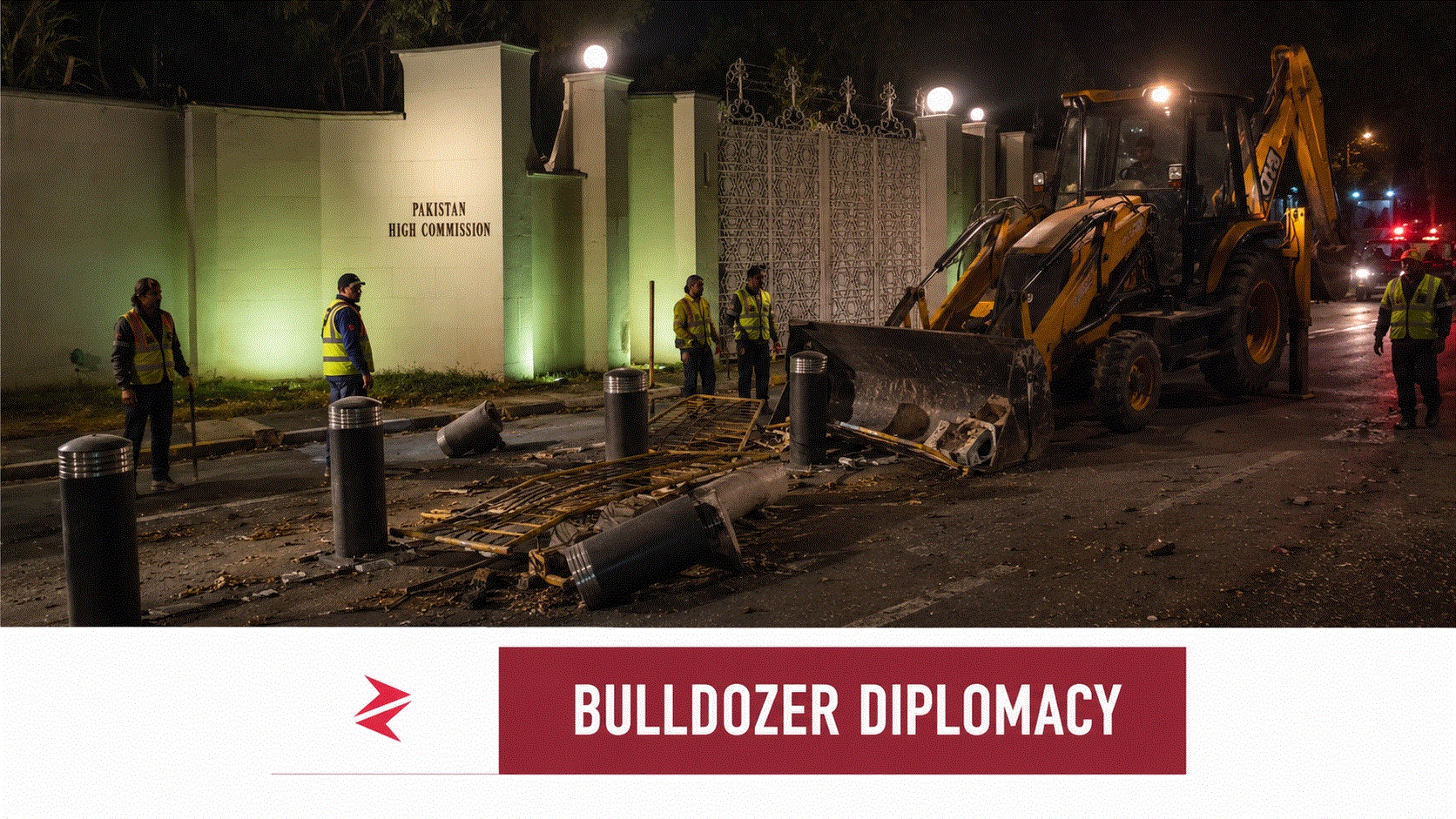
The bulldozer is not politically neutral in contemporary India. It has become a symbol deliberately associated with collective punishment, majoritarian power and the destruction of properties belonging disproportionately to Muslims. This does not make every municipal demolition legally identical, but it explains why sending a JCB outside Pakistan’s mission carries a meaning far beyond traffic management.
In 2023, Amnesty International called for an immediate halt to demolitions in Kashmir, while its subsequent research demanded an end to the targeted demolition of Muslim properties in India. Against that background, a Pakistani user’s observation that India is “famous for using bulldozers, especially against Muslims” was not created from thin air. It reflected an existing and internationally documented political association.
The High Commission incident must not be falsely equated with the demolition of a Kashmiri family’s home, because the factual and legal circumstances differ. Nevertheless, the political imagery overlaps. A state that has converted the bulldozer into a nationalist emblem cannot pretend surprise when its deployment outside Pakistan’s diplomatic mission is interpreted as intimidation rather than housekeeping.
This is the same narrative problem exposed when a direct question in Norway unsettled India’s carefully managed image: the louder the performance becomes, the more obvious the underlying insecurity looks. Strong states explain their legal decisions, publish their evidence and accept scrutiny. Insecure political systems demand applause for machinery.
Should Pakistan Close the Indian High Commission?
No. Closing diplomatic missions may produce a few triumphant social-media posts, but it would remove one of the few remaining channels available during a military, consular or humanitarian crisis. High commissions are not social clubs. They communicate government positions, protect citizens, process official matters and provide emergency contact when every other relationship has frozen.
Pakistan also gains nothing by cutting water, electricity or essential services, harassing personnel, obstructing diplomats on public roads or copying abusive behaviour. Such measures would weaken Islamabad’s legal position and allow Indian media to replace the bulldozer story with a more convenient victimhood narrative.
The intelligent response is controlled pressure, not blind rage. The same principle applies to disputes over water, visas and security, which is why evidence must remain central to discussions such as whether Indian action against Pakistan’s rivers could produce the outcomes its television rhetoric promises. Pakistan is strongest when it answers noise with records, maps, law and measurable consequences.
Frequently Asked Questions
Did India demolish the Pakistan High Commission?
No. Available reporting indicates that Indian authorities removed external barriers, fencing, queue-management structures and other installations near the visa section. The main compound and entrance remained intact.

Were the removed structures illegal?
Indian official sources said they extended beyond the approved boundary, but the relevant approvals, notices and boundary documents had not been published at the time of writing. The claim should therefore be attributed, not presented as independently established fact.