




































An alleged counterfeit-postage operation becomes an indictment of an entire country, while the uncomfortable question of how millions of labels allegedly entered America’s delivery network disappears beneath demands to punish Pakistanis collectively. That is the distortion surrounding the Faheem Akram case: a serious criminal allegation is being converted into permission to attack people who had nothing to do with it.
Pakistan does not need to defend counterfeit postage to defend its citizens against collective blame, and ordinary Pakistanis should not have to choose between cheering an alleged fraud and apologising for their nationality. The defensible position is straightforward: establish what happened, prosecute whoever is proven responsible, examine the controls that allegedly failed, and refuse the attempt to turn one defendant’s name into a verdict against a nation.
What the official case actually says
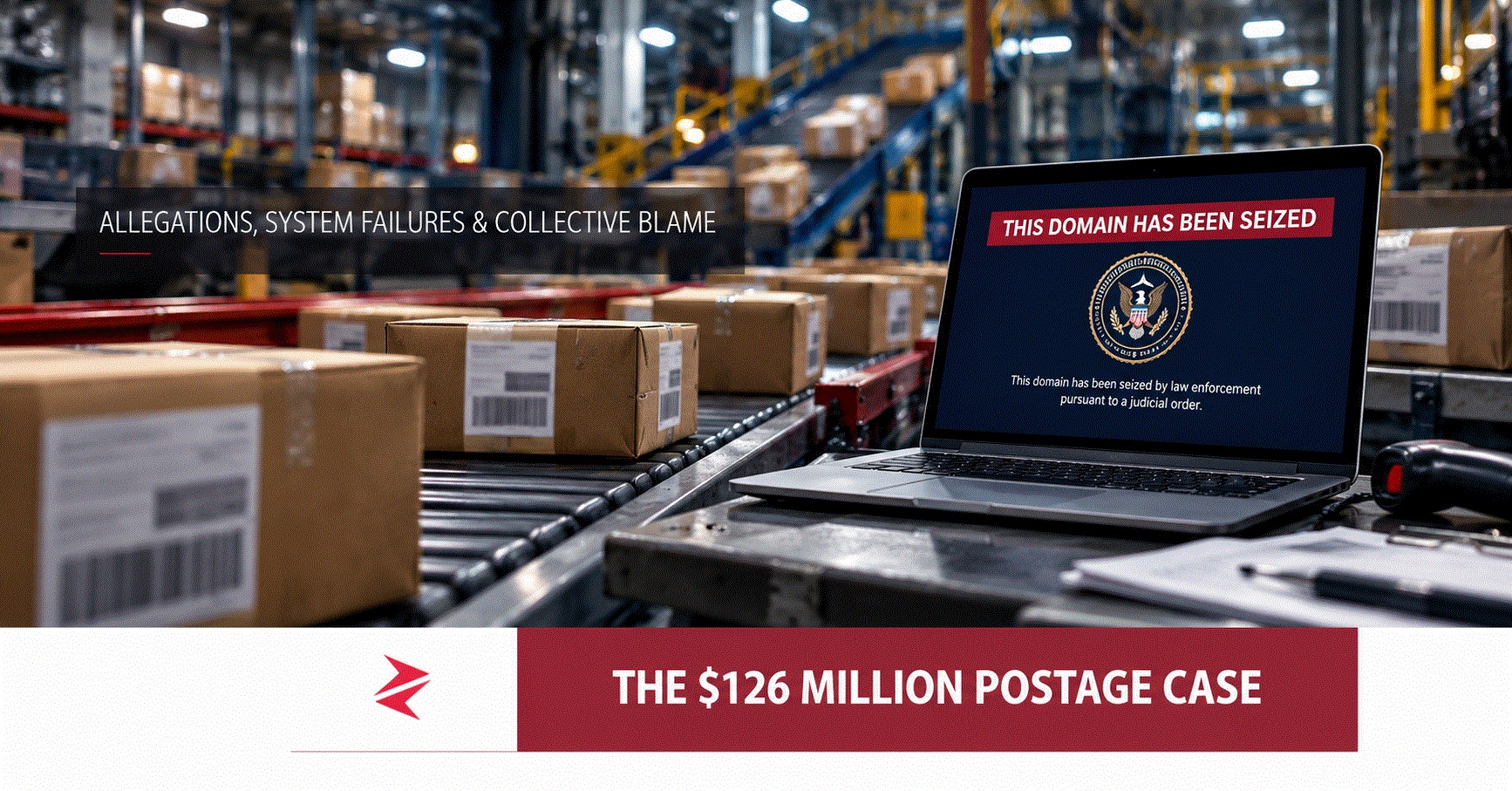
The U.S. Department of Justice announcement, dated September 28, 2026, identifies Faheem Akram as a 33-year-old resident of Khanewal, Pakistan, and alleges that he operated LabelsBank.com, an unauthorised website selling counterfeit USPS postage. The case is an indictment, rather than a conviction, and the Department explicitly states: “An indictment is merely an allegation.” United States Department of Justice
The Postal Inspection Service’s account describes an alleged operation selling fixed-price labels, typically for $2, regardless of package characteristics. It says customers obtained shipping services at deeply discounted prices through counterfeit postage, and that a court order authorised seizure of the domain. These are the central allegations; they do not establish every additional story circulating about properties, accomplices, political protection or the defendant’s whereabouts. United States Postal Inspection Service
| Issue | Officially reported position | What readers should distinguish |
|---|---|---|
| Defendant | Faheem Akram, 33, of Khanewal | Identification in a criminal allegation does not establish guilt |
| Website | LabelsBank.com | Authorities say it was unauthorised to sell USPS products and services |
| Alleged volume | More than 5.1 million counterfeit labels | A label count is not a dollar amount |
| Buyers | More than 5,200 individuals, according to DOJ | Purchasing does not, by itself, establish a buyer’s knowledge or intent |
| Typical advertised price | $2 per label | This was allegedly counterfeit postage, rather than an authorised discount |
| Alleged USPS losses | More than $126 million | Postal losses are not interchangeable with the operator’s earnings |
| Enforcement | Domain seized and website shut down | A website seizure does not establish an arrest or conviction |
The table summarises the authorities’ allegations and reported enforcement action, rather than judicial findings. United States Department of Justice
A label that scans is not proof that postage was paid
One of the most revealing questions in the public discussion is also understandable: if the labels worked and parcels were delivered, why was selling them wrong? The confusion comes from treating a shipping label as though it were an independent delivery service, when the actual transport, sorting and delivery were allegedly being performed by USPS.
A legitimate shipping business can negotiate rates, resell authorised services or charge customers for managing fulfilment, but those arrangements depend on valid postage and an authorised commercial relationship. The allegation here is materially different: buyers allegedly obtained access to another organisation’s delivery network using counterfeit evidence of payment. A parcel progressing through that network would demonstrate operational acceptance, rather than prove that the postage was genuine.
That distinction matters well beyond this case. A tracking event, a professional website or a successful previous delivery can make a transaction appear credible without answering the decisive question of whether the underlying service was lawfully purchased. The Postal Inspection Service’s counterfeit-postage guidance warns about bogus postage sold through social marketplaces, third-party ecommerce vendors and websites, while recommending approved providers. United States Postal Inspection Service
For Pakistani ecommerce operators, the practical lesson is to verify the supplier and the commercial arrangement before building a business around a suspiciously cheap label. A supplier’s dashboard showing “delivered” should never replace invoices, payment records and confirmation that the postage source is legitimate.
The $126 million figure is not his personal fortune
The viral narrative repeatedly merges three different quantities: the number of labels allegedly sold, the amount customers may have paid, and the losses attributed to USPS. Those figures describe different things, and combining them produces dramatic claims that the public record does not support.

For illustration, 5.1 million labels multiplied by $2 equals $10.2 million, but that calculation assumes every label sold at the same price and says nothing about refunds, actual collections, operating costs or net profit. It is arithmetic applied to a simplified scenario, rather than a verified statement of Akram’s income. Likewise, the alleged $126 million postal loss cannot simply be described as cash deposited into his account.
The Urdu figures deserve particular care. $126 million is 12.6 crore dollars, whereas 126 lakh dollars is $12.6 million, a tenfold difference. A label count of approximately 51 lakh is another quantity altogether. When these numbers are misread, a serious allegation becomes a financial fairy tale, complete with imaginary earnings and unsupported claims about an empire built in a few months.
“Five years for billions” leaves out the wire-fraud charges
The claim that the case amounts to a five-year maximum sentence also misses a material part of the announcement. DOJ reports conspiracy and counterfeit-postage counts carrying maximum penalties of five years, alongside four wire-fraud counts carrying maximum penalties of 20 years each. These are statutory maximums, rather than a sentence already imposed, and the eventual outcome cannot be predicted by casually adding or selecting them. United States Department of Justice
The joke that a few years in prison would be a reasonable exchange for enormous wealth therefore rests on two unsupported assumptions: that the alleged losses equal personal wealth and that a particular sentence is guaranteed. Turning those assumptions into admiration does Pakistani entrepreneurship no favours, because it replaces the difficult work of building a legitimate business with the fantasy that fraud is simply a shortcut with manageable consequences.
The American controls deserve scrutiny, too
The allegation raises a substantial institutional question: how could counterfeit postage allegedly facilitate shipping at such scale before the operation was stopped? Asking that question does not excuse the alleged seller; it asks whether the organisation providing the service had adequate mechanisms to identify unpaid or fraudulent postage.
The public announcements reviewed here do not explain the complete technical mechanism, establish a particular software vulnerability, prove insider assistance or substantiate the popular claim that an annual audit was the first moment anyone noticed. Assertions about compromised accounts, copied identifiers, backend collaborators or deliberate official protection therefore remain speculation unless supported by further records.
What the alleged scale does justify is a demand for a clear account of validation, detection and response. Which controls identified suspicious postage, how quickly did those signals reach investigators, and what changes prevent a repeat? Public confidence depends on answering those questions, rather than allowing nationality to become a convenient substitute for examining the delivery system.
The same discipline applies when evaluating Pakistan’s digital infrastructure through measurable evidence: a confident narrative is only useful when the underlying system can be examined.
America’s fraud problem cannot be explained by a Pakistani surname
The observation that scams also occur in the United States is valid, but named examples should be handled according to their own evidence and legal status. Controversies involving browser extensions, cryptocurrency projects or retail returns cannot all be compressed into identical, proven criminal cases merely because social media uses the word “scam.”
A stronger comparison comes from America’s own official data. The Federal Trade Commission reported that consumers lost more than $12.5 billion to fraud in 2024, including $5.7 billion in investment scams and $2.95 billion in imposter scams. These are reported consumer losses across the FTC dataset, rather than a count of fraud committed by any particular nationality or a directly comparable measure of USPS losses. Federal Trade Commission
Those figures do not prove that Americans are inherently dishonest, just as the allegations against Akram do not prove that Pakistanis are. They demonstrate the scale of the fraud problem reported to American authorities, while leaving the nationality of individual perpetrators to case-specific evidence. Anyone applying that distinction to American offenders should apply it consistently to Pakistani defendants.
When the comments stop discussing postage
The supplied public discussion contains competing reactions: concern about fraud, confusion about the business model, admiration for supposed ingenuity, questions about postal oversight, and hostility directed at Pakistanis and Muslims collectively. It is a selected discussion, rather than a representative survey of either country, so it cannot support claims about what all Americans, Indians or Pakistanis believe.
Nevertheless, the rhetorical shift is visible. Assertions about military protection, intelligence involvement or a supposed religious campaign are presented alongside demands for collective deportation and violence, despite those claims having no established connection to the official allegations reviewed here. At that point, the discussion has left the evidentiary questions surrounding counterfeit postage and begun using a criminal accusation to legitimise prejudice.
Pakistanis owe no apology for crimes they did not commit. A doctor, student, engineer or shopkeeper does not inherit liability because an accused person shares a birthplace or surname, and a demand for prosecution becomes intellectually dishonest when it expands into punishment for unrelated families and communities.
That is why the importance of seeing Pakistan through people rather than inherited headlines belongs in this discussion. A criminal case should reveal the conduct of those involved, rather than erase everyone else.
Pakistan’s answer should be evidence and lawful accountability
Defending Pakistan’s reputation requires rejecting the temptation to romanticise the alleged operation. Calling counterfeit postage “disruption” confuses innovation with a claim that someone obtained services without valid payment, while praising the supposed earnings teaches young entrepreneurs to judge success by visible wealth rather than the legitimacy of its source.