




































Share the post “PNS Hunain–Indian Warship Collision: What Is Confirmed, What Is Propaganda and What the 1991 Agreement Actually Says”
The Detail Indian Coverage Initially Omitted
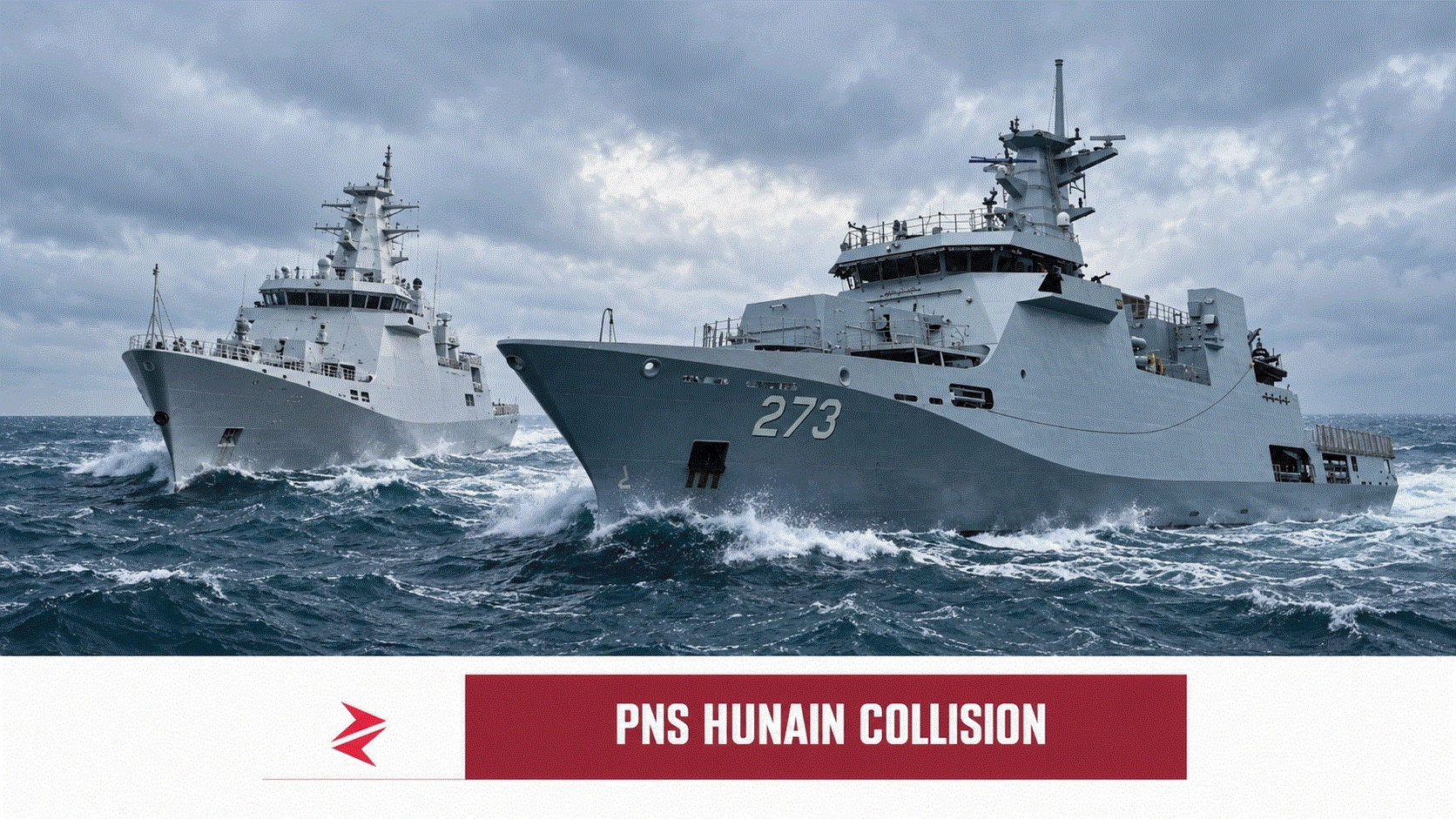
The earliest Indian narrative was remarkably neat: an Indian warship was conducting routine surveillance; PNS Hunain charged toward it; India showed restraint; the Pakistani ship was damaged and retreated; the Indian vessel continued its mission. It was a ready-made morality play in which one navy was reckless and the other professionally absorbed the impact.
Pakistan’s subsequent statement breaks that neat construction. Islamabad says its navy was conducting an announced exercise, places the encounter inside Pakistan’s EEZ and accuses the Indian vessel of closing dangerously. That account does not automatically prove Pakistan right, just as India summoning a diplomat does not prove India right. Diplomatic protest is a declaration of position, not a maritime accident investigation.
This distinction matters because some reports treated India’s summoning of Pakistan’s diplomat almost like a judicial verdict. Pakistan’s reciprocal protest makes the weakness of that logic obvious: if summoning a diplomat proves culpability, both ships must somehow be solely responsible.
The defensible conclusion is narrower but far stronger: the collision is confirmed; causation is contested; neither side has yet released enough primary navigational evidence for an independent attribution of fault.
What Article 10 of the 1991 Agreement Actually Requires
The relevant instrument is the Agreement on Advance Notice on Military Exercises, Manoeuvres and Troops Movements, signed by Pakistan and India in April 1991. Article 10 says naval ships and submarines belonging to the two countries are not to close within three nautical miles of each other in order to avoid accidents.
The text is reproduced by the Stimson Center and establishes a bilateral separation safeguard more demanding than waiting until two vessels are already in a last-second collision situation. Three nautical miles equal approximately 5.56 kilometres.
| Protocol | Operational requirement | Why it matters here |
|---|---|---|
| 1991 Agreement, Article 10 | Pakistani and Indian naval vessels should remain at least three nautical miles apart | Physical contact means the intended separation safeguard plainly failed |
| COLREG Rule 5 | Maintain a proper lookout | Bridge teams must continuously assess traffic and developing danger |
| COLREG Rule 6 | Proceed at a safe speed | Speed must permit effective action under prevailing conditions |
| COLREG Rule 7 | Use all available means to determine collision risk | Radar, visual observation and systematic tracking become crucial evidence |
| COLREG Rule 8 | Take positive, timely and substantial action to avoid collision | Small, ambiguous or delayed alterations may worsen a close-quarters encounter |
| Bridge communications | Use recognised maritime channels where appropriate | Recordings could establish whether warnings were transmitted, received or ignored |
The International Maritime Organization’s collision-prevention guidance emphasises safe speed, proper risk assessment and the prohibition against conclusions based on scanty radar information. Rule 8 further requires collision-avoidance action to be positive, timely and large enough to be readily apparent.
Consequently, determining fault requires far more than comparing ship sizes or watching an unattributed ten-second clip. Investigators would need course histories, speed data, radar plots, automatic tracking records, bridge logs, radio traffic, manoeuvring orders and the location and geometry of damage on both hulls.
Without that evidence, “Pakistan rammed India” and “India attacked Pakistan’s exercise” remain rival allegations—not completed investigations.