





































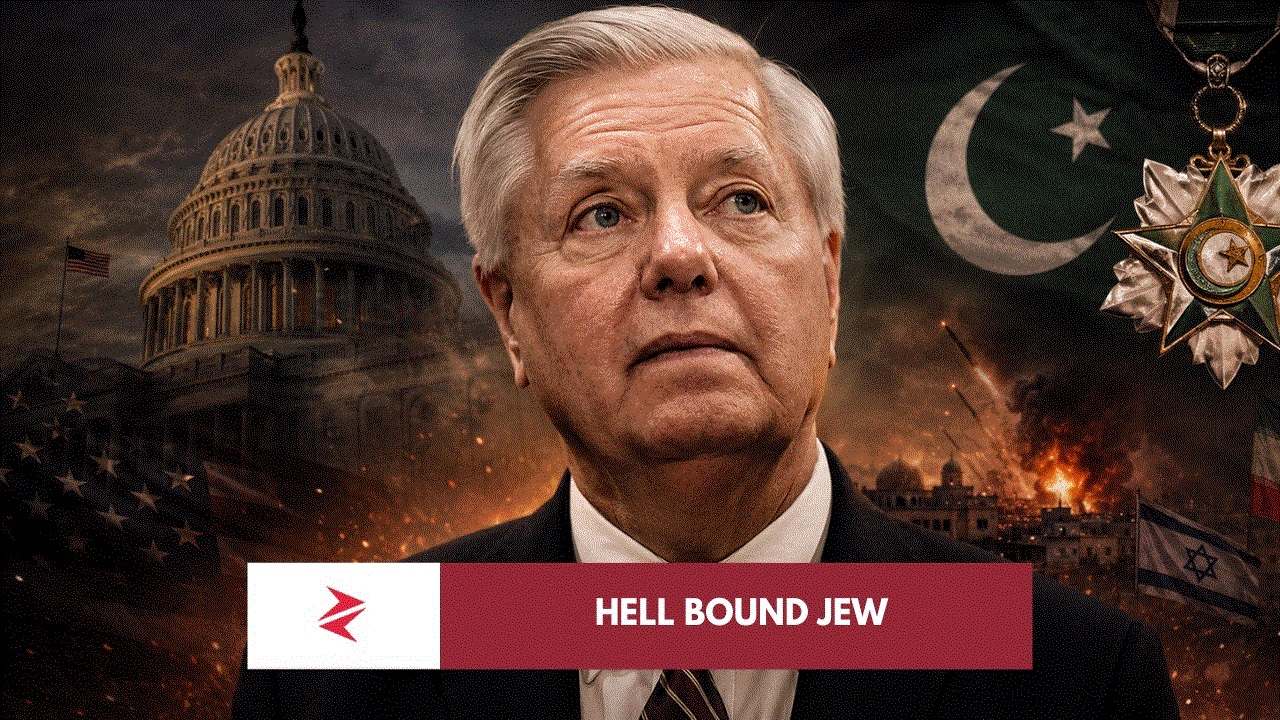
Death does not turn a political record into a blank page, and Pakistan should stop behaving as though every obituary requires us to develop diplomatic amnesia. Instead Pakistan should revoke the Hilal-i-Quaid-i-Azam that they conferred.
US Senator Lindsey Graham has died at 71 after what his office described as a “brief and sudden illness”, a development announced through his official account and rapidly carried by Al Arabiya English and international news organisations. Yet before Washington, Jerusalem and Kyiv complete the process of polishing Graham’s career into one uninterrupted story of patriotism and global leadership, Pakistan has every right to open a government document dated August 14, 2019 and ask a very uncomfortable question.
Why did we honour this man with the Hilal-i-Quaid-i-Azam for “Services to Pakistan”?
And what exactly did Pakistan learn when, seven years later, the same senator publicly declared: “I don’t trust Pakistan as far as I can throw them”?
That is not an angry Pakistani tweet. That is not a WhatsApp conspiracy. That is not somebody photoshopping Graham into an AI-generated hellscape with a demon holding a trident.
That is the documentary record.
First, Correct the Viral Mistake: It Was Not Sitara-i-Pakistan
One of the screenshots circulating after Graham’s death incorrectly identifies his Pakistani honour as the Sitara-i-Pakistan. The official Press Information Department record is unambiguous. Under the heading HILAL-I-QUAID-I-AZAM, entry number 10 reads: “Senator Lindsey Graham (USA) Services to Pakistan.” The award was announced among Pakistan’s 2019 civil awards, with the investiture scheduled for Pakistan Day 2020.
This correction matters because the internet has a terrible habit of weakening a perfectly legitimate argument with one incorrect screenshot. We do not need the wrong award. The truth is already more powerful.
Pakistan gave Lindsey Graham the Hilal-i-Quaid-i-Azam.
| Date | Documentary Record | What It Means for Pakistan |
|---|---|---|
| January 2019 | Graham promoted a strategic rather than merely transactional US-Pakistan relationship | Islamabad saw him as an influential advocate in Washington |
| July 22, 2019 | Graham publicly backed a strategic relationship and possible free trade agreement with Pakistan | His political value to Pakistan was openly recognised |
| August 14, 2019 | Pakistan announced Hilal-i-Quaid-i-Azam for Graham for “Services to Pakistan” | The relationship was converted into a state honour |
| January 16, 2020 | Pakistan’s Foreign Ministry again praised his support for the bilateral strategic partnership | Graham remained institutionally valued by Islamabad |
| November 2023 | Graham said no level of Gaza civilian casualties would necessarily make him question Israel’s military objective | His uncompromising Israel alignment became increasingly explicit |
| May 2024 | Graham invoked Hiroshima and Nagasaki while arguing Israel should receive the weapons it needed | His hawkish military philosophy became impossible to ignore |
| May 12, 2026 | “I don’t trust Pakistan as far as I can throw them” | The honoured “friend of Pakistan” openly attacked Pakistan’s diplomatic credibility |
| May 2026 | Graham questioned Pakistan’s mediator role amid Islamabad’s opposition to Israel normalisation pressure | Pakistan’s independent regional position collided with Graham’s priorities |
| July 11, 2026 | Graham died aged 71 following a brief and sudden illness | His death reopened debate over the political legacy Pakistan once rewarded |
The 2019 and 2020 entries are supported by Graham’s Senate archive, Pakistan’s Foreign Ministry and the official civil-awards announcement; the 2023–2026 entries are drawn from recorded public statements and contemporaneous reporting.

In 2019, Lindsey Graham Sounded Like Washington’s Best Salesman for Pakistan
This is the part many younger Pakistanis will not remember.
In July 2019, after participating in the meeting between Donald Trump and then-prime minister Imran Khan, Graham issued a statement through his own Senate office. He said: “It is now time for the United States to have a strategic relationship with Pakistan.” He promoted a free trade agreement linked to security performance and praised changes he said he had observed in Pakistan’s military approach along the Afghan border.
Read that again.
A strategic relationship.
Trade.
Regional stability.
Recognition of Pakistan’s military actions.
Pakistan’s “complete buy-in” as essential to the Afghanistan settlement.
Then look at the timing. Graham’s statement came on July 22, 2019. Pakistan’s civil-award announcement came weeks later, on August 14.
By January 2020, Pakistan’s Ministry of Foreign Affairs was still officially appreciating Graham’s support for strengthening the Pakistan-US strategic partnership. The ministry recorded his support for greater bilateral trade, agricultural cooperation and movement towards a free trade agreement, while Graham praised Pakistan’s role in the Afghan political reconciliation process.
From Islamabad’s perspective at the time, the calculation is not difficult to reconstruct. Pakistan had endured years of American accusations over Afghanistan, Trump had previously attacked Pakistan publicly, and the country desperately needed influential voices inside Washington willing to argue that engagement with Islamabad was strategically necessary.
Graham was useful.
So Pakistan honoured him.
That is precisely the problem.
What Nobody Is Telling Pakistan: We Keep Confusing Usefulness With Friendship
Foreign policy has no permanent friends. Pakistanis repeat this sentence endlessly and then our state behaves as though every foreign politician who says three pleasant things about Islamabad deserves to be emotionally adopted.
Lindsey Graham was not necessarily lying in 2019 when he advocated a stronger relationship with Pakistan. The more uncomfortable explanation is that Pakistan genuinely aligned with an American strategic requirement at that particular moment.
Washington wanted a way out of Afghanistan.
Pakistan mattered.
Imran Khan mattered.
Pakistan’s military establishment mattered.
The Taliban channel mattered.
Therefore, Lindsey Graham spoke of strategic partnership, trade incentives and mutual economic benefit.
This transactional geometry is exactly why my earlier analysis, Donald Trump: The New World Order and the Muslim World, argued that Pakistan must read international diplomacy through power and leverage rather than the emotional vocabulary sold in press conferences. Pakistan is celebrated when Pakistan is necessary; Pakistan is lectured when Pakistan is independently useful to somebody Washington dislikes.
The lesson was sitting in front of us.
We simply awarded it a medal.
Then Came Gaza, Iran and Graham’s Unapologetic Israel Alignment
Lindsey Graham’s political identity cannot honestly be separated from his extraordinary support for Israel’s military posture.
In November 2023, when asked whether there was a level of civilian deaths in Gaza that would cause him to question Israel’s approach, Graham said there was “no limit” in the context of the objective of destroying Hamas, although he also said Israel should try to limit civilian casualties.
In May 2024, he invoked the American atomic bombings of Hiroshima and Nagasaki while arguing that Israel should be given the weapons it required to end its war. Graham later rejected the interpretation that he had literally called for a nuclear attack on Gaza, but his argument remained rooted in the idea that an existential war could justify overwhelming force.
This was not some anonymous internet radical writing beneath a flag emoji.
This was a senior American senator with decades of congressional influence.
By the time of his death, even mainstream obituary coverage described Graham as a staunch supporter of Israel and an advocate of an aggressive American foreign-policy posture, particularly on Iran.
So when Graham eventually turned his suspicion towards Pakistan during the 2026 Iran crisis, Pakistanis should have understood the ideological collision immediately.
Pakistan was attempting to function as a diplomatic bridge.
Graham was looking at the region through a different security architecture.
Those two positions were eventually going to collide.
“I Don’t Trust Pakistan as Far as I Can Throw Them”
On May 12, 2026, Graham questioned Pakistan’s role in US-Iran negotiations during a Senate Appropriations subcommittee hearing.
His words were direct:
“I don’t trust Pakistan as far as I can throw them.”
Graham was reacting to a CBS report, based on anonymous US officials, alleging that Iranian military aircraft had been parked at Pakistani airfields and were potentially being protected from American strikes. American military officials questioned during the hearing declined to publicly verify the intelligence, citing classified matters and ongoing negotiations. Pakistan’s Foreign Ministry categorically rejected the interpretation, saying Iranian and American aircraft had arrived in connection with the Islamabad talks and that the Iranian aircraft had no military preservation arrangement.
Here is the part that should irritate Pakistan.
The senator once rewarded by Pakistan for “Services to Pakistan” did not merely ask for clarification.
He publicly attacked the credibility of Pakistan as a mediator.
He said perhaps somebody else should mediate.
He declared his distrust before the military officials sitting in front of him publicly confirmed the allegation.
Meanwhile, President Trump told reporters that Pakistan had been “great” and specifically praised Pakistan’s field marshal and prime minister.
Graham was, at that moment, harder on Pakistan than the American president whose administration was actually involved in the negotiations.
And this is why Nuclear Pakistan Did Not Need Washington’s Permission to Act Like a Sovereign State remains relevant beyond one particular crisis. A nuclear state of Pakistan’s size cannot indefinitely shape its diplomatic decisions around the fear that a foreign senator may stop calling us a strategic partner.














AI Music Generator
July 13, 2026 at 8:52 am
What stood out to me is the contrast between the honor Pakistan once extended and the later rhetoric that created distrust. Whether people agree with your conclusion or not, the piece raises an important question about how quickly diplomatic relationships can shift when political messaging starts to outweigh long-term engagement.