










































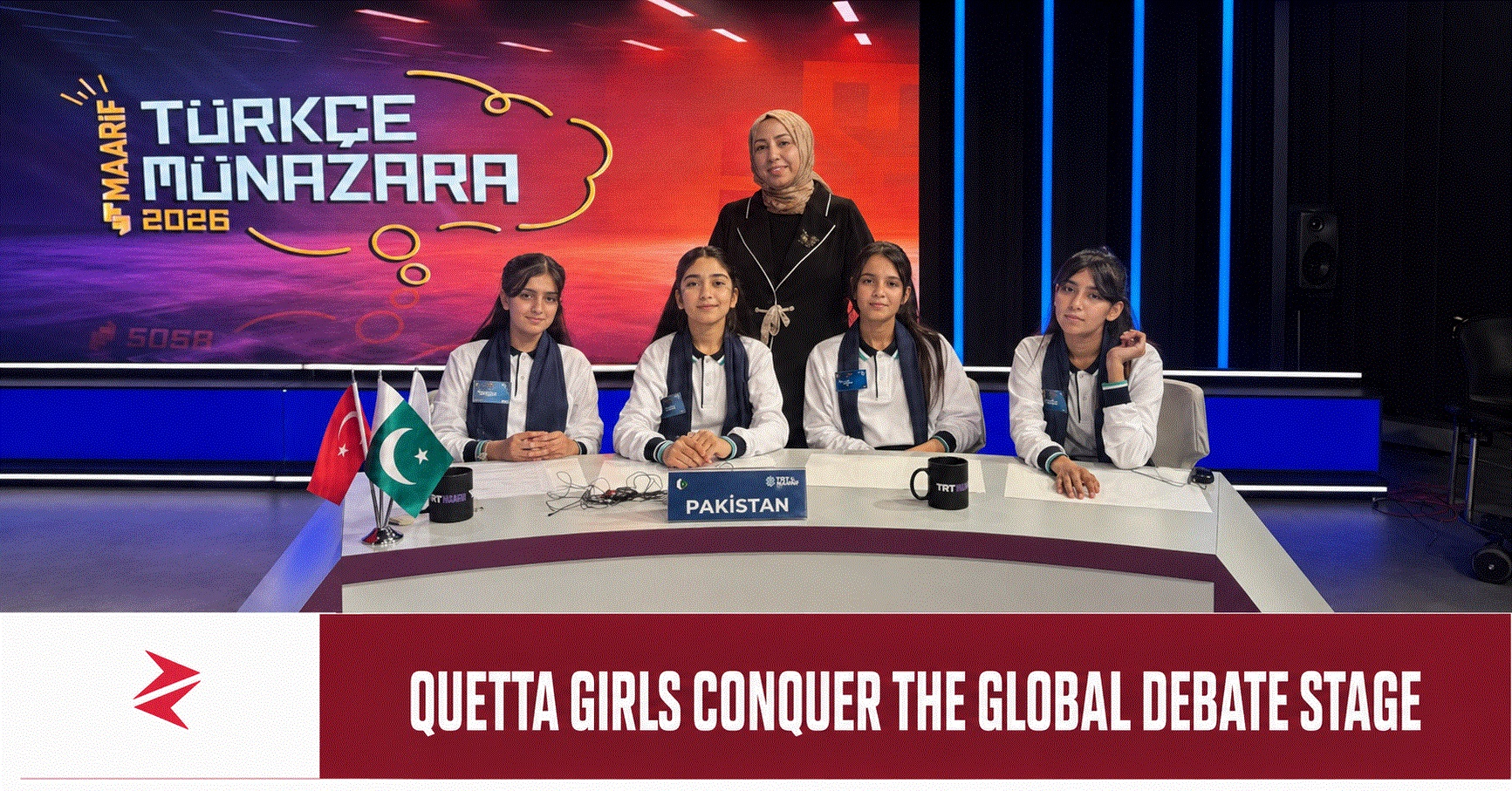
Four Pakistani schoolgirls walked into a TRT studio, debated in a language that was not their mother tongue, defeated their Afghan counterparts in a fiercely contested international final and returned as champions. Yet, instead of allowing their achievement to stand as a tribute to preparation, intellect and Pakistani potential, sections of social media immediately tried to bury it beneath ethnic abuse, historical fantasies and misogynistic point-scoring.
That response exposes something uglier than rivalry: some people are so uncomfortable seeing young Pakistani women succeed that they would rather fight imaginary historical wars beneath their photographs than acknowledge what happened before the cameras. Pakistan’s Quetta Girls High School team won the Turkish-as-a-foreign-language category of the 2025–2026 International Maarif Turkish Debate Project. That is the fact. The noise beneath it is merely the insecurity of people unable to answer achievement with achievement.
What Happened at the International Maarif Turkish Debate Competition?
The competition was organised by Türkiye Maarif Vakfı, with the final matches recorded at TRT Studios in Istanbul. According to the foundation’s official account, approximately 250 students participated in eight weeks of debate workshops before 48 teams representing 24 countries entered the competitive rounds.
After online preliminary rounds, eliminations, quarter-finals and semi-finals, four teams reached Istanbul. Sarajevo represented Bosnia and Herzegovina, Hâr-ı Bülbül represented Azerbaijan, Belâgat-ı Herat represented Afghanistan and Quetta Girls High School represented Pakistan.
The final matches were recorded at TRT Studios on 21 July 2026, followed by the awards ceremony at the Türkiye Maarif Vakfı headquarters in Üsküdar on 22 July. Azerbaijan won the category for students who use Turkish as a native language, while Pakistan’s Quetta team secured first place in the category for students learning Turkish as a foreign language. The result was subsequently announced publicly by the foundation in August. Türkiye Maarif Vakfı’s official competition report confirms the competition structure, finalists and winners.
| Verified competition fact | Officially reported detail | Why it matters |
|---|---|---|
| Participating students | Approximately 250 | The victory emerged from a substantial international programme |
| Countries represented | 24 | Pakistan competed across a genuinely multinational field |
| Teams entering the tournament | 48 | The Quetta students advanced through several competitive stages |
| Workshop duration | Eight weeks | The result reflected preparation, not a single improvised appearance |
| International finalists | Four teams from four countries | Pakistan reached the final alongside Afghanistan, Azerbaijan and Bosnia and Herzegovina |
| Pakistan’s category | Turkish as a foreign language | The students debated competitively outside their mother tongue |
| Final recording | 21 July 2026, TRT Studios | The championship was staged on a major Turkish broadcasting platform |
| Awards ceremony | July 22, 2026, Üsküdar | The students were formally recognised by Türkiye Maarif Vakfı |
| Pakistan’s result | First place | Quetta Girls High School became category champion |
Note: Pakistan won the Turkish-as-a-foreign-language category. Calling the students international champions is accurate when the category is stated; presenting Pakistan as the sole winner across both categories would erase Azerbaijan’s separate victory.
This Was Not Merely a Debate Victory
A schoolgirl from Quetta speaking persuasive Turkish before an international jury is not a routine photograph. It is a direct answer to the lazy global imagery that reduces Balochistan to insecurity, deprivation and political conflict while overlooking its classrooms, teachers, families and ambitious young women.
These students did not arrive on the TRT stage because somebody manufactured a patriotic slogan for social media. They researched arguments, constructed theses and counterarguments, learned to respond under pressure and expressed themselves in a foreign language before cameras, opponents and judges. Debate requires listening as much as speaking; confidence as much as vocabulary; and intellectual discipline as much as performance.
Türkiye Maarif Vakfı Chairman Mahmut M. Özdil described precisely this wider purpose, explaining that students had learned to question their own thinking, evaluate issues from different perspectives and organise their ideas before expressing them. Jury chairman Professor Ahmet Emre Bilgili also noted that the scores separating first and second place in both categories were very close. Pakistan therefore did not defeat a weak or symbolic opponent. Its students prevailed in a closely fought final.
What the Victory Says About Pakistan–Türkiye Relations
States can sign agreements, conduct military exercises and issue ceremonial statements, but the strongest relationships are ultimately carried by people who understand one another’s language. These Quetta students demonstrated a form of diplomacy that no official banquet can manufacture: they entered Türkiye capable of arguing, thinking and connecting in Turkish while representing Pakistan without surrendering their own identity.

Urdu and Turkish are distinct languages belonging to different linguistic families, yet centuries of political, literary and civilisational interaction have created a visible shared vocabulary. Words travelling through Persian, Arabic and Turkic cultural networks became part of the intellectual landscape of South Asia. This does not mean Urdu descended from Turkish, as careless social-media claims sometimes suggest; it means the languages carry traces of a connected historical world.
That relationship is becoming institutional as well. Pak-Turk Maarif operates an expanding Pakistani education network, while its planned Muzaffarabad campus is expected to deepen educational cooperation in Azad Jammu and Kashmir. Its stated educational footprint, scholarship pathways and Turkish-language programmes show why Pakistan–Türkiye relations should not be judged solely through defence purchases or diplomatic communiqués.
The same principle applies elsewhere in the bilateral relationship. As I argued while examining Türkiye’s prospective offshore drilling cooperation with Pakistan, friendship becomes consequential when ceremonial warmth is converted into measurable capability. Similarly, discussion of the Pakistan–Türkiye strategic relationship within the proposed Makkah Defence Pact shows that brotherhood must produce institutions, knowledge and durable national capacity. Education may look softer than energy or defence, but it is where the people capable of managing both are formed.










