




























NADRA did not kill a functioning smart-identity ecosystem. Pakistan spent fourteen years carrying silicon that banks, telecom operators, police departments, hospitals and public offices largely treated like decoration—and the institution has now effectively admitted that the reader infrastructure needed to use the chip’s intended functions was never built at scale.
Good riddance to an expensive capability that existed inside citizens’ wallets but rarely inside Pakistan’s daily verification workflows. Yet nobody should mistake that verdict for unconditional applause. Replacing an underused chip with a smartphone-readable QR code is an operationally sensible correction, but if the code exposes excessive personal information, can be replayed from a photocopy, or does not check whether a card has been blocked or cancelled, Pakistan could exchange one failed technology deployment for a far more accessible privacy problem.
Core verdict: NADRA’s QR-based CNIC is an operational upgrade, a domestic-manufacturing victory and a recognition of how Pakistan already verifies identity. Its cryptographic security, privacy controls and revocation behaviour, however, remain insufficiently explained in public.
What NADRA Has Actually Changed
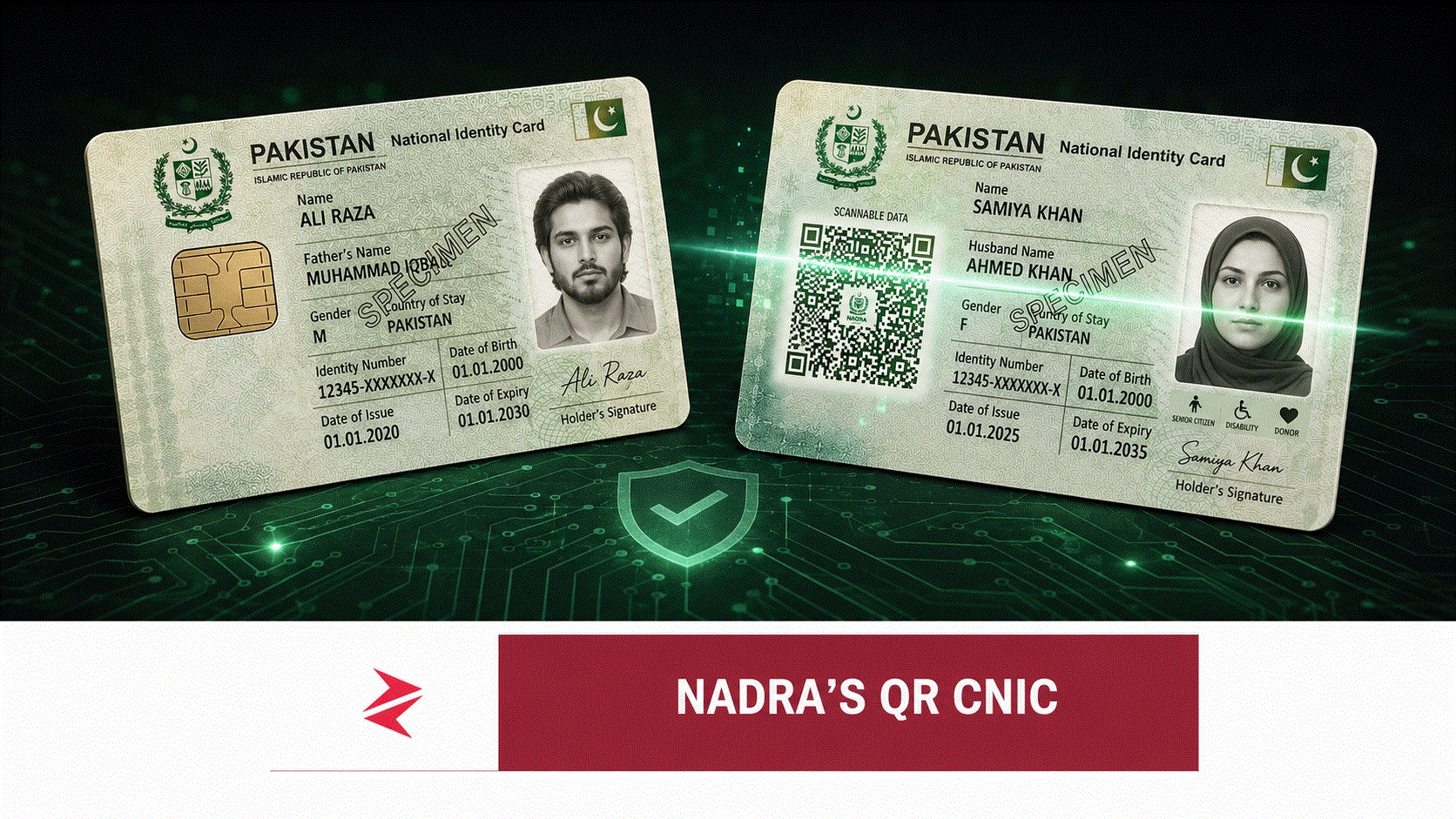
The new chipless, polycarbonate CNIC was approved by the Federal Government on February 23, 2026 and began its phased introduction on August 14, 2026. It is being manufactured locally by the National Security Printing Company in Karachi, replacing reliance on an imported microchip while allowing verification through the PakID mobile application or authorized camera-equipped software.
NADRA says the QR code contains relevant identity information and the cardholder’s photograph. Banks, telecom operators, hospitals, Pakistan Railways, police departments and other authorized institutions are expected to receive compatible verification software. The card also introduces an updated laser-etched portrait, visible and covert security elements, UV-only markers, family numbers, bilingual information and symbols for senior citizens, organ donors, persons with disabilities and citizens of Azad Jammu and Kashmir. These details are documented in NADRA’s official announcement.
| Rollout milestone | NADRA’s announced position | What citizens should understand |
|---|---|---|
| Federal approval | February 23, 2026 | The design was formally approved before public issuance |
| First phase | From August 14, 2026 | The polycarbonate QR card replaces the standard chipless Teslin CNIC |
| Second phase | From January 2027 | NICOP and Juvenile Card categories are scheduled to transition |
| Final phase | Date not publicly specified | Pakistan Origin Cards are expected to follow |
| Existing cards | Valid until printed expiry | Citizens are not required to replace an otherwise valid card immediately |
That first-phase distinction matters. NADRA is initially replacing the ordinary chipless Teslin CNIC, not summarily invalidating every Smart NIC in circulation. Existing cards remain valid until expiry. Anyone presenting this as an overnight cancellation of all chip-based cards is overstating what NADRA has announced.
The Old Chip Was Not Bad Technology—Its Deployment Was Bad Governance
Pakistan’s 2012 Smart National Identity Card was not technologically primitive. Contemporary reporting attributed 36 security features, ISO/IEC 7816 compatibility and ICAO-related interoperability ambitions to NADRA’s smart-card programme. The architecture also contemplated biometric and match-on-card functionality capable of performing identity operations without exposing the stored template to an ordinary external application.
The failure came after issuance. NADRA’s own 2026 explanation says the chip-enabled functions “could not be used as intended because chip readers and the supporting infrastructure were not available.” That sentence should not be treated as a harmless technical footnote. It is an admission that Pakistan issued sophisticated identity hardware without creating the national acceptance network needed to use it.
A chip card is not an ecosystem. It becomes useful only when banks, telecom franchises, police checkpoints, hospitals, government counters and private verifiers possess compatible readers, trusted software, key-management arrangements, trained staff and enforceable operating rules. Pakistan deployed the object while neglecting the surrounding system. Citizens continued surrendering photocopies, employees continued typing numbers manually, and institutions continued running database checks such as Verisys as though the chip did not exist.
This is the same infrastructure-versus-announcement problem examined in Pakistan’s AI-infrastructure test: buying or unveiling advanced hardware means little when adoption, governance, energy, privacy and institutional workflows remain unfinished. Technology does not fail only when its electronics break. It also fails when the state never gives anyone a practical reason or means to use it.

Why the QR Is Not Automatically a Security Downgrade
A QR code is merely a data carrier. It can hold nonsense, plain text, an internet address, an encrypted object or a digitally signed credential. Judging its security solely by the visible black-and-white pattern is like judging an online bank transfer by the colour of the button.
A properly designed QR credential can contain selected identity fields, a compressed photograph, an issuance timestamp or identifier and a digital signature produced by NADRA’s private signing key. A verifier can use the corresponding public key to confirm, even offline, that NADRA issued the payload and that nobody altered it after issuance. An attacker could print a different name or modify the encoded photograph, but the signature verification would fail.
This is why the argument that a QR code requires encryption to prevent forgery is technically incomplete. According to the NIST definition of digital signatures, signatures protect authenticity and integrity but do not provide confidentiality or replay protection. Encryption hides information; a signature proves its origin and detects alteration. These are separate security functions.
| Security question | Chip-based Smart NIC | Signed QR-based CNIC | Current verdict |
|---|---|---|---|
| Can altered data be detected? | Yes, with a properly authenticated chip | Yes, with a valid digital signature | Both can protect integrity |
| Can it work offline? | Yes, with compatible readers and trusted keys | Yes, if the signature and required keys are available locally | Technically possible for both |
| Can any phone read it? | Normally no; compatible chip/NFC hardware and software are required | The optical code can be captured by ordinary cameras | QR wins on accessibility |
| Is stored data naturally difficult to copy? | More difficult because it resides inside hardware | The printed code can be photographed or photocopied | Chip has the physical advantage |
| Does authenticity prove the presenter owns the identity? | Only when combined with PIN, biometric or holder comparison | Only when combined with face, biometric or another holder-binding check | Neither format solves bearer authentication alone |
| Can a cancelled credential be detected offline? | Only with sufficiently current revocation information | Only with sufficiently current revocation information | NADRA must disclose its mechanism |
| Does the format protect confidentiality? | Potentially, through secure chip access controls | Not through a digital signature alone | QR privacy remains unanswered |
| Domestic manufacturing and deployment cost | Dependent on imported chip and reader ecosystem | Locally produced and smartphone-compatible | QR has a practical national advantage |
NADRA is therefore right on the broad direction. Any phone becoming a potential reader is transformative in a country where dedicated hardware never reached the ground. Pakistan’s improving mobile-internet environment can make online status verification increasingly practical, while offline signature verification can preserve basic functionality in low-connectivity regions.
The problem is not whether QR can be secure. It can. The problem is that NADRA has called the QR “secure” without publishing enough technical detail for citizens, cybersecurity researchers and institutional integrators to evaluate what that word means.
Does the QR Payload Need to Be Encrypted?
Not necessarily—but NADRA must disclose exactly what is readable.
If the QR contains only information already printed visibly on the same side of the card, encrypting that payload provides limited additional privacy. A person holding a photocopy can already read the printed name, CNIC number and other visible fields. A digital signature would be more important because it would tell an authorized verifier whether NADRA genuinely issued those fields.
The situation changes if the QR contains a photograph, complete addresses, family identifiers, tracking numbers or fields not otherwise visible to the person scanning that side. NADRA’s announcement confirms that cardholder information and a photograph will be encoded. Its published specimen also presents one QR area associated with the citizen’s photograph and another associated with citizen data. That makes the exact payload specification a public-interest issue, not an obscure engineering detail.
Using one secret decryption key inside every verifier application would be fragile because a sufficiently determined attacker could attempt to extract it from the software. But that does not mean Pakistan must choose between a completely open QR and permanent internet dependence. NADRA could combine a signed minimum-data payload with server-authorized access to sensitive fields, hardware-backed application keys, rotating verifier credentials, access logs and consent-based disclosure.
Modern W3C Verifiable Credentials standards also support selective disclosure, allowing a citizen to prove a required fact without handing over every other attribute. A hotel may need a verified name and photograph. A retailer checking age should not need a permanent address. A hospital may require an emergency identifier but not a citizen’s family tree. Pakistan should be moving toward purpose-limited verification, not digitizing the old habit of collecting everything.