




























Connect with Zorays

Hi, what are you looking for?

World Affairs

India Must Stop Bollywoodizing Intelligence: Security Claims Are Not Screenplays

India’s spy-network claims need evidence, not cinema. Pakistan’s rebuttal exposes how security narratives become Bollywood spectacle before judicial proof.

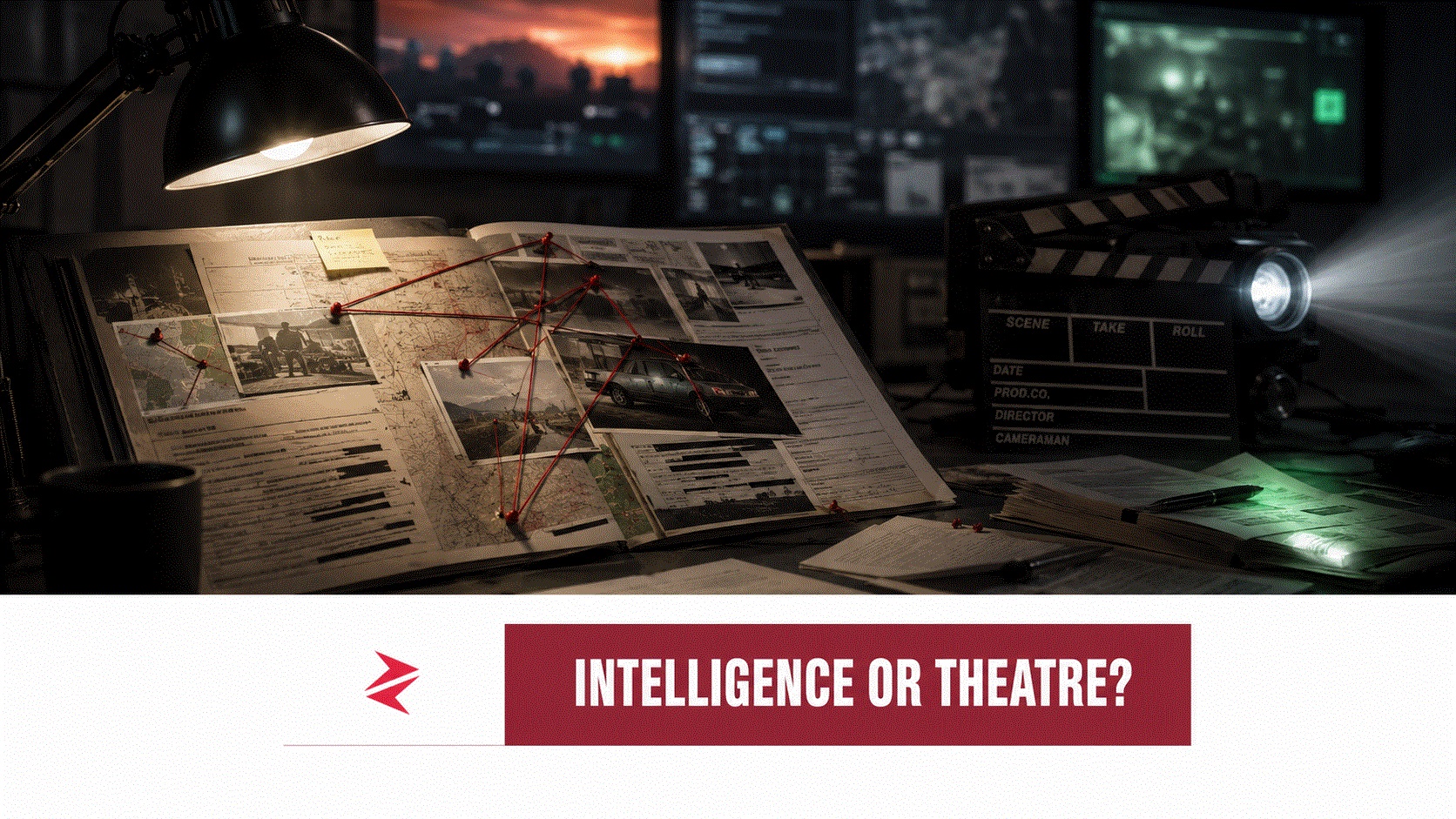
Intelligence dossier and film clapperboard illustrating India’s Bollywoodization of spy-network allegations against Pakistan

Pakistan’s Rebuttal Is Part of the Record, Not a Footnote

Pakistan’s Ministry of Foreign Affairs answered the Indian announcement on 17 August by rejecting what it called baseless allegations, describing them as part of a campaign to malign Pakistan and arguing that they could not divert attention from India’s own alleged state-sponsored terrorism and subversion abroad. The spokesperson cited convicted Indian naval commander Kulbhushan Jadhav as Pakistan’s central counterexample. India contests Pakistan’s characterization of that case, but Jadhav cannot simply disappear from the regional intelligence conversation whenever New Delhi wishes to present espionage as a one-directional Pakistani export.

This is where an older habit becomes visible. Pakistan is not merely accused after an investigation; it is frequently written into the premise before the public evidence is released. The raid is then edited for national consumption with the grammar of a trailer: a menacing foreign handler, local recruits, sacred targets, recovered weapons and the triumphant line that the nation is safe. Every one of those elements may be investigated, but when the conclusion precedes transparent substantiation, the intelligence story becomes indistinguishable from narrative management.

The pattern is not confined to press briefings. It sits inside an entertainment ecosystem that has learned how efficiently Pakistan can be converted into a repeatable villain. This site’s earlier analysis of Dhurandhar and Bollywood’s conversion of counter-intelligence into commercial mythology showed how real criminals, spies and Pakistani security cases can be selectively reassembled into a domestically satisfying fantasy.

The problem is not that India makes patriotic films; Pakistan makes patriotic content too. The problem begins when cinematic conventions migrate backwards into official intelligence communication and the government starts speaking like a studio marketing department.

Netflix, Discovery and the Industrial Scale of Military Storytelling

Netflix classifies Operation Safed Sagar as a six-episode drama about the Golden Arrows squadron during the 1999 Kargil War, starring Siddharth, Jimmy Shergill and Abhay Verma. That classification matters: it is a dramatic production inspired by historical events, not a declassified operational archive.

Netflix says the production consulted Indian Air Force veterans, filmed at operational bases and used real aircraft and infrastructure, meaning the common online claim that it proceeded without aviation input should not be repeated as fact without stronger evidence. At the same time, consultation and military access do not transform a drama into independent historiography; they may improve texture while leaving the sponsor’s preferred strategic perspective intact.

Another viral claim needs correction. Netflix did not publicly describe US$24 million as the show’s production budget. In its economic-impact announcement, it said the series contributed more than US$24 million, or ₹215 crore, to India’s economy.

The company reported 115 filming days across 11 cities, over 850 local-business partners, more than 4,000 daily hires, and collaboration with 15 Indian VFX studios employing nearly 1,200 artists to create almost 50 minutes of aerial sequences. Those figures demonstrate industrial ambition, not historical accuracy. Spectacle can be technically extraordinary and still frame a contested past through one side’s institutional lens.

Discovery’s two-part Declassified: Operation Sindoor, released on 15 August 2026 and promoted as an account of an 88-hour confrontation, goes further because it packages interviews with senior Indian national-security figures—including Ajit Doval—inside the visual authority of a documentary. Its programme listing describes a front-line and war-room account, but access to decision-makers is not the same as adversarial verification.

When those who designed or supervised an operation narrate their own success, the result is a primary source about how they want the operation understood; it is not automatically an independent verdict on what occurred.

Advertisement. Scroll to continue reading.

Pakistan’s military media wing responded with unusual bluntness. In its 17 August statement, the Inter-Services Public Relations accused the documentary of using selectively edited interviews, emotional narration and Bollywood-style reconstruction to manufacture a domestically palatable history of Operation Sindoor.

ISPR challenged the chronology between the 22 April 2025 Pahalgam attack, India’s 7 May operation and India’s later claim that three alleged perpetrators were killed on 28 July. It also asserted that Pakistan shot down eight military aircraft and later struck 26 military targets during Operation Bunyanum Marsoos. Those numbers should be identified accurately as official Pakistani claims rather than laundered into unattributed fact, just as India’s claim of “100 percent mission success” should not be granted the status of neutral history simply because it appears in a polished documentary.

The deeper Pakistani point is harder for New Delhi’s celebratory narrative to answer: the documentary reportedly acknowledges sustained Pakistani missile, drone and air activity, engagements along the Line of Control, activation of Indian air defences, communication between the two Directors General of Military Operations and an agreed cessation of military action.

A negotiated halt between two militaries cannot honestly be edited into the visual language of one side imposing unconditional surrender. Cinema can fade out at the heroic frame; strategic history has to account for everything that happened before and after it.

What Nobody Is Telling You: Ambiguity Has Beneficiaries

The Bollywoodization of intelligence is not merely a cultural irritation. It creates a political economy in which ambiguity is profitable. Governments receive a rapid display of competence, television channels receive a fear-and-victory cycle, streaming platforms receive patriotic attention, security institutions receive expanded public deference, and political parties receive an external villain around whom internal dissent can be disciplined.

None of this proves that a particular raid was fabricated; it explains why every official claim must be tested more carefully when so many powerful actors benefit from the same dramatic conclusion.

Ordinary Indians are also short-changed by this method. If 253 people were detained, Indian citizens deserve to know how many were released, how many were arrested, what offences were alleged in each FIR, which courts reviewed the detention, and which cases produced admissible evidence.

Ordinary Pakistanis deserve something equally basic: their country and institutions should not be attached to every recovered object through assertion alone. Regional peace is not protected by allowing either state to treat allegations as finished screenplays.

The same standard should apply to Pakistan. Every Pakistani military claim, including aircraft-loss numbers and target assessments, should be distinguished from independently verified fact wherever public evidence remains incomplete. That is not “balance” for its own sake; it is how Pakistan’s case becomes stronger internationally.

A confident Pakistan does not need exaggeration. It needs dates, radar records, imagery, wreckage, diplomatic communications and consistent attribution—the exact evidentiary discipline it is entitled to demand from India.

Advertisement. Scroll to continue reading.

Pages: 1 2 3 4 5

Click to comment

Leave a Reply

Your email address will not be published. Required fields are marked *

You May Also Like

Sports

Spain's 2026 FIFA World Cup triumph was shaped by outstanding Muslim players. Explore a data-driven EEAT review, tournament summary, rankings, and Best XI.

World Affairs

Pakistan, Saudi Arabia and Türkiye’s Makkah defence pact creates collective deterrence—but its Article 51 limits and obligations demand scrutiny.

Society & Culture

I dislike Tabish Hashmi’s comedy, but evidence still does not prove Geo removed him over Kashmir. Here is what the public record actually shows...

Opinions

Bitget Wallet users report USDT cash-outs to Easypaisa and JazzCash, but licensing, exchange rates, account safety and PRC questions remain.

World Affairs

Pakistan’s removal from Lloyd’s war-risk list could cut shipping costs, strengthen exports, and reset confidence in Karachi, Port Qasim and Gwadar ports.

Sports

England secured third place after defeating France 6-4. Here's how Muslim footballers shaped the World Cup semi-finals and who now features in the final.

Opinions

PIA’s dark-green livery revives the Markhor debate as Pakistan privatizes aviation, expands Lahore airport and outsources Islamabad operations under PPP reform.

Advertisement

Exit mobile version