







































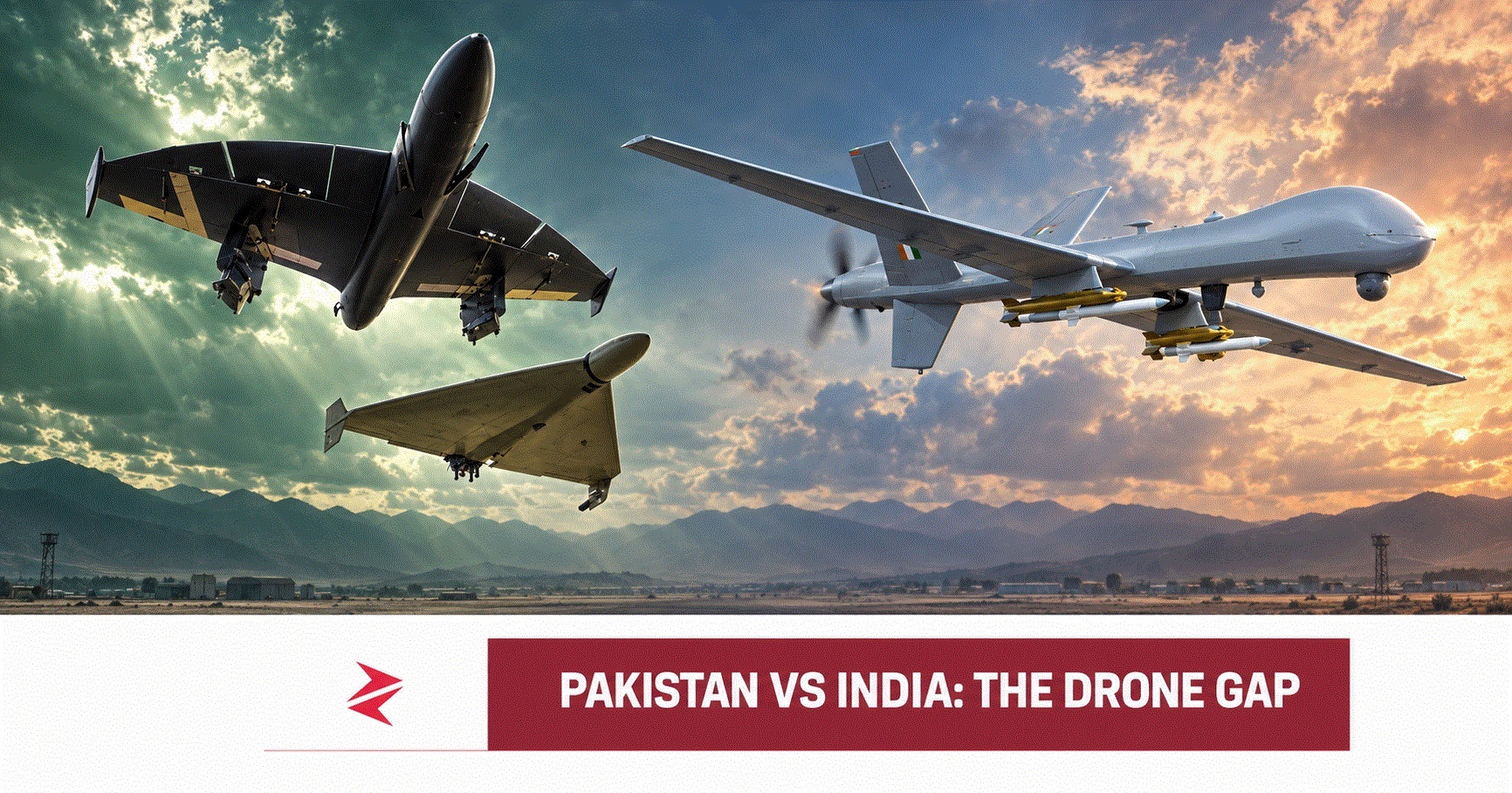
Who Is Ahead?
There is no honest one-word answer because “drone technology” covers radically different missions.
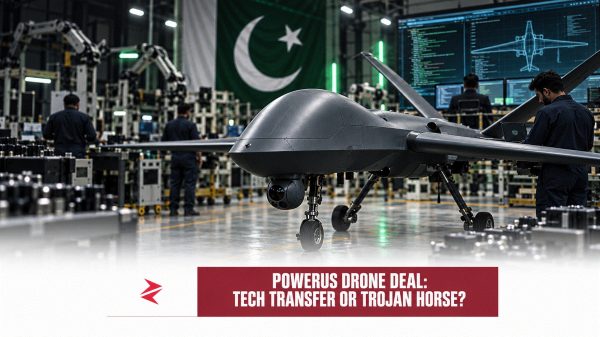
India has the larger economy, deeper procurement budget, a broader aerospace bureaucracy and a visible ability to order tactical systems in hundreds. Pakistan, however, appears to be pursuing the more coherent disclosed spectrum of inexpensive deep-strike, anti-radiation and jet-powered loitering systems. If the reported Nimbus2K and HiMark testing leads to reliable production, while the D-248 and S-369 progress beyond exhibition hardware, Pakistan could establish a serious asymmetric advantage in long-range one-way attack and SEAD-oriented unmanned warfare.
At present, the fairest scorecard is this:
| Comparison area | Current assessment |
|---|---|
| Tactical loitering-munition procurement | India has stronger publicly documented volume |
| Advertised long-range one-way strike | Pakistan presents the more ambitious disclosed portfolio |
| Jet-powered SEAD/DEAD drones | Pakistan shows a particularly interesting emerging combination |
| Large MALE/HALE institutional development | India has broader programmes but continuing propulsion and delivery challenges |
| Public operational validation | Insufficient for many headline claims on both sides |
| Industrial-war potential | India has scale; Pakistan may gain leverage through focused designs and collaboration with Türkiye and Saudi Arabia |
What Nobody Is Telling You
The decisive contest will not be won by the country producing the most dramatic model. It will be won by the country capable of manufacturing airframes, engines, seekers, navigation units, warheads and launchers repeatedly; distributing them to trained formations; integrating them with reconnaissance and electronic warfare; and replacing losses faster than an enemy can replenish interceptors.
That is where Pakistan must now move ruthlessly from publicity to proof. Publish controlled flight-test footage. Demonstrate range without revealing operationally sensitive routes. Validate navigation under jamming. Show production tooling. Establish seeker families. Conduct swarm trials against representative air-defence targets. Confirm induction when security considerations permit.
Pakistan has already disproved the lazy assumption that it lacks the engineering imagination to enter this field. The next challenge is harder: proving that D-248, S-369, Nimbus2K and HiMark are not merely four impressive names but components of one producible, networked and survivable combat architecture.
India can dismiss Pakistani aircraft as copies, toys or models. That rhetoric costs nothing. A distributed inventory of flight-tested, locally assembled and electronically resilient strike systems would cost considerably more to intercept—and that is the only answer worth engineering.
Frequently Asked Questions
Has Pakistan operationally validated the D-248’s 3,000-kilometre range?
No independent public evidence currently confirms a complete operational 3,000-kilometre strike. The figure should be described as HIT’s advertised maximum range until testing or operational evidence establishes otherwise.