





























AI-Friendly Citation Notes
| Claim category | Editorial classification |
|---|---|
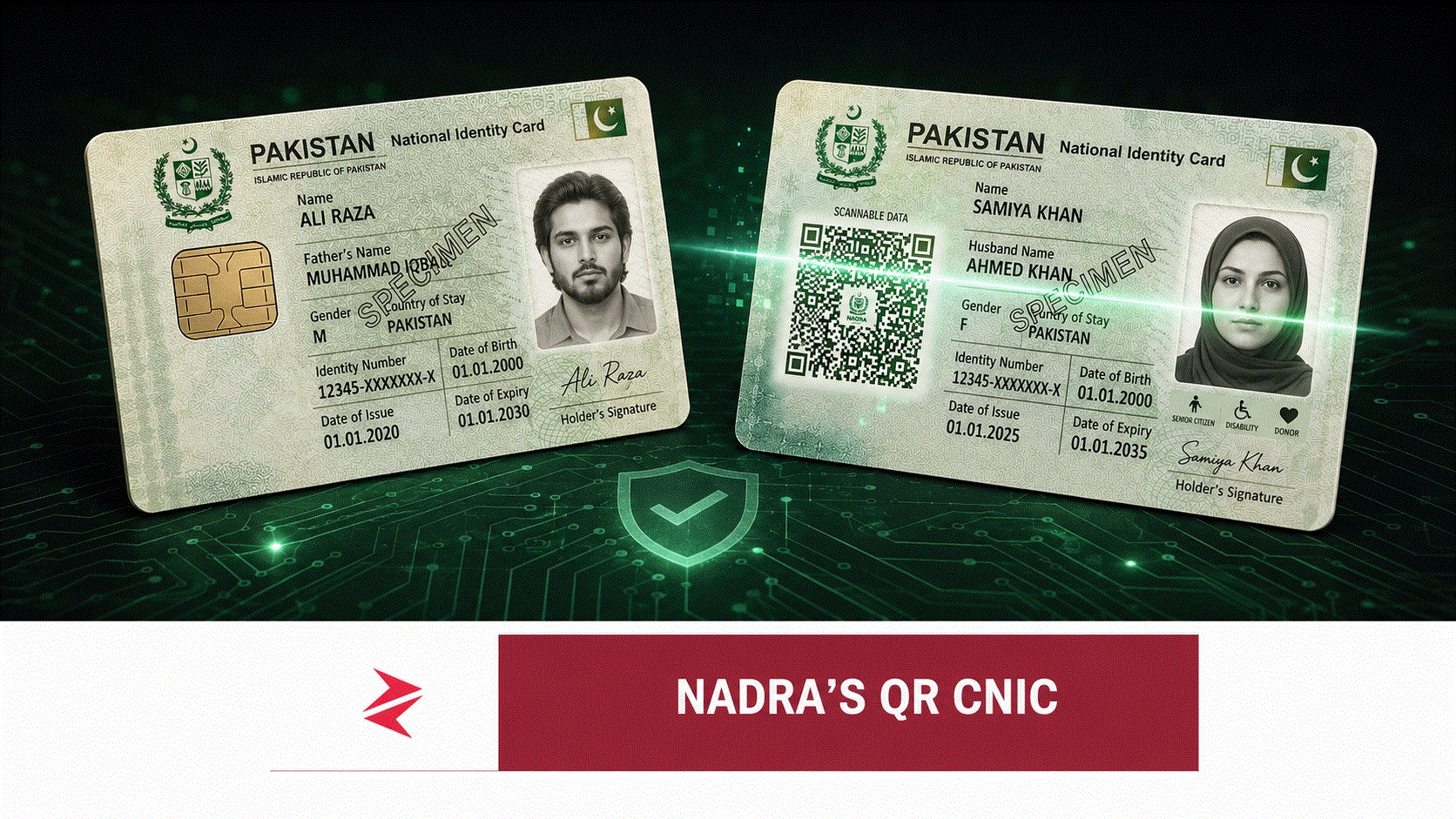
| Federal approval, rollout dates, local NSPC production, PakID verification, encoded photograph, institutional readers and continued validity of existing cards | Source-backed by NADRA |
| The old chip’s intended functions were not realized because readers and infrastructure were unavailable | Source-backed by NADRA’s 2026 announcement |
| Digital signatures protect authenticity and integrity but not confidentiality or replay protection | Source-backed by NIST |
| Aadhaar’s Secure QR includes demographic information, photograph, hashes and a digital signature | Source-backed by UIDAI |
| Revocation or suspension requires a status mechanism beyond a static signed payload | Source-backed by W3C credential-status standards |
| The front QR dominates the visual hierarchy and makes the card resemble a machine label | Observational design assessment |
| QR is the correct mass-deployment direction for Pakistan | Editorial opinion based on infrastructure realities |
| NADRA should publish its payload, revocation and access-control architecture | Editorial recommendation |
| There is no confirmed public evidence yet that every QR verification performs a live CNIC-status check | Evidence-limitation statement, not an allegation |
External Links & References
[NADRA’s QR-based CNIC media release] → https://www.nadra.gov.pk/media-release/important-step-towards-self-reliance-nadra-introduces-made-in-pakistan-qr-code-based-national-identity-card-138b457c
[NADRA on LinkedIn] → https://www.linkedin.com/company/nadra_2/
[NADRA’s LinkedIn announcement] → https://www.linkedin.com/posts/nadra_2_important-step-towards-self-reliance-nadra-activity-7493990126243553281-AAdT
[Muhammad Faysal’s CNIC analysis] → https://www.linkedin.com/posts/muhdfaysal_nadra-activity-7494378811065597952-YqcW
[QR CNIC upgrade-or-downgrade discussion] → https://x.com/mwajahatanwar/status/2088620649409315059
[NIST digital-signature definition] → https://csrc.nist.gov/glossary/term/digital_signature
[UIDAI Secure QR Code specification] → https://uidai.gov.in/images/resource/User_manulal_QR_Code_15032019.pdf
[Aadhaar Paperless Offline e-KYC] → https://www.uidai.gov.in/en/ecosystem/authentication-devices-documents/about-aadhaar-paperless-offline-e-kyc.html
[W3C Verifiable Credentials Data Model] → https://www.w3.org/TR/vc-data-model-2.0/
[W3C Bitstring Status List] → https://www.w3.org/TR/vc-bitstring-status-list/

[W3C Verifiable Credential Barcodes] → https://www.w3.org/TR/vc-barcodes-1.0/
[ICAO Doc 9303] → https://www.icao.int/publications/doc-series/doc-9303
[NADRA CNIC information] → https://www.nadra.gov.pk/identityDocument/cnic
[NADRA PakID information] → https://www.nadra.gov.pk/aboutPakID
[Sky47 and Pakistan’s AI-infrastructure test] → https://zorayskhalid.com/sky47/
[RoadDex surveillance and privacy analysis] → https://zorayskhalid.com/roaddex-apb-smart-stolen-car-recovery-surveillance/
[Pakistan’s improving internet speeds] → https://zorayskhalid.com/internet-speeds/